Cosmic expansion uncertainty refers to the fundamental limits and systematic errors in measuring the universe's expansion rate (the Hubble constant) and its overall size. Even with perfect instruments, there are inherent constraints: the cosmic microwave background provides a snapshot of the early universe, while local distance measurements use a 'cosmic distance ladder' of standard candles like Cepheid variables and supernovae. These two methods yield slightly different values, a discrepancy known as the 'Hubble tension,' which may indicate new physics or hidden systematic errors.
History
The expansion of the universe was discovered by Edwin Hubble in 1929, building on Vesto Slipher's redshift measurements. The modern era of precision cosmology began with the COBE satellite (1989) and later WMAP and Planck missions, which measured the cosmic microwave background to high accuracy.
How it works
Measuring cosmic expansion requires comparing distances to velocities of galaxies. Distances are inferred from standard candles (objects of known intrinsic brightness) or standard rulers (features of known physical size, like baryon acoustic oscillations). Each rung of the distance ladder relies on calibrations from the previous rung, accumulating uncertainties. Additionally, the universe's geometry and the presence of dark energy affect how expansion evolves over time, adding model-dependent assumptions. Quantum fluctuations in the early universe also imprint a fundamental 'noise' that limits how precisely we can know initial conditions.
In practice
Understanding cosmic expansion uncertainty is crucial for interpreting dark energy observations and for planning next-generation surveys like the Euclid mission or the Vera Rubin Observatory, which aim to map the universe's expansion history.
Fun fact
The Hubble tension currently stands at about 5 sigma significance — meaning the chance it's a statistical fluke is less than one in a million — yet no one knows if it's a real crack in cosmology or a hidden measurement error.
An old stellar ball that has gathered hundreds of thousands of suns has been circling the edge of a dwarf galaxy for billions of years. By all calculations, it should have long ago plunged into the center like a heavy stone into jelly. But the ball holds its ground, and this fact has been nagging astrophysicists for several decades.
In the heart of an old city stands a clock tower whose hands have never been adjusted since it was built. By how far it runs slow, you can calculate how much time has stretched since then. In space, the role of such towers is played by relic galaxies — dense stellar systems that formed in the first few billion years and have since neither merged with neighbors nor given birth to new stars.
Six runners sprint down the track, and officials time their speed without noticing a tailwind. The wind blows at their backs, and the stopwatches show a better result than the truth. Roughly this is how six megamasers — natural cosmic lasers in distant galaxies — misled astronomers measuring the expansion rate of the universe.
Light from the very beginning of the cosmos has been traveling toward us for 13.8 billion years. During that time, its polarization, the direction of its oscillations, might have been twisted, like a compass needle that someone quietly nudged. Physicists call this phenomenon cosmic birefringence.
Through three minutes after the Big Bang, the Universe played its first symphony. It was the big bang nucleosynthesis — the formation of light nuclei, where each element sounded its own note, and the tempo was set by the expansion of space.
The cosmological debate is like two craftsmen measuring the same wall but getting different lengths. One uses a tape measure, applying it to nearby landmarks — Cepheids (pulsating beacon stars) and Type Ia supernovae (flashes of dying stars). He finds the wall is stretching at 73.5 arbitrary units.
A drama is brewing in cosmology: two principal musical instruments, the orchestra of the early Universe and the chamber ensemble of the modern cosmos, play the same symphony of expansion at different tempos.
Imagine a cosmic orchestra performing a symphony from the Big Bang to the present day. The conductor, dark energy, long seemed an impassive metronome: the cosmological constant Λ motionless, like a baton frozen in mid-air.
The Universe is an orchestra playing the symphony of the Big Bang. For a long time, the conductor was thought to be dark energy — an unwavering metronome setting the pace of expansion.
At the center of galaxy M87, 55 million light-years away, lurks a black hole with a mass of 6.5 billion Suns. In 2019, the Event Horizon Telescope (EHT) gave us its first portrait: an orange donut with a dark core. But the donut is not the abyss itself.
The cosmological orchestra doesn't tune to a single tuning fork. There are two groups of instruments: one listens to the hum of the young universe — the cosmic microwave background, while the other reads notes from mature galaxies and supernovae.
A translator hears not just words, but intonation, pauses, the tremor in a voice. Ordinary entropy analysis of cosmic perturbations is like meeting minutes: it records facts but loses the nuances. Pseudoentropy entropy is a new tool that captures the hidden "music" of the early universe.
Two rulers show slightly different lengths for the same table. That's roughly the situation in cosmology with the Hubble constant — the number that tells how fast the universe is expanding.
Cosmology is experiencing a tectonic rift. Cepheid-calibrated supernovae, measured by Adam Riess’s team, point to a rate of about 73 km/s per megaparsec.
Imagine a giant inflatable balloon with galaxies painted on it. As it inflates, the pattern stretches and neighboring dots move apart. The rate of that stretching is the Hubble constant. Astronomers usually catch light from distant stars and see how much it has reddened due to the stretching of space.
On the kitchen counter, there's a flour scale and a measuring cup for water. Individually, they're precise, but when you bake bread, the recipe calls for the perfect ratio. Astronomers have a similar dispute about the universe's expansion rate.
Two clocks tell different times. One sits on our desk, the other lies far in the past, in the glow left over from the Big Bang. The first, looking at nearby galaxies, ticks off the expansion rate of the universe — about 73 kilometers per second per megaparsec of distance. The second, peering into ancient light, gives a noticeably lower value — roughly 67.
Neutrinos are the most abundant massive particles in the universe. Trillions of them pass through us every second, yet they leave barely a trace. Their collective gravity, though tiny, can influence the motion of entire galaxies. Think of two people approaching each other on a busy street; invisible passersby alter their speed.
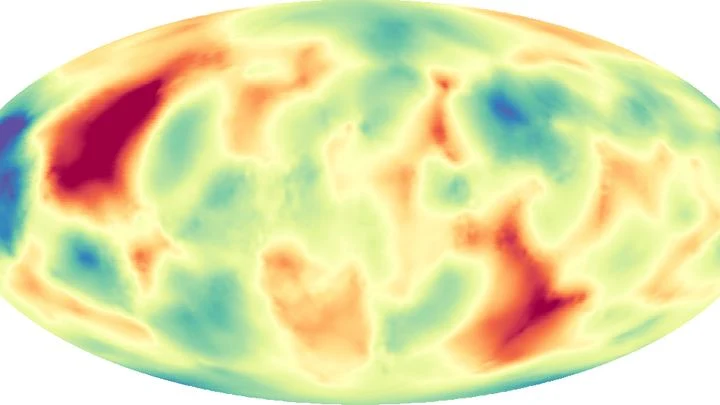
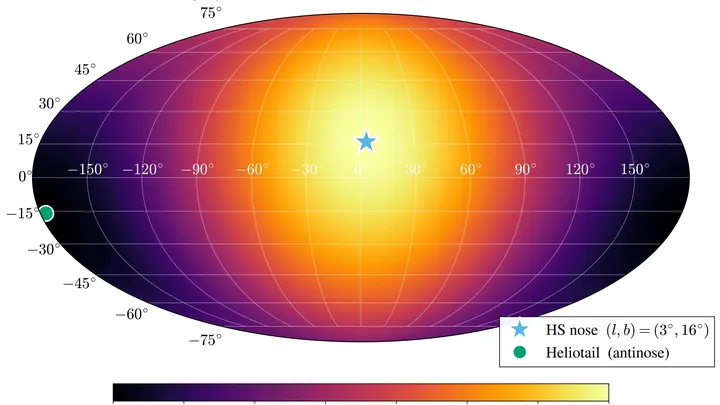
Cosmologists have measured how fast distant galaxies are receding in different parts of the sky. To do this, they used two kinds of "cosmic rulers": galaxy clusters and a certain type of supernova explosion. Both methods showed the same thing: in one direction, the Universe is expanding slightly faster than in the opposite direction.
The Universe is expanding, but at what speed? Astronomers have been arguing for decades about the precise value of the Hubble constant. Two classic methods give slightly different results. Now there's a third — using mysterious radio bursts.
If space is a canvas, then brushstrokes cannot be infinitely thin. There's a tiniest segment, shorter than which there's no point in measuring. This quantum 'graininess' alters the geometry itself: the motion of galaxies and the growth of large-scale structures bear its mark.
Two astronomers look at the same universe but see it differently. One measures the expansion rate using ancient light that has been traveling toward us for nearly 14 billion years. The other uses recent stellar explosions in nearby galaxies. The first gets 67 kilometers per second per megaparsec, the second gets 73.
The universe is like an ocean, where waves of different lengths roll onto the shore. The longest waves are the giant fluctuations in the distribution of matter that we see in the cosmic microwave background. Standard theory says such waves should exist on all scales.
In the standard cosmological model ΛCDM, galaxies recede under the pressure of dark energy — an invisible spring. However, different methods of measuring the expansion rate give different numbers, as if the ruler's scale is off.
The universe is expanding, but at what rate is a question that has been troubling astronomers for decades. Two methods of measurement give different answers, and this discrepancy is called the Hubble tension. Some look at the early universe through the cosmic microwave background, others at nearby supernovae and Cepheid variables.
The visible edge of the universe is a holographic screen that, like a black hole, obeys laws discovered by Bekenstein and Hawking. Normally, information is preserved on it, but calculations show that if a few bits are lost, energy is released that accelerates expansion.
Light from distant galaxies, passing through clusters of matter, gets distorted — much like the bottom of a pool breaks up into ripples of water. Astronomers measure these barely perceptible bends in shape and create a map of gravitational ‘ripples.’ This is weak lensing — a natural detector of invisible matter.
The universe is a pie baked from a single recipe, but the teaspoon and the kitchen scale stubbornly show different amounts of sugar. That’s how it is with the expansion of the universe: measurements from nearby stars (the spoon) give one number, while those from the ancient light of the Big Bang (the scale) give a completely different one.
Two methods of measuring the Universe's expansion rate yield conflicting results. Measurements from supernova explosions, carried out by Adam Riess's team, show faster expansion than data from the cosmic microwave background — the light left over from the Big Bang.
The cosmological community has been living in a state of quiet civil war for several years. Two camps measure the expansion rate of the Universe and get different answers. Planck, peering at the cosmic microwave background, says 67.4 km/s/Mpc. SH0ES, climbing the distance ladder from Cepheids to supernovae, insists on 73.2.
In the first moments after the Big Bang, space expanded at an incredible rate. A tiny quantum ripple, embedded in the uncertainty principle itself, pushed matter apart more strongly than any known force. This ripple is the generalized uncertainty principle, or GUP.