Lunar muons could illuminate subsurface voids express
The Moon is an airless sphere of dense rocky grit called regolith. When fast particles from space slam into it, muons are born in the soil — unstable relatives of electrons, but two hundred times heavier. Most fly downward and fade away in the depths. But those that pop upward into the vacuum can travel tens of kilometers before decaying. Those are the ones to catch.
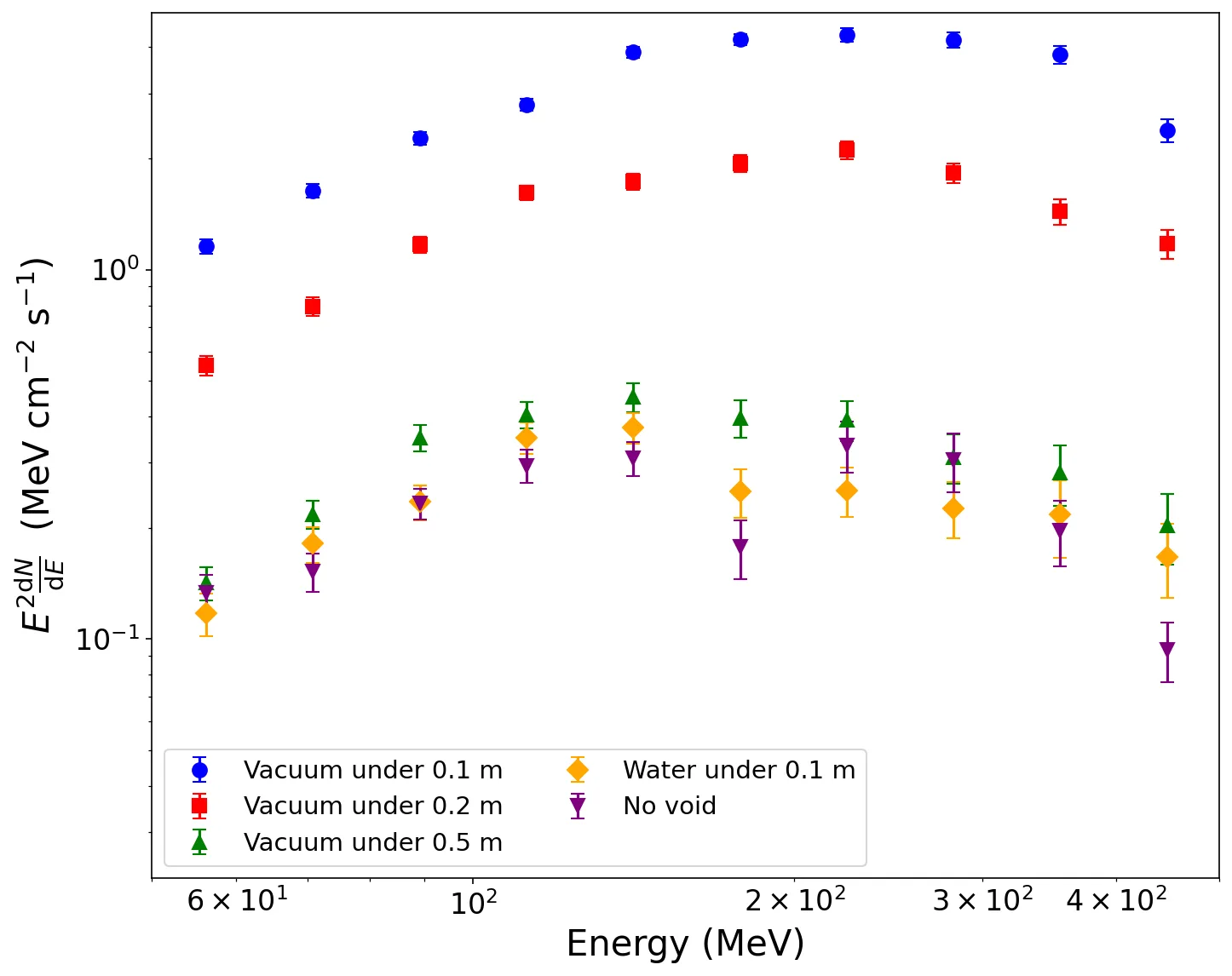
The idea is as simple as sonar: muons are weakly absorbed by rock, but voids or water alter their flux. An instrument above the surface — on a lander or satellite — counts incoming particles. Where there's a cave under the soil, muons are slightly more numerous: they didn't have to punch through an extra layer of rock. Where there's water, they're slightly fewer: water does stop some particles.
The authors ran the numbers on a computer model. On a flat plain, the signal from a room-sized void emerges within 40–50 seconds. Water ice a few meters deep leaves a weaker but still noticeable trace — after about ten minutes of data accumulation. Sensitivity improves if you raise the detector higher: in a 100-kilometer orbit, the picture sharpens because more muons that pierced the ground at various angles enter the frame.
Such a muon 'X-ray' would benefit future lunar missions. Caves could shelter bases from radiation and meteorites. Water is a resource for breathing and fuel. And all of it can be surveyed simply by listening to the 'rain' of particles the Moon creates itself.
Muons live only 2.2 microseconds, but at near-light speed they travel hundreds of meters in air and tens of kilometers in vacuum.