Black Holes Without Singularities: Almost Indistinguishable express
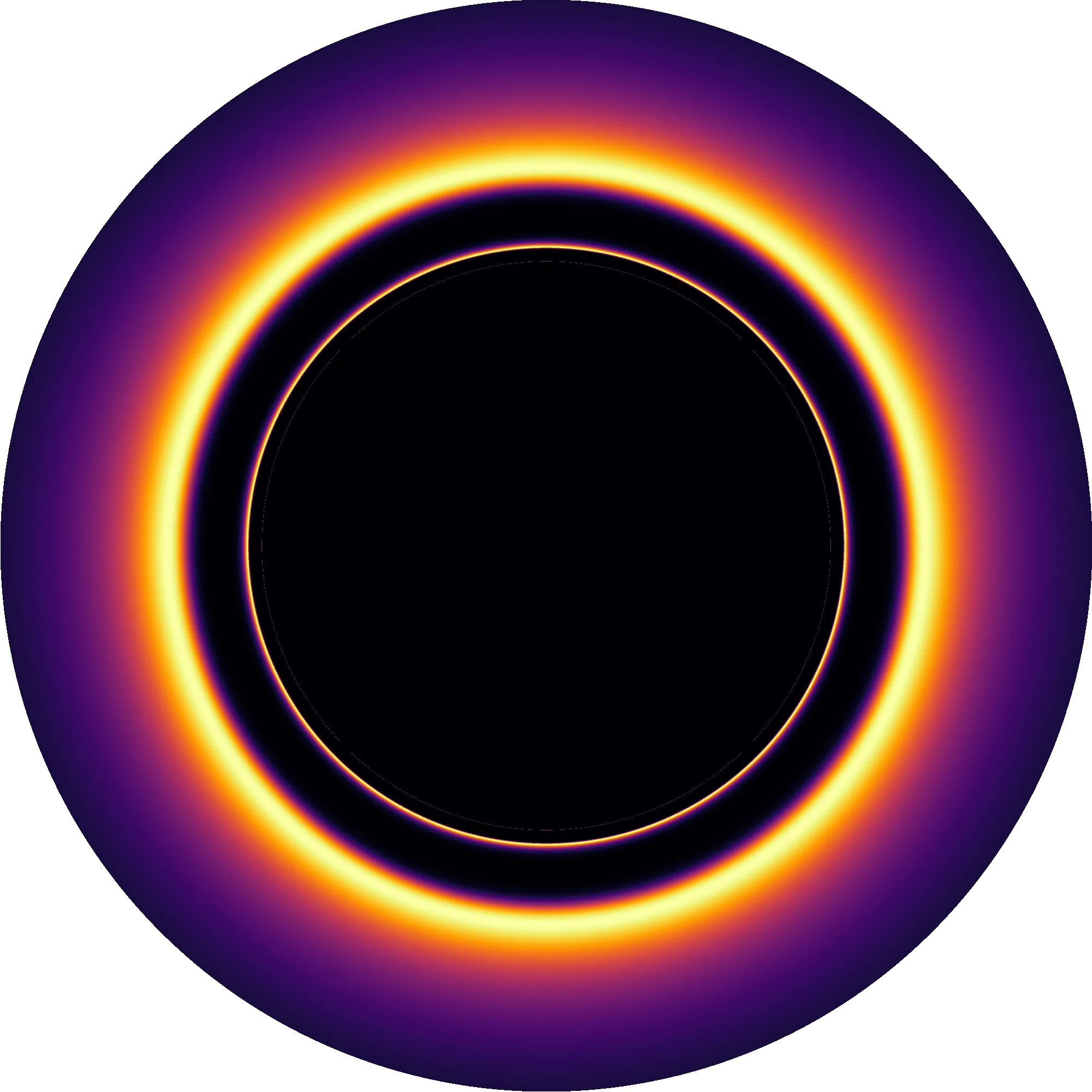
An ordinary black hole hides a singularity at its center — a point where density and curvature become infinite and the laws of physics break down. The authors of the new work built a model of a rotating black hole that, instead of a singularity, contains a calm "core" resembling ordinary flat space. Outside, it has two event horizons, just like the classical solutions.
To do this, they used the method of gravitational splitting (a mathematical trick that allows "adding" new physics to known solutions of Einstein's equations). The result is a geometry that is simple to calculate and remains regular everywhere — no infinities. Then the scientists tested how such a hole would appear to a distant observer: they calculated its shadow and produced images of a thin accretion disk (the rotating gas that glows before falling into the hole).
The result was unexpected. Although the internal structure of such a regular hole is radically different from a singular one, its optical signatures, the shadow and the disk image, remain remarkably close to those of standard Schwarzschild (non-rotating) and Kerr (rotating) holes with the same mass and angular momentum. The differences are so small that current telescopes, including the Event Horizon Telescope, would simply not notice them.
This poses a serious challenge to astrophysics. We are used to thinking that a black hole's shadow can reveal the geometry of spacetime near the horizon. But the work shows that two completely different internal structures can cast almost identical shadows. To look deeper, we will need next-generation observations — perhaps gravitational wave analysis or more detailed spectra of accretion disks.
The first-ever image of a black hole's shadow, at the center of galaxy M87, was obtained in 2019—and it matched predictions for a classical Kerr hole, even though its internal structure remains unknown.
In the movie "Interstellar," the characters travel through a wormhole near the supermassive black hole Gargantua: its visualization is based on calculations for a Kerr hole with an accretion disk, but without a singularity inside.