The Gas That Pretends to Be a Brain express
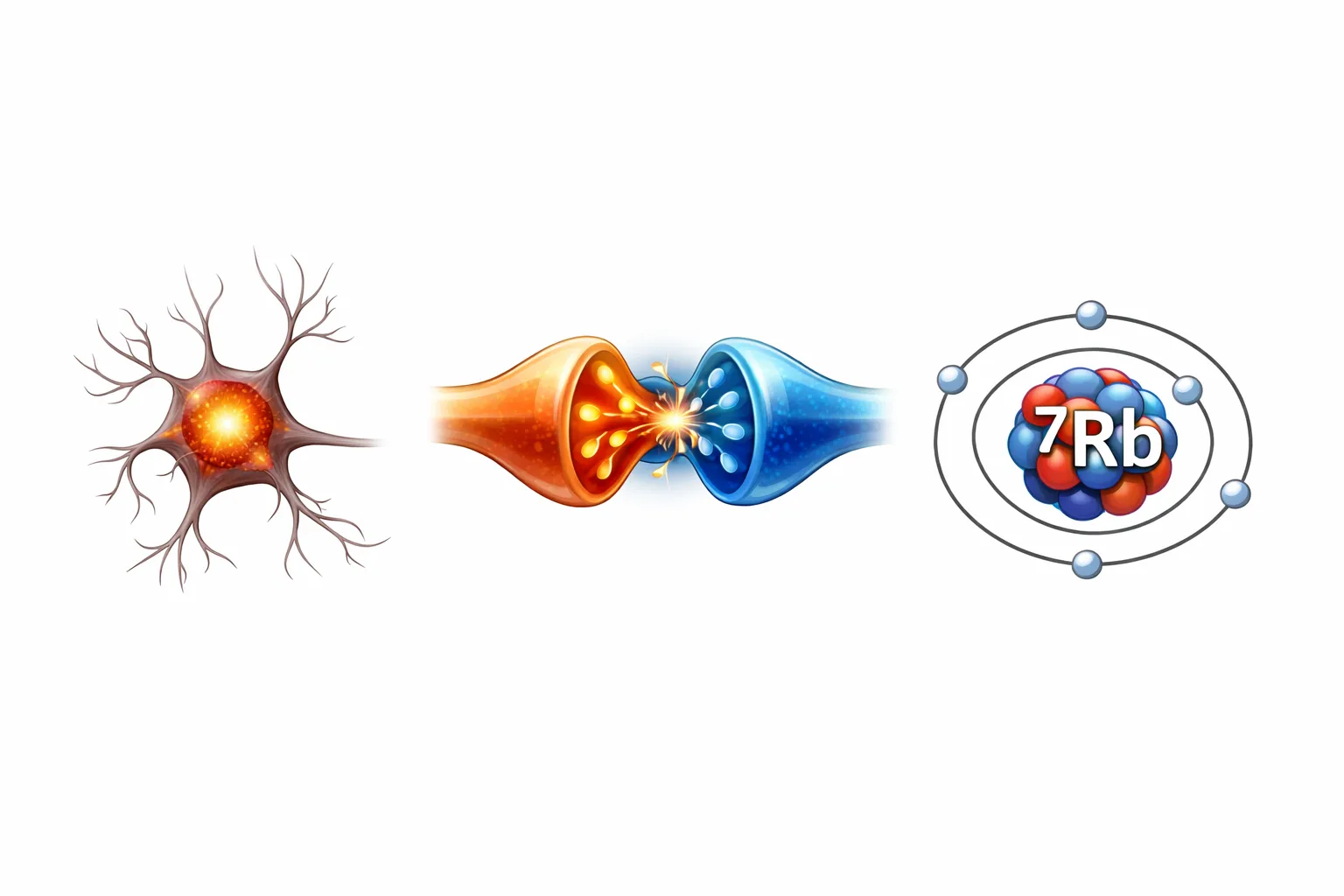
A cloud of atoms cooled to near absolute zero suddenly starts behaving like a brain. One excited atom triggers a chain reaction — neighbors light up in turn, and an avalanche of activity sweeps through the gas. Physicists call this Rydberg facilitation: atoms are easier to excite when an excited one is nearby. The process is strikingly similar to how neurons exchange electrical signals across synapses.
In the experiment, two phases were clearly separated. The absorbing phase, where avalanches quickly die out. The active phase, where excitation sustains itself. At the boundary between them, the system enters a critical state — the same kind suspected in the working brain. Here, avalanche sizes follow a power law: many small ones, few large ones. And their shapes become universal. The authors confirmed these signatures of criticality for the first time in a controlled physical model.
To keep the system from dying out, the researchers added a controlled pump — a kind of metabolic resource that replenishes lost atoms. This allowed them to hold the gas in a nonequilibrium steady state, like a living organism that constantly expends and restores energy. In the active phase, stochastic oscillations emerged with rare but giant bursts, so-called "dragon avalanches." This regime resembles rhythmic activity of neural networks that accompanies information processing.
The work turns ultracold Rydberg gas into a powerful simulator for neuroscience. Here, one can tune parameters that are nearly elusive in living cells and test theories about how collective behavior of neurons gives rise to complex brain functions.
Original abstract
as written by the authors arXiv:2607.16368
Efficient operation of neural networks has been linked to criticality in their underlying non-equilibrium excitation dynamics. However, obtaining experimental evidence of this conjecture remains challenging due to limited control and undersampling in biological systems. Here, we experimentally explore neural network criticality using an ultracold Rydberg gas as a highly controllable simulator. We highlight the similarity of the excitation spreading via Rydberg facilitation and the synaptic connection of spiking activity of neurons, giving rise to distinct absorbing and active phases. We systematically explore and resolve criticality criteria, including power-law scaling of excitation avalanches and the emergence of universal avalanche shape collapse. Crucially, we implement a controlled gain mechanism to compensate for atom loss, mimicking metabolic resource replenishment and stabilizing the system in a controlled non-equilibrium steady state. We find peak temporal correlations at the critical point and stochastic oscillations with dragon king avalanches in the active phase, consistent with predictions for systems orbiting criticality. Our work establishes facilitated Rydberg gases as a platform for investigating criticality, resource dynamics, and emergent oscillations in neural networks.
Rydberg atoms can be thousands of times larger than ordinary ones — a single such atom is the size of a bacterium, and its electron sits so far from the nucleus that it feels the slightest influence from neighbors.
In Peter Watts's novel Blindsight, an alien intelligence operates on principles reminiscent of critical dynamics: it does not think continuously but "wakes up" in response to stimuli, much like avalanches in a Rydberg gas.