A Quantum Top in a Magnetic Trap express
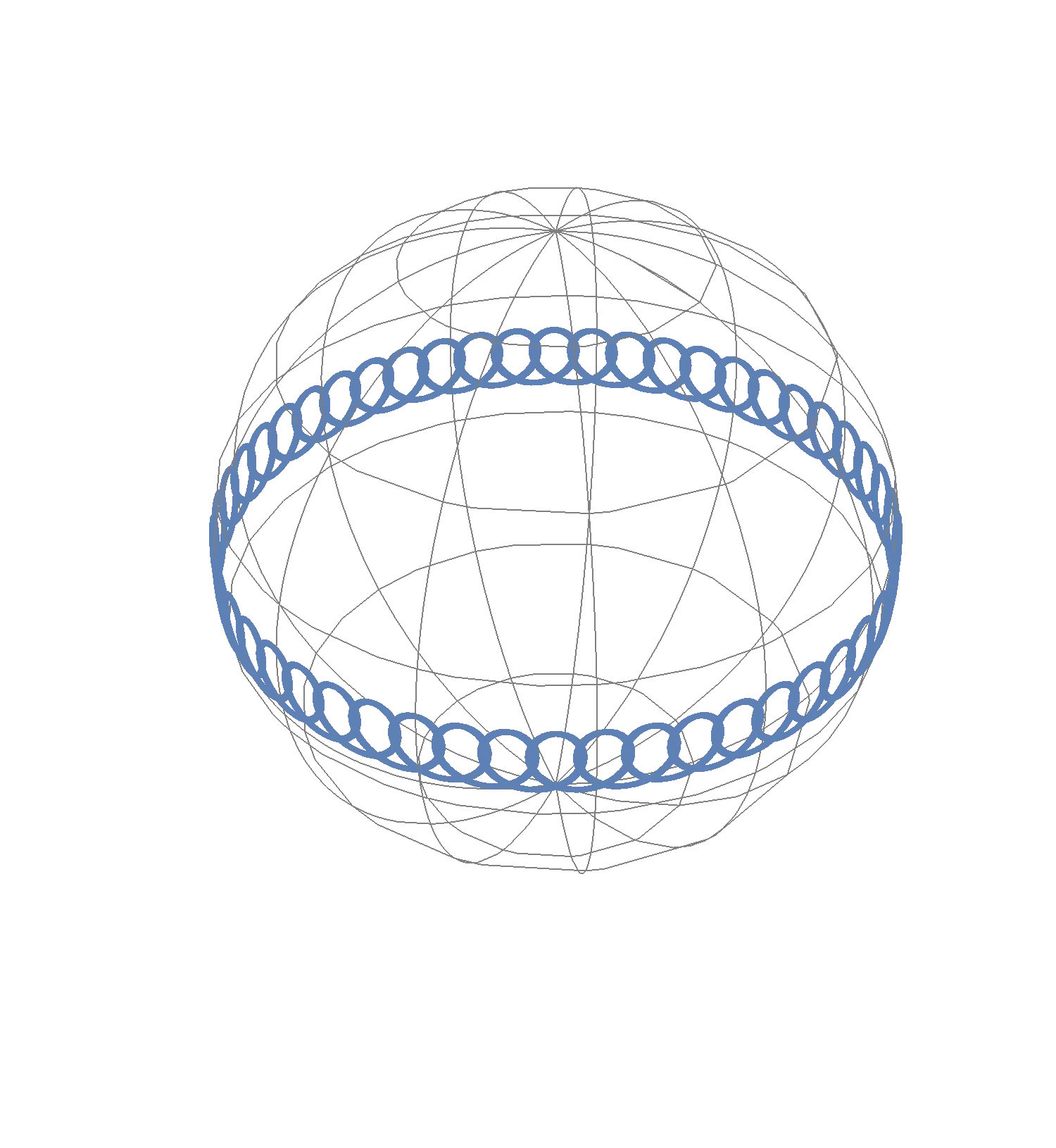
A tiny magnetized sphere floats in a vacuum, held by invisible fields. It starts to spin around the axis of the magnetic field, just like a top that's been given a gentle nudge. That's precession. But when the sphere becomes really small, quantum laws come into play. In a new study, physicists described the behavior of such a freely floating magnetic top, a levitating ferromagnetic gyroscope, in the language of quantum mechanics.
The main character here is the total angular momentum along the magnetic field. It's made up of the particle's intrinsic spin and its mechanical rotation. This quantity is quantized: it can only take on strictly defined values, multiples of Planck's constant. As a result, the gyroscope has discrete precession states, like steps on a staircase that the system can climb by absorbing or emitting radio waves. Alongside these, there are also quantum levels of wobbling, librations, similar to the oscillations of a pendulum.
Surprisingly, precession persists even in strong fields, when the mechanical angular momentum associated with it far exceeds the particle's intrinsic spin. This means that quantum behavior doesn't hide in the microworld but can show up in relatively large objects. The authors showed how radio pulses can switch the gyroscope between different quantum states, control its tilt, and even couple precession to libration — much like in laser spectroscopy, but for rotation.
Such a system promises to become an ultra-sensitive sensor: the slightest external influence would shift the quantum levels, and that shift could be detected. This could mean detecting weak magnetic fields, gravitational effects, and even hypothetical dark matter particles. The quantum top turns into a versatile tool for fundamental physics.
Original abstract
as written by the authors arXiv:2607.16592
We develop a quantum model for the rotational dynamics of a freely floating levitated ferromagnetic gyroscope (LFG), emphasizing the interplay between intrinsic spin $$\boldsymbol{S}$$, mechanical angular momentum $$\boldsymbol{L}$$, and magnetic torque. The conserved total angular momentum projection along the $$z$$-directed magnetic field $$\boldsymbol{B}$$, $$J_z=S_z+L_z$$, is quantized, leading in the small-libration-amplitude limit to discrete precessional states $$|m\rangle$$ (eigenstates of $$J_z$$ with eigenvalues $$J_z = m\hbar$$) and librational harmonic oscillator states $$|n\rangle$$ ($$n=0,1,2,\ldots$$). The discreteness of the energies and dynamical variables is governed by the quantum precession scale $$\Omega_Q=\hbar/I$$, where $$I$$ is the moment of inertia of the LFG. We find that the phenomenon of LFG precession persists into high-field regimes where the magnitude of the rotational angular momentum associated with precession exceeds the total intrinsic spin. We analyze the complementary quantum limits of localized semiclassical LFG orientation wave packets and exact $$J_z$$-eigenstates $$|m\rangle$$, clarifying the relation between classical precession signals and the underlying quantized spin-rotor dynamics. We further show that radio-frequency fields can drive $$\Delta m = \pm 1$$ and $$\Delta n = \pm 1$$ transitions, enabling ladder spectroscopy, tilt-angle control, and sideband-like coupling between precession and libration. The coupled dynamics also exhibit branch-point magnetic resonances where precession and librational motion become strongly coupled. These results establish a framework for using LFGs not only as ultrasensitive torque and magnetic-field sensors, but also as controllable mesoscopic quantum systems. The techniques developed here may be applied to searches for exotic, beyond-the-standard model spin-dependent interactions, ultralight dark matter, and spin-gravity couplings.
The moment of inertia of a levitating gyroscope can be so small that the quantum of precession energy ħ/I becomes comparable to thermal energy at room temperature — quantum effects become noticeable without ultra-deep cooling.
In Isaac Asimov's novel "The End of Eternity," gyroscopes served as the basis for time travel — perhaps their quantum counterparts will help pick up signals from other dimensions.