Quantum frictionless motion refers to the movement of particles in a quantum system without energy dissipation, a phenomenon that defies classical expectations of friction. In everyday experience, moving objects slow down due to interactions with their environment, but in certain quantum regimes, particles can glide indefinitely without losing energy. This behavior emerges from the wave-like nature of quantum particles and the discrete energy levels available to them, allowing them to avoid scattering channels that would normally cause drag.
History
The concept is rooted in the theory of superfluidity, developed in the 1930s by Pyotr Kapitsa, John Allen, and Don Misener, with theoretical foundations laid by Lev Landau. The specific term 'quantum frictionless motion' is a modern description of this phenomenon in broader quantum contexts.
How it works
In a quantum system, particles occupy discrete energy states. Friction typically arises when a moving particle excites surrounding degrees of freedom, transferring energy away. However, when the system's energy spectrum has a gap — meaning there are no low-energy excitations available — the particle cannot lose energy and moves without dissipation. This is analogous to a superfluid, where atoms flow without viscosity because the energy cost to create excitations is too high.
In practice
This principle underpins technologies like superconducting quantum interference devices (SQUIDs) and quantum computing qubits, where maintaining coherent quantum states without energy loss is essential for reliable operation.
Fun fact
In a superfluid, atoms can flow through tiny cracks and pores without any resistance, even climbing up the walls of a container due to quantum effects.
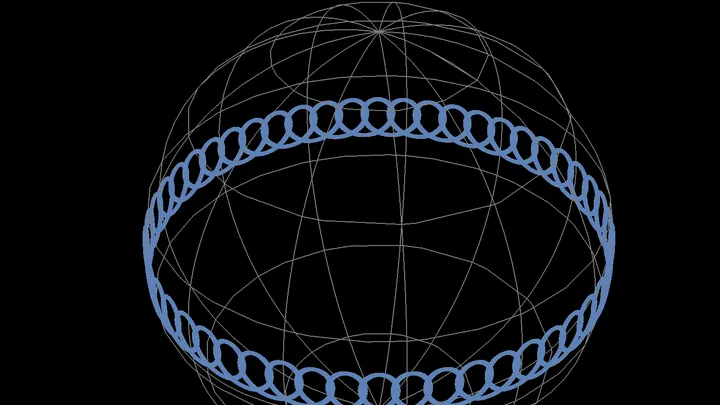
A tiny magnetized sphere floats in a vacuum, held by invisible fields. It starts to spin around the axis of the magnetic field, just like a top that's been given a gentle nudge. That's precession. But when the sphere becomes really small, quantum laws come into play.
Ever since Fritz Zwicky noticed that galaxy clusters were moving too fast, and Vera Rubin measured the rotation of spiral arms, dark matter has remained cosmology's greatest mystery.
Quantum matter rarely treats us to the spectacle of self-motion. Where the classical world teems with starling murmurations, fish schools, and bustling bacteria, quantum thermodynamics long remained serene.
A pebble falls into a pond, and ripples spread across the water. In the quantum world, the pond is not made of water but of many identical particles, and the pebble is also a particle, just a foreign one. Such a foreign particle is called a Fermi polaron.
A handful of rice grains falls onto a hot skillet, and they start jumping. Each grain pushes its neighbors, and the whole pile stirs without any external hand. That's active matter: a multitude of particles that draw energy on their own and convert it into motion.
The boundary between two liquids is like an invisible skin: it's there, but you can't touch it with your finger. Scientists have found a way to measure its elasticity without touching it. They made a tiny probe oscillate above the surface, and between the probe and the interface lay a thin film of liquid.
In the macroscopic world we know, any motion inevitably decays: friction, a dissipative process that scatters energy, intervenes. But quantum reality has surprises in store.