Tricoupler on a Chip: The Knot That Cancels Starlight ✛
Every night, hundreds of observatories scan the sky, yet planets around other stars remain ghosts. Their light is billions of times fainter than the glare of their parent star — the task seems hopeless. But optics found a way: rather than block the star’s light, cancel it with a counter-wave of the same amplitude, shifted by half a period. This technique is called nulling interferometry.
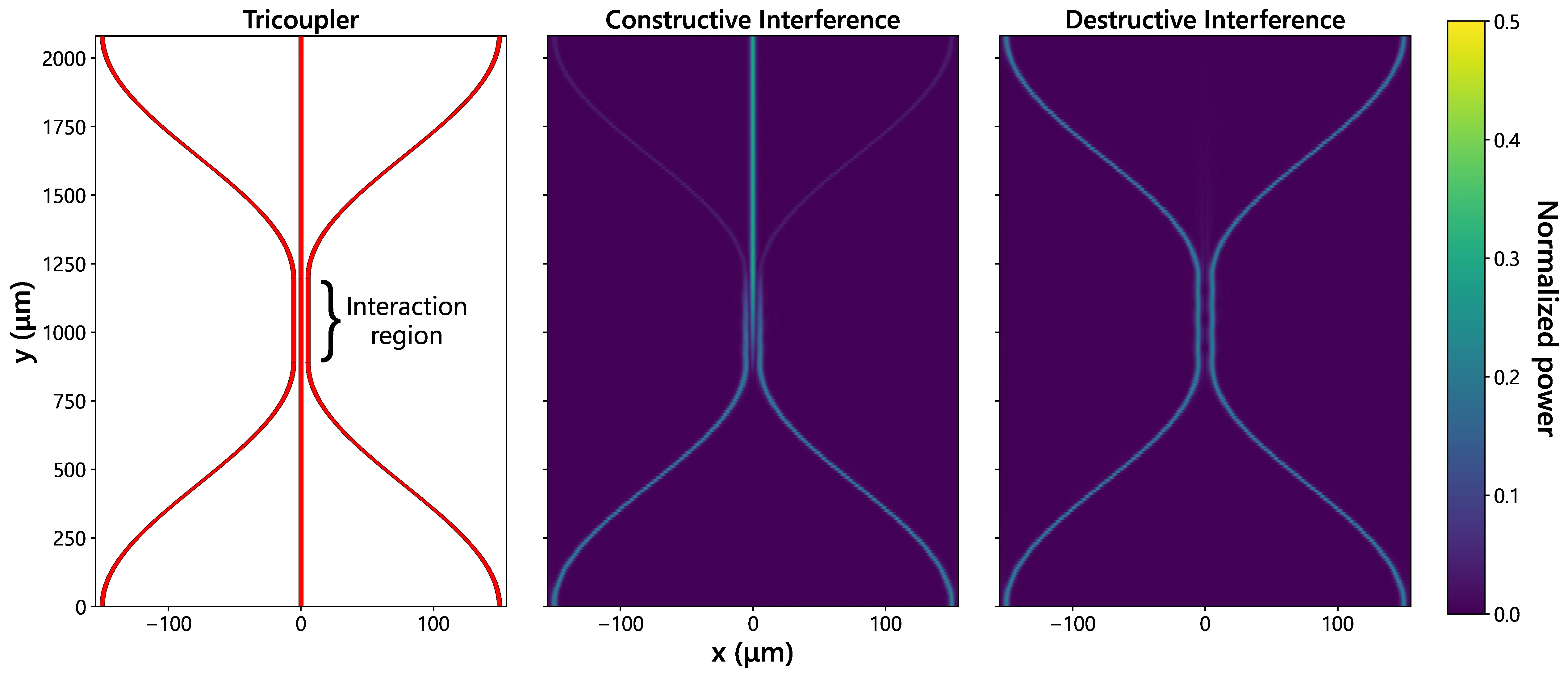
The light knot: three threads, three waveguides on a fingernail-sized silicon chip, intertwine so that light is completely canceled in the central fiber. That’s how a tricoupler works — a symmetric beam splitter that channels energy into the side ports, leaving the central port dark. It’s not blocking; it’s interference cancellation: the crest of one wave meets the trough of another, and pure darkness is born right in the circuit.
In the lab, they tested the idea with light at a wavelength of 1,59 micrometers. Using thermo-optic phase shifters, tiny heaters atop the waveguides, they tuned the optical path difference to within fractions of a nanometer. As a result, the null depth reached –54 dB — the star’s light was dimmed by a factor of 250,000. Crucially, the chip itself introduced no extra chromaticity: the null position depended linearly on wavelength, just as theory predicted.
The measurement bandwidth spanned 200 nanometers — the entire near-infrared H-band. Without special polarization filtering, they got about –30 dB. The culprit: birefringence of the silicon platform — different polarization states travel at different speeds, so the cancellation conditions no longer line up. Convinced by this, the researchers added a polarizer and instantly improved the contrast by two orders of magnitude.
Now, the engineering challenge is to create achromatic phase shifters and separate channels for the two polarizations. That will enable contrasts of 10⁻⁵–10⁻⁶ over a broad band — essential for spectroscopy of atmospheres of exoplanets. Numerical simulations of new configurations are already underway, with dual-input circuits, mimicking light collection from two telescopes, next in line.
This knot woven from silicon tracks has shown for the first time that it can reliably suppress a star’s light across a whole palette of colors. In the future, arrays of such tricouplers could be part of space interferometers like the proposed Habitable Worlds Observatory, and perhaps this very light knot will loosen the tongues of distant worlds’ atmospheres.
Interestingly, the on-chip tricoupler is like a light-based version of noise-canceling headphones: it doesn’t block, it cancels the wave with a counter-wave, and it does so for all colors at once without any mechanical adjustment.
The idea of nulling interferometry echoes the concept of a 'stellar shield' in Arthur C. Clarke’s novel The Fountains of Paradise, where a space-based mirror system was used to cancel a star’s light for observing distant objects.