On-Chip Tricoupler: The Node That Nulls Starlight ✛
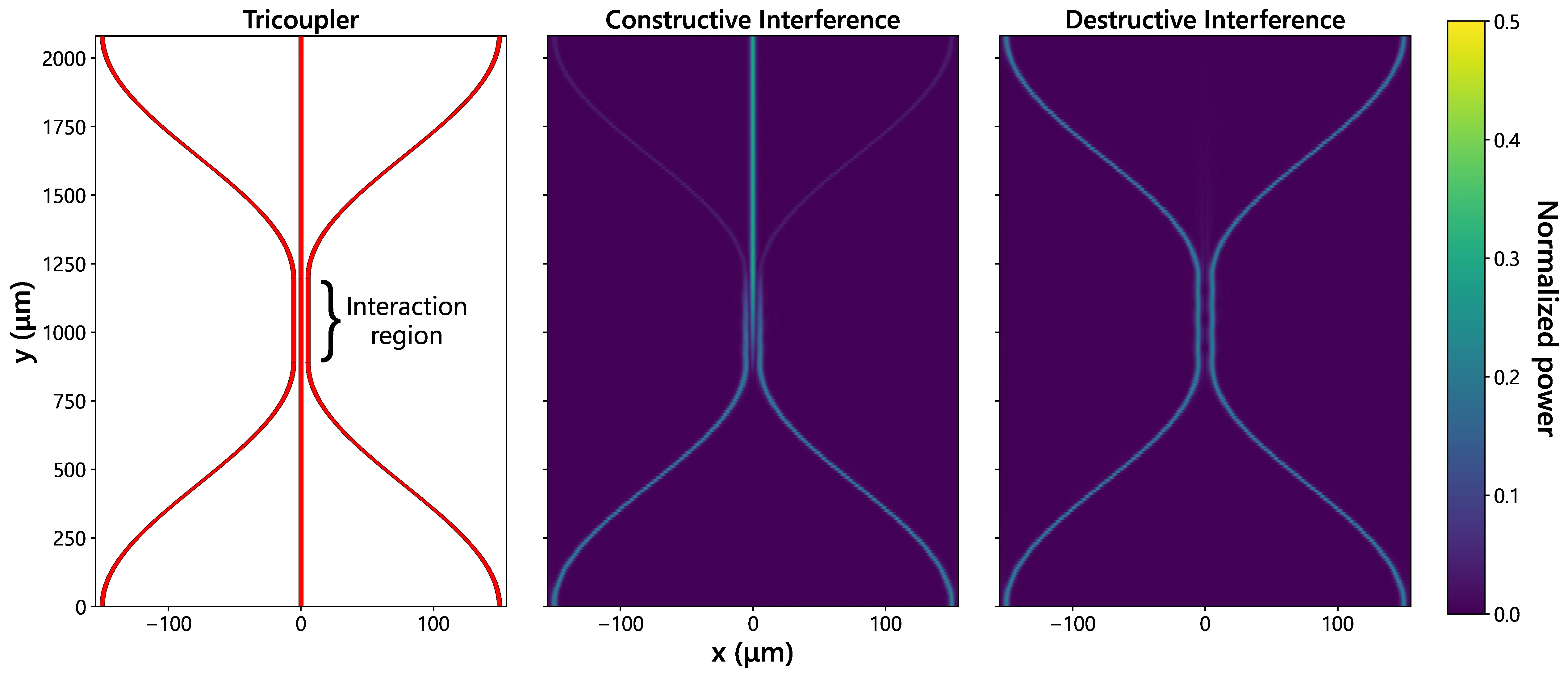
Context
Jupiter-like gas giants and rocky planets in habitable zones remain elusive for traditional detection methods: their transits are rare, radial velocities weak, and angular separation from the star smaller than the inner working angle of coronagraphs. Nulling interferometry with a long baseline, based on the superposition principle of waves, suppresses starlight, boosting spatial resolution and enabling direct detection of faint planetary signals. Exoplanets near the snow line are crucial for understanding planet formation and water delivery, but demand a contrast of order 10⁻¹⁰ — achievable only with exceptionally precise optical path control. Photonic integrated circuits, inheriting telecom technology, promise miniaturization and vibration resilience, opening the door to scalable interferometers for future space observatories like the Habitable Worlds Observatory.
Methods
The study was carried out on a planar silicon-on-insulator (SiO₂/Si) platform with germanosilicate waveguides and a core refractive index contrast of 2%. Lithographically fabricated tricouplers were tested in a single-input configuration: the input beam was split by a Y-branch, then passed through a system of Mach–Zehnder interferometers for intensity equalization and a thermo-optic phase shifter before entering the tricoupler. Measurements were taken in two modes: photometric monitoring of all output ports under 1590 nm monochromatic illumination, and spectral analysis of one port across the broad H-band (1450–1650 nm). A pinhole mask was used to suppress stray light. Polarimetric filtering allowed assessment of the birefringence contribution. Numerical simulation of beam propagation in the tricoupler confirmed the ideal achromaticity of the null.
Results
In monochromatic light, a null depth of −54 dB (4.1×10⁻⁶) was achieved with polarization filtering — two orders of magnitude better than without. This indicates that the main limiting factor is chip birefringence, causing the nulling conditions for the two polarizations to mismatch. Without a polarizer, all three devices — a 1×3 and two 1×5 tricouplers, one of which includes a waveguide crossover — showed comparable nulls around −30 dB (~10⁻³), with the crossover causing no degradation. Notably, the phase-shifter voltage corresponding to the null depends on wavelength, explained by the chromaticity of the thermo-optic effect. Comparison with a Mach–Zehnder interferometer on the same chip showed that the chromatic slope, normalized to voltage squared, is identical for all nulls and close to the theoretical value of 1/λ₀, indicating that the tricoupler itself introduces almost no additional chromaticity. Nulling interferometry with tricouplers thus proved fundamentally viable.
Implications
The results show that lithographic planar tricouplers can deliver achromatic nulling with contrast sufficient for direct exoplanet detection within an interferometer. Eliminating birefringence and developing achromatic phase shifters should bring broadband contrast to 10⁻⁵–10⁻⁶, which is required for exoplanet atmosphere spectroscopy. Compatibility with waveguide crossovers enables building complex cascaded architectures and kernel nullers without performance loss.
Future development
Near-term steps include developing integrated circuits with separate channels for the two polarizations, creating static achromatic phase delays via segmented waveguides of variable width, and adding thermo-optic elements for fine tuning. A shift to a dual-input configuration, mimicking light collection from two telescopes, is also planned, with simultaneous use of bright ports for wavefront sensing.
Impact
The results directly impact the design of future space interferometers like the Habitable Worlds Observatory and ground-based systems such as Asgard/NOTT at the VLTI, bringing closer an era of routine direct spectroscopy of exoplanet atmospheres.
Next steps
Experimental validation of the dual-input mode with coherent sources, and fabrication of chips with achromatic phase shifters and polarization-decoupled paths.
Key open problems
Achieving a contrast of 10⁻¹⁰ to detect Earth analogs around Sun-like stars is one of the major technical challenges in observational astrophysics. PIC-based nulling interferometry offers a pathway to a solution, but requires suppressing instrumental noise to <1 nm in optical path difference, which remains a challenge.
The knowledge machine's view
This section is addressed to the author of the paper and their colleagues. Neighbouring works were found by meaning-based search across our archive, not by word overlap. We do not review: we show the field around the work.
What the work does
The work demonstrates a planar tricoupler on a chip (SiO₂/Si, germanosilicate waveguides) and measures the null depth in monochromatic light down to −54 dB with polarization filtering. It is shown that the main limiting factor is birefringence, while the tricoupler itself introduces almost no additional chromaticism.
Where its strength is
The principle of nulling interferometry with tricouplers is demonstrated, achieving record suppression of starlight in an integrated-optics implementation. This paves the way for compact, vibration-robust systems for direct exoplanet detection.
Where it could go next
- It might be interesting to see how background suppression methods developed for scalar dark matter searches can be adapted to further reduce parasitic stray light in nulling interferometers. In our archive, there is a related work that uses synchronous detection and correlation analysis to extract weak signals from noise.based on: Hearing the Silence: The Hunt for Scalar Dark Matter arXiv:2607.12144
- For future space observatories, attention should be paid to approaches that use solar gravitational lensing to amplify light from distant objects. This direction may offer alternative schemes for combining interferometry with natural lenses to enhance contrast.based on: A Sun-Sized Lens Searches for Life Around Distant Stars arXiv:2606.29138
Worth trying
- Test synchronous detection with phase modulation to suppress uncorrelated noise, similar to dark matter searches.
- Investigate whether telecom optical communication techniques can be used for real-time active compensation of birefringence.
- Assess the gain of placing a tricoupler at the focus of the Solar Gravitational Lens (SGL) to achieve extreme contrast.
Why this may matter
Miniaturizing nulling interferometers to chip scale is a step toward scalable space missions for direct observation of Earth-like planets. If such chips can be combined with background suppression methods from other fields and with natural lenses, it could radically reduce the cost and complexity of future observatories.
Nearby works in our archive
- How to Spot a Pale Planet in a Star's Blinding Lightsimilarity 0.61
- A Lunar Telescope Will Reveal the Shadows of Distant Black Holessimilarity 0.61
- Hearing the Silence: The Hunt for Scalar Dark Mattersimilarity 0.60
- A Levitating Dust Grain Hunts Invisible Mattersimilarity 0.60
- A Sideways Glimpse into the Hearts of Starssimilarity 0.60
- Black Hole Lens Catches Light from Distant Nebulaesimilarity 0.59
- A Sun-Sized Lens Searches for Life Around Distant Starssimilarity 0.59
The archive is sparse around this work: the closest review is only 0.61, against a usual 0.64. It looks like few have drilled nearby.
Original abstract
as written by the authors arXiv:2607.26168v1
Solar System analog gas giants and habitable-zone terrestrial planets are observationally elusive to conventional exoplanet detection and characterization techniques, i.e. transits, radial velocities, and direct imaging. Long baseline nulling interferometry across multiple apertures suppresses starlight and enables detection of faint planetary signals at higher spatial resolution than traditional coronagraphs on single-aperture telescopes. Leveraging technological advancements from the telecommunications industry, photonic integrated circuits (PICs) offer a promising platform for performing the optical operations necessary for astronomical applications, including phasing and beam combination for nulling interferometry in both long-baseline and cross-aperture configurations. PICs provide compact, scalable architectures with reduced sensitivity to alignment as well as thermal and mechanical perturbations compared to bulk optics. However, their design and manufacturing precision remain insufficient for the stringent requirements of exoplanet instrumentation. Here, we investigate the nulling capabilities of photonic tricouplers, devices composed of three equal-width waveguides that are geometrically predisposed to produce achromatic nulls upon beam combination through their symmetric construction. In the laboratory, we characterize null depths in monochromatic light at 1.55 $$\mathrm{\mu}$$m with devices on a planar silica-on-silicon platform. In broadband $$H$$-band light, we explore chromatic effects from components such as thermo-optic phase modulators used for fine-phasing. Our ongoing efforts towards maturation of PICs for direct detection and atmospheric characterization of exoplanets will support scalable testing and deployment of high-contrast technologies for future space-based observatories, such as the Habitable Worlds Observatory.
Interestingly, an on-chip tricoupler resembles a light-based version of noise-cancelling headphones: it doesn’t block, but actively cancels a wave with a counter-wave, and does so for all colors simultaneously without mechanical tuning.
The idea of nulling interferometry echoes the concept of a ‘stellar shield’ in Arthur C. Clarke’s novel The Fountains of Paradise, where a space-based mirror system cancels starlight to observe distant objects.
Key numbers
- null depth with polarization filtering: –54 dB (4,1×10⁻⁶)
- null depth without filtering: about –30 dB (10⁻³)
- measurement bandwidth: 200 nm (1.45–1.65 µm, H-band)
- core refractive index contrast: 2%
- laser wavelength: 1590 nm