Black Hole Echo: What the Horizon Sounds Like
When two black holes merge, ripples spread across the fabric of spacetime — gravitational waves. But what if one of them isn't a run-of-the-mill black hole but something else — an exotic compact object?
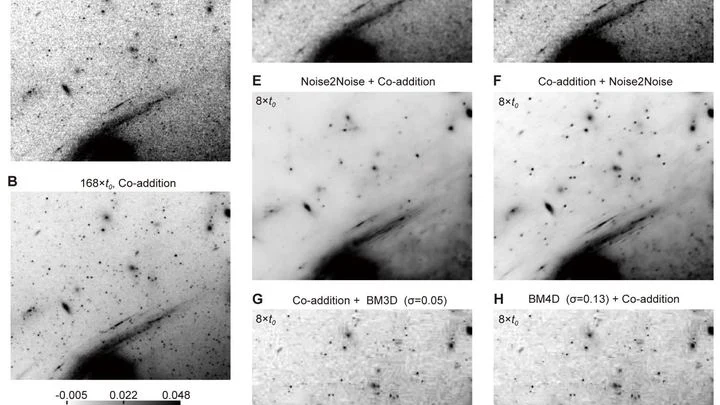
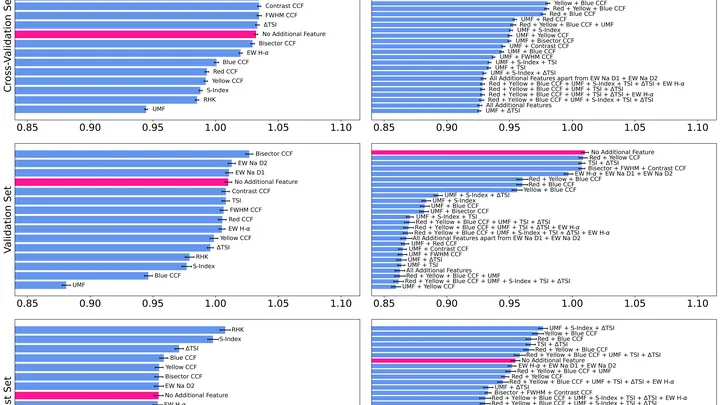
Methods to reduce observational noise and artifacts that interfere with detecting exoplanets.Exoplanet detection noise reduction refers to the suite of techniques used to separate the faint signals of distant planets from the overwhelming noise of their host stars, the interstellar medium, and the instruments themselves. This is crucial because the dimming of a star during a transit or the tiny wobble induced by a planet's gravity is often buried in stellar variability, photon noise, and systematic errors. Without effective noise reduction, many exoplanets would remain undetectable, and the ones we do find would have unreliable measured properties.
The field grew rapidly after the first exoplanet discoveries in the 1990s, with early efforts focusing on removing stellar jitter in radial velocity measurements. The development of sophisticated noise models and the application of machine learning became prominent in the 2010s, especially with the high-precision data from the Kepler and TESS missions.
The methods include advanced statistical techniques like Gaussian process regression to model stellar activity, machine learning algorithms that learn to distinguish planet signals from noise, and careful calibration of instruments to remove systematic drifts. For transit photometry, one can also use multi-wavelength observations to separate a true planetary signal from starspot-induced variations, since the depth of a transit is wavelength-independent while starspot signals are not. Additionally, observing the same target with multiple telescopes or over multiple orbits helps average out random noise.
These techniques are essential for the operation of space telescopes like Kepler, TESS, and the James Webb Space Telescope, enabling them to find and characterize thousands of exoplanets, including potentially habitable rocky worlds.
The Earth's own atmosphere is a major source of noise for ground-based observatories, and some of the most effective noise reduction methods involve observing from space or using adaptive optics to correct for atmospheric distortion in real time.
| a_{X-Y} | variable | mass-scaled anomaly difference — anomaly difference |
| a_X | variable | anomaly of particle X — anomaly |
| a_Y | variable | anomaly of particle Y — anomaly |
| m_X | variable | mass of particle X — mass kilogram |
| m_Y | variable | mass of particle Y — mass kilogram |