Optical Clocks Take Time Into Their Own Hands express
The world's most precise stopwatch still runs with one eye on an old pendulum. Hydrogen masers — the best radio-frequency flywheels (devices that keep the rhythm between comparisons with a reference)—accumulate error because noise between ticks leaks into the final signal. Physicists call this the Dick effect, and it sets a limit on the accuracy of any time scale built on radio frequencies.
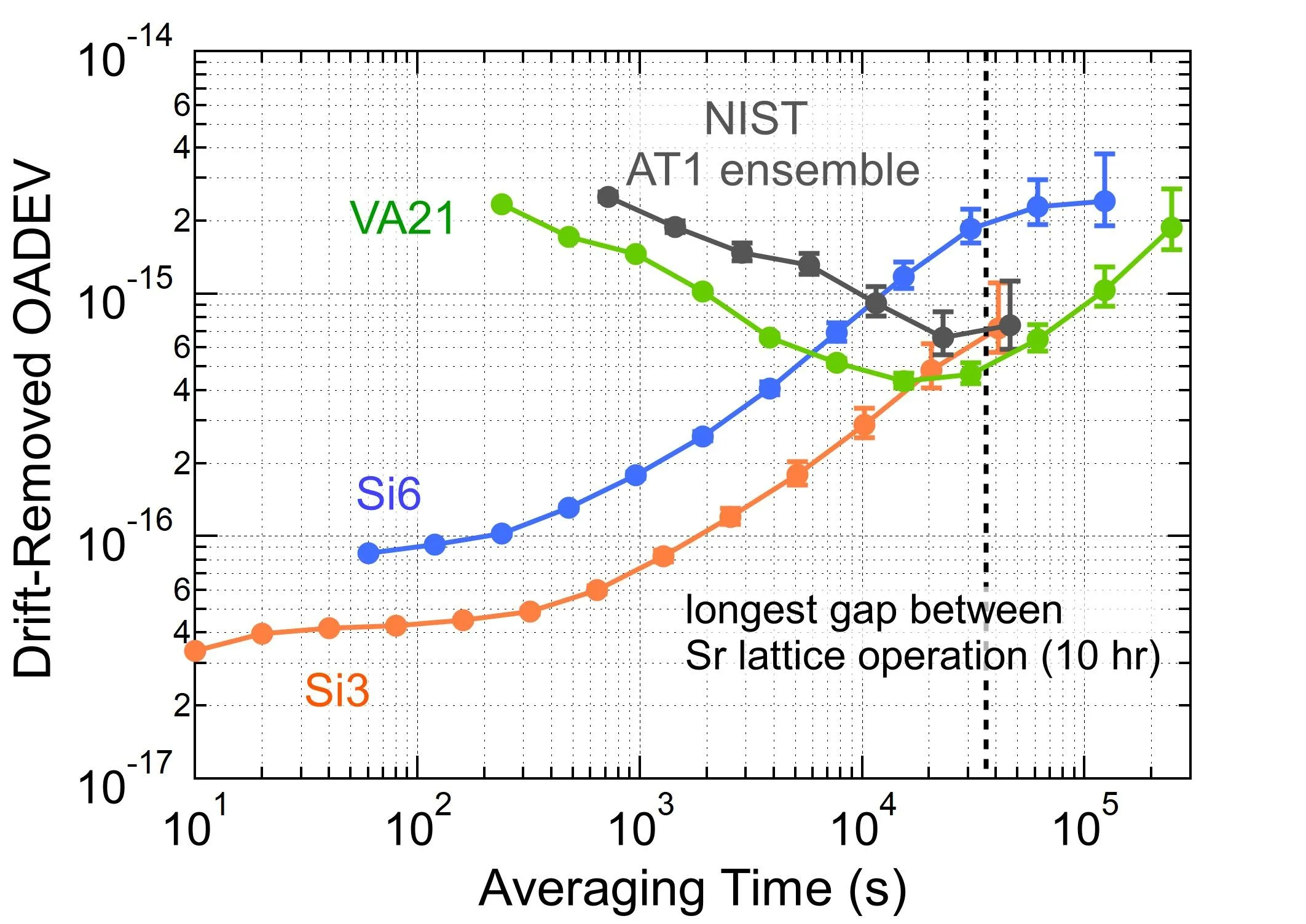
The authors replaced the radio-frequency flywheel with an optical one. Their setup has three independent rhythm keepers: two pairs of mirrors made of cryogenic silicon forming an ultra-stable resonator, and an iodine clock whose frequency is tied to a molecular transition. Each is steered by optical clocks based on strontium atoms — the primary reference whose accuracy extends beyond the 18th decimal place. This ensemble ran continuously for more than 20 days, and during that time the three parallel optical time scales diverged by less than 100 picoseconds — the time it takes light to travel just 3 centimeters.
When the optical reference is temporarily unavailable (for example, during alignment or due to a glitch) each flywheel keeps ticking on its own. Over a typical six-hour interruption, the drift amounts to about 20 picoseconds. That is hundreds of times less than a hydrogen maser would produce in the same situation. The loop closes: the Dick effect, which once dictated the limits of accuracy, is now suppressed to the point that the time scale, for the first time, lives by purely optical rules.
Original abstract
as written by the authors arXiv:2608.00910v1
Optical frequency standards have progressed rapidly over the past two decades, leading to the anticipated redefinition of the SI second by an optical frequency. However, time scales have not yet significantly improved despite this development because they are still fully reliant on rf flywheel oscillators, mostly hydrogen masers, which impose a performance limit related to incompletely sampled noise known as the Dick effect. To best benefit from the exceptional stability and accuracy of optical frequency standards, time scales must employ optical flywheels with orders-of-magnitude better short-term (<$$10^4$$ s) stability than masers. Here, we introduce three optical flywheel oscillators (two cryogenic silicon cavities and one iodine optical clock) with superior short-term stability than hydrogen masers and long-term stability on par with masers. Steering each optical flywheel with a high-uptime Sr optical frequency standard generates three parallel all-optical time scales with continuous operation over >20 days. When compared with each other, these all-optical time scales achieve <$$10^{-16}$$ relative instability after just a few days of averaging. During typical steering gaps of ~6 hours, the accumulated time difference is ~20 ps, leading to the total time difference of <100 ps over the full measurement period. With the proliferation of long-distance optical fiber links and commercialization of optical flywheels and frequency standards, we anticipate all-optical time scales to be the future of timekeeping.
The silicon resonators in this work are cooled to cryogenic temperatures, where thermal vibrations of atoms nearly freeze. At room temperature, the same crystal 'breathes' hundreds of times more strongly, smearing the precision of the count.