Optical Clocks Take Time Into Their Own Hands express
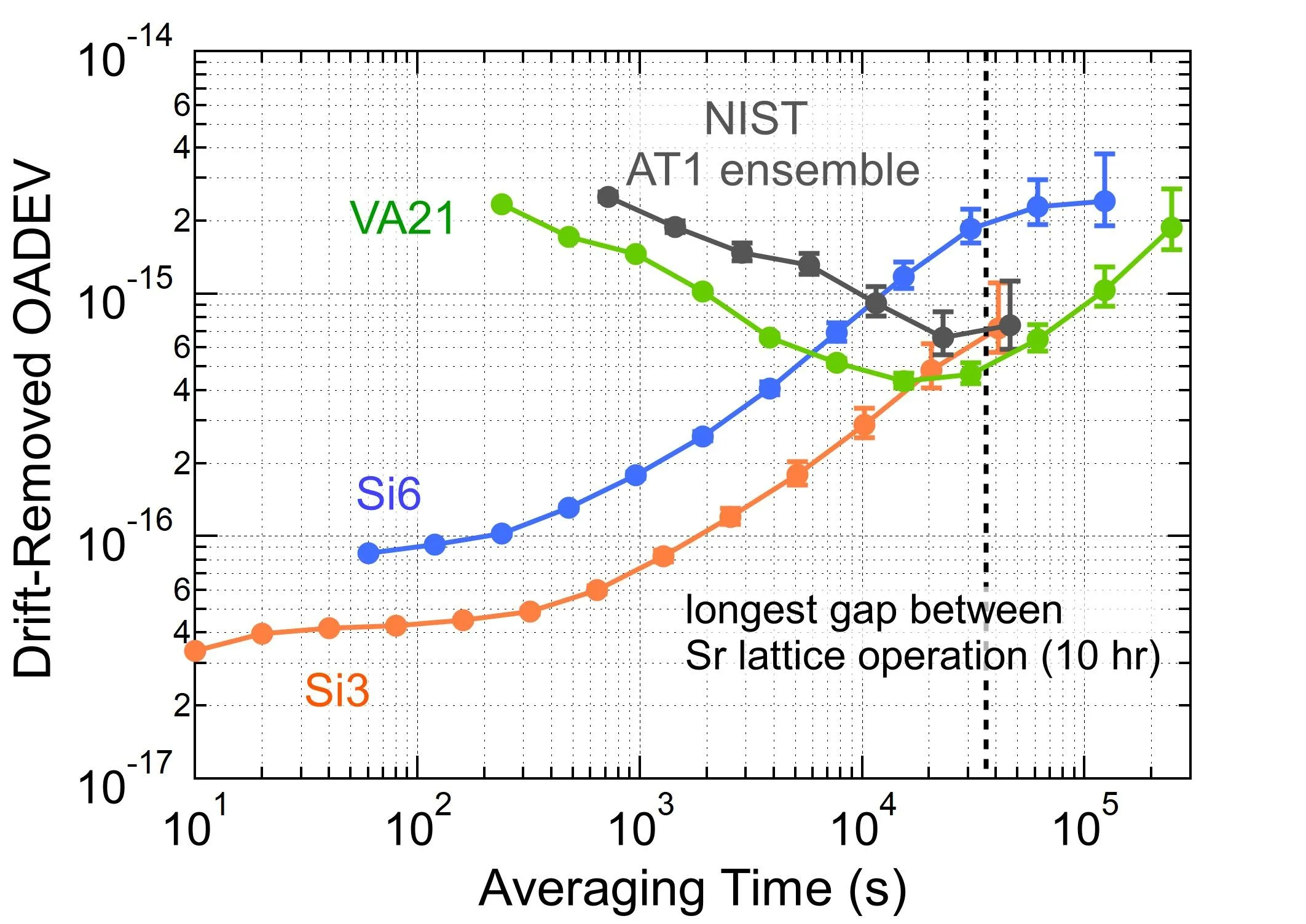
The world's most precise stopwatch still runs with one eye on an old pendulum. Hydrogen masers — the best radio-frequency flywheels (devices that keep the rhythm between comparisons with a reference)—accumulate error because noise between ticks leaks into the final signal. Physicists call this the Dick effect, and it sets a limit on the accuracy of any time scale built on radio frequencies.
The authors replaced the radio-frequency flywheel with an optical one. Their setup has three independent rhythm keepers: two pairs of mirrors made of cryogenic silicon forming an ultra-stable resonator, and an iodine clock whose frequency is tied to a molecular transition. Each is steered by optical clocks based on strontium atoms — the primary reference whose accuracy extends beyond the 18th decimal place. This ensemble ran continuously for more than 20 days, and during that time the three parallel optical time scales diverged by less than 100 picoseconds — the time it takes light to travel just 3 centimeters.
When the optical reference is temporarily unavailable (for example, during alignment or due to a glitch) each flywheel keeps ticking on its own. Over a typical six-hour interruption, the drift amounts to about 20 picoseconds. That is hundreds of times less than a hydrogen maser would produce in the same situation. The loop closes: the Dick effect, which once dictated the limits of accuracy, is now suppressed to the point that the time scale, for the first time, lives by purely optical rules.
The silicon resonators in this work are cooled to cryogenic temperatures, where thermal vibrations of atoms nearly freeze. At room temperature, the same crystal 'breathes' hundreds of times more strongly, smearing the precision of the count.