Star Explosions Sing on Two Frequencies express
When a star many times heavier than the Sun dies, it collapses and explodes as a supernova. This is not just a flash of light — the entire process, from core collapse to the ejection of the outer layers, makes space itself tremble. These ripples are called gravitational waves.
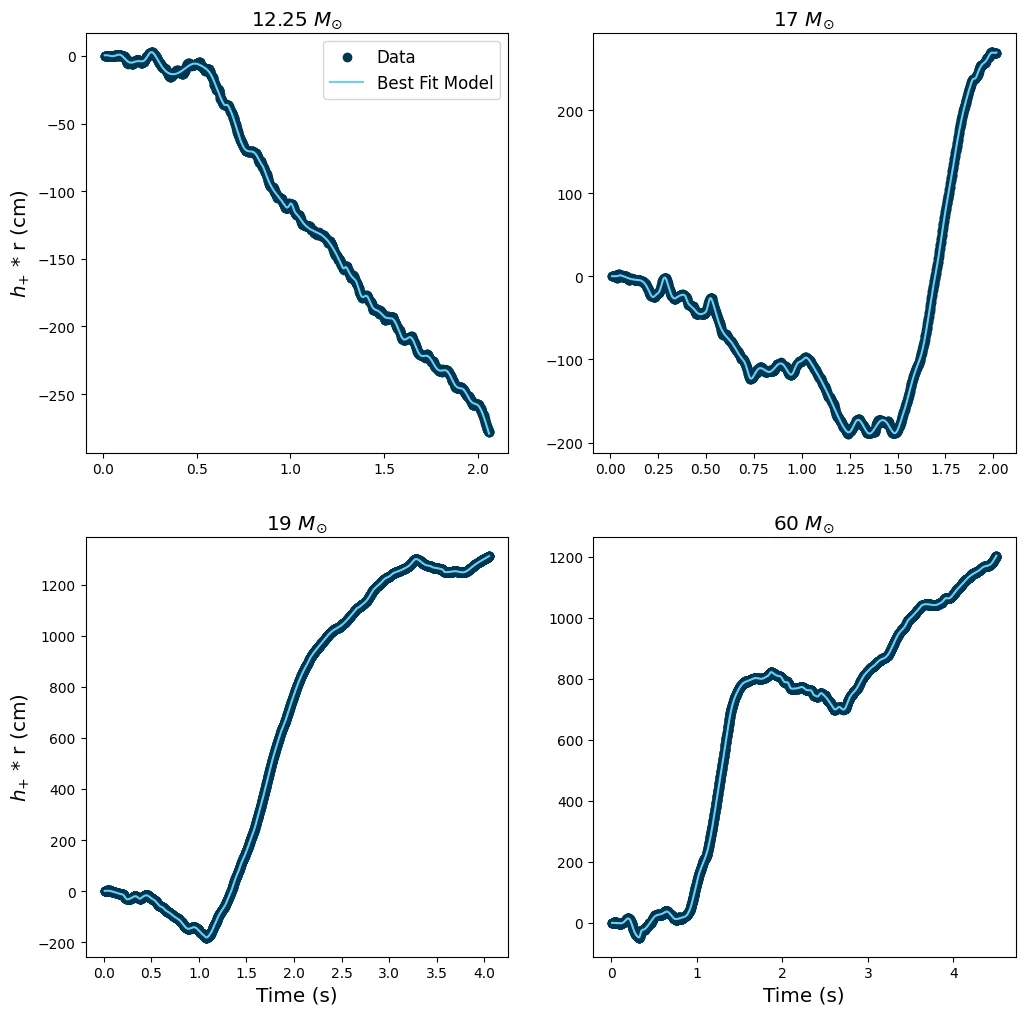
Scientists took dozens of three-dimensional explosion models and found that the gravitational hum from supernovae has two components. The low note, with a frequency of about one-tenth of a hertz, is born when neutrinos (light particles) are emitted unevenly. The high note, above a hundred hertz, comes from the churning matter at the center. The low note is the loudest. Its peak falls in the range of future space antennas, which will detect ripples in space while drifting freely millions of kilometers apart.
This hum could interfere with other searches. Its strength is comparable to the echo from the very first moments after the Big Bang. To hear the ancient whisper, astronomers will have to learn to subtract the noise of dying stars from the signal.
Original abstract
as written by the authors arXiv:2608.02747v1
Gravitational waves originating from unresolved sources, or stochastic gravitational wave backgrounds (SGWBs), carry precious information about the physics underlying their diverse sources, and represent an important target for future experimental searches. Here, we model the SGWB due to core collapse supernovae. Using an extensive collection of state-of-the-art, three-dimensional, multi-second supernova simulations, we characterize the two main components of this background: one at $$f \sim 10^{-2} - 1$$ Hz, due to anisotropic neutrino emission (the gravitational wave memory); the other at $$f \gtrsim 10^{2}$$ Hz, from the near-core matter dynamics. We find that the memory component offers the best prospects of detection, as its characteristic peak at $$f\sim 0.1$$ Hz is within the reach of future space-born detectors. At the peak, the energy density might be comparable to that of backgrounds from slow roll inflation and from possible cosmological relics, thus potentially impacting searches of these important signals.
Gravitational memory from neutrinos is like residual deformation: after the wave passes, space does not return to its original state but remains slightly stretched.