Star Explosions Sing on Two Frequencies express
When a star many times heavier than the Sun dies, it collapses and explodes as a supernova. This is not just a flash of light — the entire process, from core collapse to the ejection of the outer layers, makes space itself tremble. These ripples are called gravitational waves.
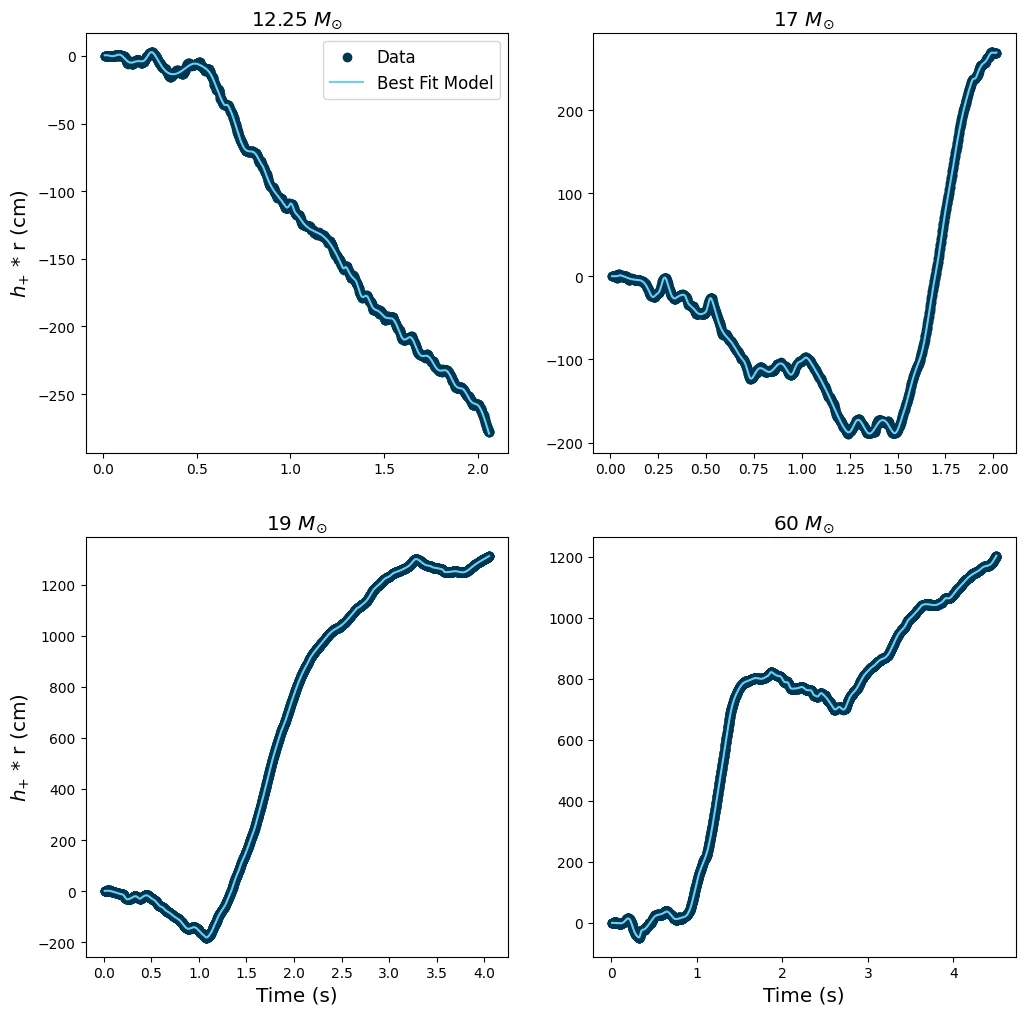
Scientists took dozens of three-dimensional explosion models and found that the gravitational hum from supernovae has two components. The low note, with a frequency of about one-tenth of a hertz, is born when neutrinos (light particles) are emitted unevenly. The high note, above a hundred hertz, comes from the churning matter at the center. The low note is the loudest. Its peak falls in the range of future space antennas, which will detect ripples in space while drifting freely millions of kilometers apart.
This hum could interfere with other searches. Its strength is comparable to the echo from the very first moments after the Big Bang. To hear the ancient whisper, astronomers will have to learn to subtract the noise of dying stars from the signal.
Gravitational memory from neutrinos is like residual deformation: after the wave passes, space does not return to its original state but remains slightly stretched.