Why biological recognition doesn't snap but smoothly switches express
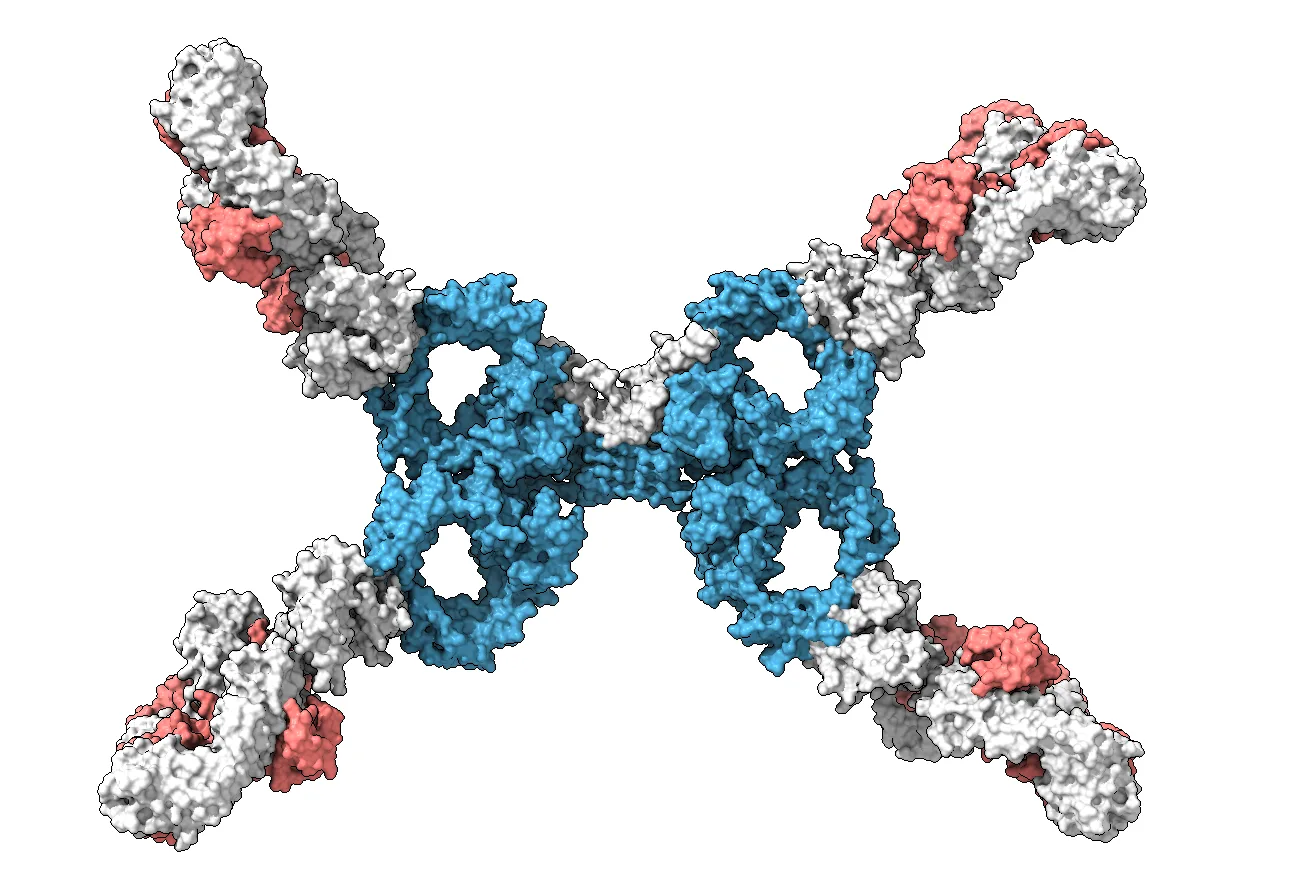
When an antibody meets a virus, it doesn't latch on with a single death grip. Rather, it's like two bunches of grapes tumbling in water, catching each other with dozens of short tendrils. Each tendril is weak on its own, easily torn by the thermal jitter of water molecules, but together they hold tight.
In the new review, this process is reassembled in the language of statistical mechanics. It turns out that the task of counting all possible ways two Velcro-studded surfaces can engage reduces to an old mathematical puzzle — the monomer-dimer problem on a graph. And the solution to that puzzle speaks clearly: multi-toothed binding knows no sharp phase transitions. The switch is always smooth, like turning a volume knob, not like flipping a light switch. That's why a living cell can fine-tune its responses.
From this smooth behavior follow three hard constraints. First, the repulsive coat on a molecule's surface is not an evolutionary whim but a mandatory feature: without it, all the sticky bits would clump chaotically. Second, the bonds do not act independently: the snapping of one affects the availability of its neighbors. Third, because binding energy enters the reaction rate through an exponential, a tiny change in receptor number (say, from ten to twelve) can lengthen the retention time by hundreds of times. The same equations describe how antibodies work, how lipoproteins grab fat particles, and how T-cells scan other cells' surfaces for foreign invaders. Everywhere, the decisive factor is not the strength of a single contact but how the total stickiness is spread across many weak points. Affinity is a property of a single molecule; selectivity is a property of the whole ensemble.
So biological recognition is not like a lock and key but like a crowd of people holding each other by their clothes: no one holds tight, but together they keep everyone from falling. And when someone lets go of a hem, the whole structure gently reshuffles rather than collapsing all at once.
Original abstract
as written by the authors arXiv:2608.08571v1
Biological recognition rarely rests on one strong bond. It works by forming many weak ones at once, between crowded, deformable surfaces in water. This review develops that process as a problem in statistical mechanics. Counting the ways two multivalent objects can bind proves to be the classical monomer-dimer problem on a graph, with a rigorous consequence: the apparent switching of multivalent binding is always a smooth crossover, never a phase transition. Three constraints follow. A repulsive surface layer is obligatory rather than a design choice; bonds do not act independently; and since free energies enter rates exponentially, small changes in receptor number shift binding lifetimes by orders of magnitude. One set of equations then covers antibodies, lipoproteins, and T cell recognition. In each, what decides the outcome is not the strength of any single bond but how a fixed total is spread over many: affinity is a property of a molecule, selectivity a property of an assembly.
A T-cell checking a single body cell forms and breaks hundreds of weak contacts per second, like a person quickly feeling out keys to find the right note.