Magnetic Patterns in Graphene express
Graphene, a sheet of carbon just one atom thick, can change its magnetic properties the way water changes shape: sometimes flowing, sometimes freezing into ice. In a new study, physicists peered inside this process for the first time using a sensor the size of a needle tip. The sensor detects magnetic fields the way a finger senses the warmth of a radiator — from a distance.
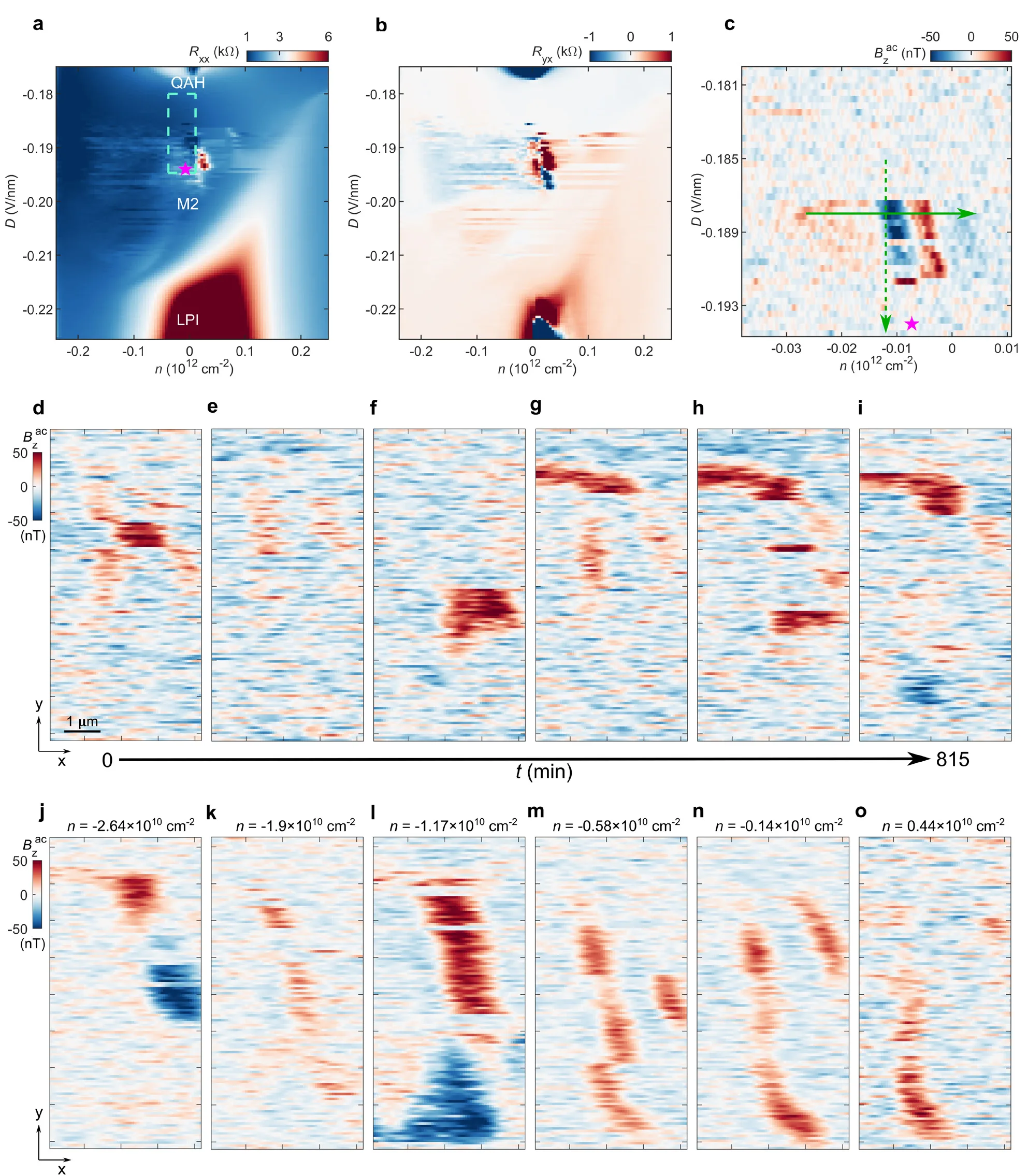
It turns out that the transition between states in graphene is not a smooth glide but a sharp jump. It's as if water doesn't cool gradually but instantly turns to ice at zero. At the same time, flickering magnetic patches appear at the boundary between two states, like ice floes in still-liquid water. This means the two states can coexist, competing for space.
Such jumps matter: if we learn to control them, we could create switches for quantum computers. Graphene's magnetic state is like a light switch: click, and current flows. Only instead of current, it's the electron spin, the particle's internal "top."
The work shows for the first time that topological transitions in graphene are abrupt, like changes in water's aggregate states. This changes our view of the nature of quantum phases and opens the path to new devices.
Original abstract
as written by the authors arXiv:2608.08697v1
Topological quantum phase transitions in non interacting systems occur through continuous gap closing and reopening. In strongly interacting systems, however, competing ordered states have long been predicted to drive first order transitions, although this possibility has remained experimentally unresolved. Recent transport studies of correlated phases in charge neutral rhombohedral graphene were interpreted as evidence for continuous topological transitions. Here, using nanoSQUID on tip magnetometry, we directly image the local orbital magnetization of a spin orbit proximitized rhombohedral graphene quantum anomalous Hall (QAH) state. We provide the first real space visualization of a QAH phase with a record Chern number, reconstruct its local thermodynamic gap, and track the evolution of its magnetization across competing correlated states. Combined with self consistent Hartree Fock calculations, these measurements show that the sequential transitions between the layer antiferromagnetic, QAH, and layer polarized insulating states are first order, accompanied by discontinuous changes in orbital magnetization. Near the phase boundaries, we observe fluctuating magnetic domains, providing direct microscopic evidence of phase coexistence between nearly degenerate competing ordered states. Together, these observations provide the first direct thermodynamic evidence for first order topological quantum phase transitions and establish a microscopic framework for understanding interaction driven topological quantum phase transitions through phase competition and coexistence.
The temperature at which these transitions occur is about 1 kelvin, just one degree above absolute zero.
In the series "The Expanse," ships use exotic matter for quantum jumps — here we also have jumps, but magnetic ones.