A Cosmic Shoal and an Airless Valley ✛
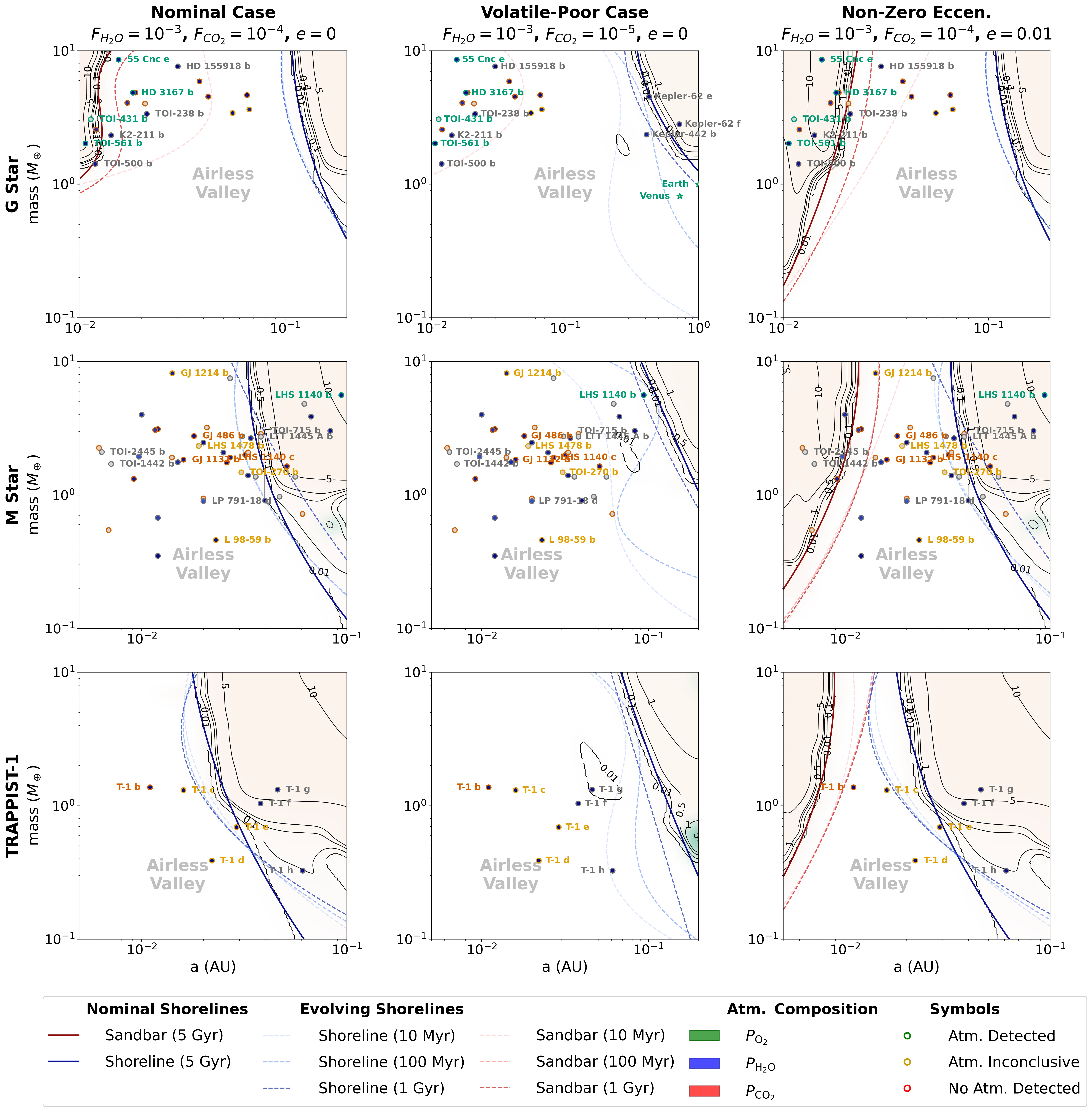
The JWST space telescope aimed its lens at the scorching rocky world 55 Cancri e, and spotted a dense gas envelope. But the cooler TRAPPIST-1 b, which orbits a dim red dwarf, showed no envelope: just bare rock. The picture came out upside down: hot planets hold onto atmospheres, while cooler ones lose them. The old 'cosmic shoreline'—a single boundary separating worlds with air from bare rocks — couldn't explain this.
Astrophysicists built a model where a planet's interior and atmosphere exchange gases like communicating vessels. While a planet is young and hot, its rocky shell is partially molten — a magma ocean. Water, carbon dioxide, and other volatiles hide in this melt like valuables in a safe. The star only blows off a thin layer of gas from the top, while the bulk of the supply stays in the interior. Thus, around the hottest planets, closest to their star, a 'cosmic shoal' emerges — a zone where atmospheres survive despite the radiation.
Farther from the star, planets cool faster. The magma solidifies, the safe opens: gases are pushed out into the atmosphere. But the stellar wind, a stream of particles and radiation, is still strong. It blows away everything that escapes. This creates an 'airless valley'—a wide band where atmospheres cannot survive. Planets here are bare, even though old models said they should hold onto air.
Even farther out, radiation is weaker. Gases released from solidified magma stay with the planet. This is the classic 'cosmic shoreline'—the boundary beyond which atmospheres are stable. So instead of one line, we get two: a hot shoal and a cold shoreline. Between them lies the airless valley, a graveyard of bare worlds.
The boundaries aren't fixed. Over time they shift: the shoal narrows as planets cool, and the airless valley widens. Mass also matters: bodies lighter than 0.5–0.8 Earth masses almost always lose their atmospheres, while more massive ones may retain oxygen or carbon dioxide remnants. Now astronomers have a map to predict where to look for air on rocky worlds. And a first glance at this map explains why 55 Cancri e breathes while TRAPPIST-1 b does not.
For an Earth-mass planet with a thin steam atmosphere, the magma ocean contains about 400 times more water than the atmosphere itself. The magma acts as a giant reservoir that hides volatiles from cosmic erosion.