A Cosmic Shoal and an Airless Valley ✛
Context
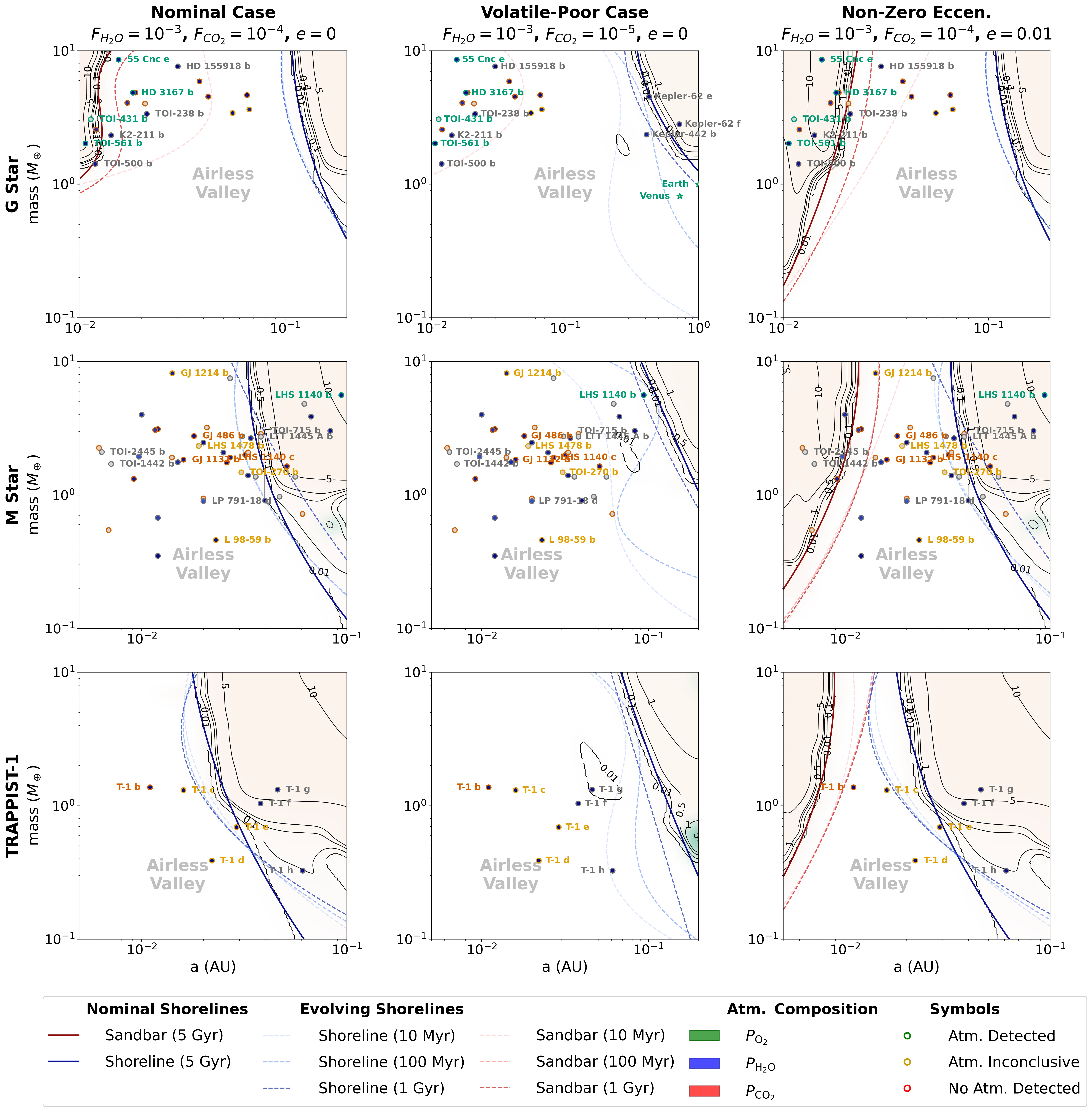
The classic 'cosmic shoreline' separated planets with atmospheres from bare rocky bodies based on the level of X-ray and ultraviolet irradiation. But new data from JWST and Spitzer break this picture: super-hot planets like 55 Cancri e have dense gas envelopes, while cooler worlds around red dwarfs, such as TRAPPIST-1 b, are bare rock. This work joins a line of research linking atmospheric evolution to planetary interiors: companion papers examine volcanic replenishment of atmospheres, lava oceans, and the behavior of volatiles in melts. But here, for the first time, two physical processes—magma degassing and gas escape—are combined into a single framework with two boundaries.
Methods
The authors used a model of coupled interior–atmosphere evolution, where a magma ocean, solidifying mantle, and gas envelope exchange water, carbon dioxide, and oxygen. They added hydrodynamic escape of hydrogen, oxygen, and carbon atoms driven by stellar X-ray and ultraviolet radiation, with new diffusion calculations. They computed a grid of 50 by 50 models varying planet mass and distance from the star for four stellar types, from G-dwarfs to ultracool M-dwarfs like TRAPPIST-1. They varied the initial volatile inventory and tidal heating to see how the boundaries of atmospheric survival move over time from 10 million to 5 billion years.
Results
The picture splits into three zones. Closest to the star is the 'cosmic shoal': planets there remain partially molten, and the magma holds almost all volatiles in solution, exposing only a thin atmosphere to escape. For example, for an Earth-mass planet with a steam atmosphere of 0.01 bar, the melt dissolves roughly 400 times more water than the gas envelope. Farther out lies the 'airless valley': the planet cools, the magma solidifies, and volatiles are outgassed just when escape is still strong—and are lost. Even farther out is the 'cosmic shoreline', beyond which atmospheres survive. The boundaries move over time and depend on planet mass: bodies lighter than 0.5–0.8 Earth masses almost always lose their atmospheres, while more massive ones may retain oxygen- or CO2-rich remnants. Around red dwarfs, the 'shoal' does not appear without sustained tidal heating, and around TRAPPIST-1 all planets except the most distant are likely bare.
Implications
This work for the first time separates atmospheric retention into two distinct physical regimes: degassing from magma and gas escape. It resolves the contradiction between the observed slope of the 'shoreline' and predictions of energy-limited escape—they simply describe different zones. Unlike companion studies that focus on individual processes—volcanism, lava oceans, or gas loss—here these processes are unified into a single evolutionary picture. This provides a tool for interpreting JWST observations and future missions: a planet in the 'airless valley' was not necessarily always bare, and a hot world with a thick atmosphere may be not an exception but a regular resident of the 'shoal'.
Future development
The model can be extended to nitrogen, post-solidification volcanism, and tectonics, which are currently not included. This would help understand whether islands with transient atmospheres can exist in the 'airless valley', as with L 98-59 b and its sulfur gases. It is also important to account for the role of primordial hydrogen envelopes and volatile redistribution during core formation. Such improvements will help better predict where to look for atmospheres on terrestrial planets.
Impact
The results will directly affect the interpretation of JWST data, especially the Rocky Worlds DDT program and TRAPPIST-1 observations. They will also help in target selection for future missions like HWO and Roman.
Next steps
The immediate next step is to include nitrogen and volcanic degassing after mantle solidification in the model. Then, predictions should be tested against new JWST data on hot rocky planets.
Key open problems
For planetary science, an open question remains: how are the initial volatile inventory, degassing history, and present-day atmosphere linked for rocky planets? This work shows that the answer depends on whether the planet experienced a long-lived magma ocean stage, and offers a way to test this using observable properties.
The knowledge machine's view
This section is addressed to the author of the paper and their colleagues. Neighbouring works were found by meaning-based search across our archive, not by word overlap. We do not review: we show the field around the work.
What the work does
The authors built a model of coupled interior-atmosphere evolution, combining magma degassing and hydrodynamic escape of gases. They computed a grid of models for different stars and planet masses, tracking atmospheric survival boundaries over time. As a result, they identified three zones: a hot 'cosmic sandbar', an 'airless valley', and a 'cosmic shoreline', explaining the contradictions observed by JWST.
Where its strength is
The strength of the work lies in merging two physics domains, retention of volatiles in magma and their loss from the atmosphere, into a single picture with two moving boundaries. This allows interpreting heterogeneous observations and provides a new tool for predicting the atmospheric fate of rocky planets.
Where it could go next
- Nearby is an analysis of 'reflation', where the atmosphere after complete loss can partially recover through degassing of the solidifying mantle. Perhaps your model should be extended to scenarios of gas reaccumulation, which would show how stable the 'airless valley' boundaries are in the long term.based on: Reflation: When a Planet Inhales After Exhaling arXiv:2607.13793
- In the archive, there is work on worlds with perpetual magma oceans, which considers long-term retention of volatiles in the melt. Your 'cosmic sandbar' relies on a similar mechanism; comparing their approaches to heat transfer and degassing could clarify under what conditions the sandbar persists for billions of years.based on: Worlds with Eternal Magma Oceans arXiv:2512.05816
- A quick review of hydrogen atmospheres on hot planets links them to volcanic replenishment. Your model predicts mostly oxygen or carbon dioxide remnants; it would be interesting to test how including hydrogen from the interior would shift the boundaries and the composition of surviving atmospheres.based on: Hydrogen Atmospheres on Scorching Planets: The Volcano Secret arXiv:2510.07378
Worth trying
- Test the 'reflation' scenario: set a complete atmospheric loss and see if it recovers from the mantle in your model.
- Compare the magma ocean lifetime in your model with predictions from the work on perpetual magma oceans for the same parameters.
- Add volcanic hydrogen supply and check whether it shifts the 'airless valley'.
Why this may matter
Such development would help connect the model with observations of secondary atmospheres and refine habitability criteria for planets around red dwarfs.
Nearby works in our archive
- How a Planet's Breath Shapes Its Fatesimilarity 0.57
- The Stellar Family Tree of Planetssimilarity 0.55
- Icy Pebbles: Why Some Comets Are Rich in Carbon Monoxidesimilarity 0.55
- How Tidal Waves Sort Planetssimilarity 0.55
- Reflation: When a Planet Inhales After Exhalingsimilarity 0.55
- Worlds with Eternal Magma Oceanssimilarity 0.55
- Hydrogen Atmospheres on Scorching Planets: The Volcano Secretsimilarity 0.54
The archive is sparse around this work: the closest review is only 0.57, against a usual 0.64. It looks like few have drilled nearby.
For an Earth-mass planet with a thin steam atmosphere, the magma ocean contains about 400 times more water than the atmosphere itself. The magma acts as a giant reservoir that hides volatiles from cosmic erosion.
Key numbers
- dissolved water inventory in magma: 400 times the atmospheric amount
- transition mass between regimes: 0.5–0.8 Earth masses
- peridotite melting temperature: 1420 K
- atmospheric pressure threshold: 0.01 bar
- eccentricity for tidal heating: 0.01