A Little Monster Fed by Its Neighbor ✛
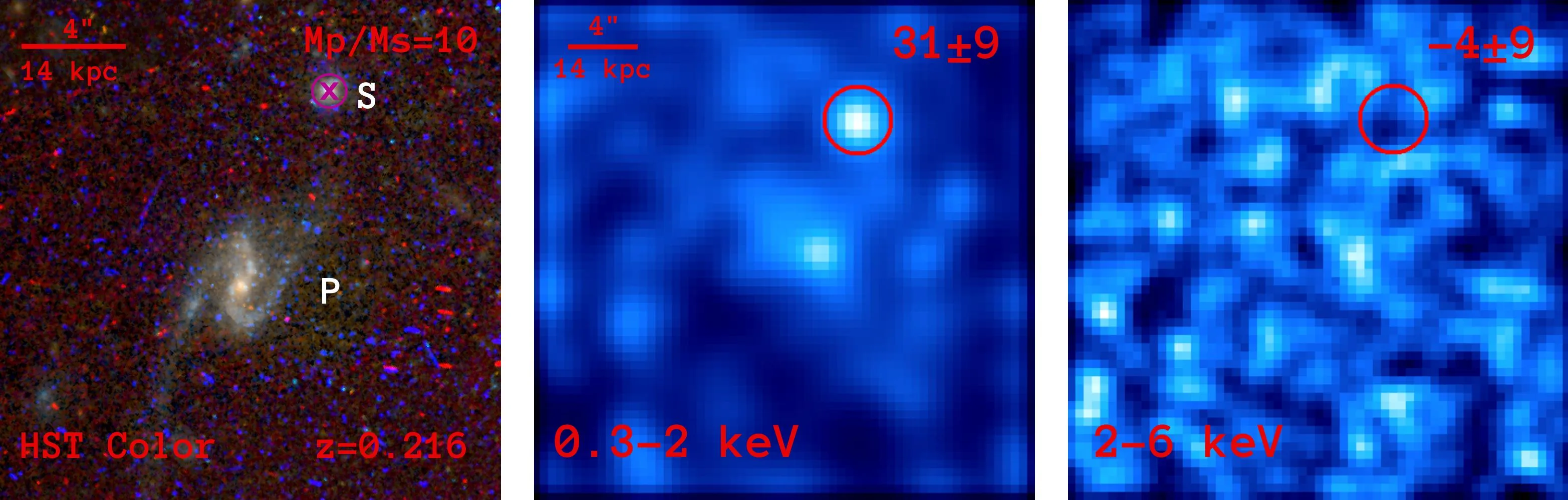
In a small galaxy, there's a black hole being fed by its neighbor. The satellite galaxy is slowly merging with a larger galaxy, and gas from the companion falls toward the center, where the black hole resides. It's not a giant, but it's not a lightweight either: its mass ranges from 800 to 5,000 solar masses. The Chandra telescope watched it for 16 years and caught just 31 photons, but these rare visitors revealed that the black hole is eating.
The photons arrive only in soft X-rays, like the warm glow of a lamp. That's how gas shines when it swirls around a black hole in a flat disk, like water in a funnel. The closer to the black hole, the hotter the gas, and from its temperature astronomers weighed the black hole itself. It turns out the black hole is feeding quite eagerly, but not at full throttle.
This case shows how small black holes grow: they get their meals from larger neighbors during galaxy mergers. Previously, this had only been seen in computer simulations, but now we have a real example. The method used to extract information from 31 photons will help find more such black holes in future surveys.
Chandra's total exposure of 6.6 million seconds is equivalent to 76 days of continuous observation. Yet the source yielded only about 31 useful photons, roughly one photon every 2.5 days.
Intermediate-mass black holes are a popular subject in science fiction, for example in the series 'Stargate Universe', where the crew of the ship Destiny uses such a black hole for recharging. This paper describes a real candidate that may resemble those that inspire screenwriters.