How a Small Neighbor Feeds a Little Monster ✛
Context
This work sits among studies of intermediate-mass black holes (IMBHs), which are the missing link between stellar-mass and supermassive black holes. Related papers in the archive address accretion onto black holes in dwarf galaxies, quasi-stars, gamma-ray bursts, and the influence of dark matter on black hole growth. This paper stands out because it is the first to describe in detail an accreting IMBH in a satellite galaxy during a minor merger, confirming predictions from numerical simulations about episodic rapid black hole growth in such systems.
Methods
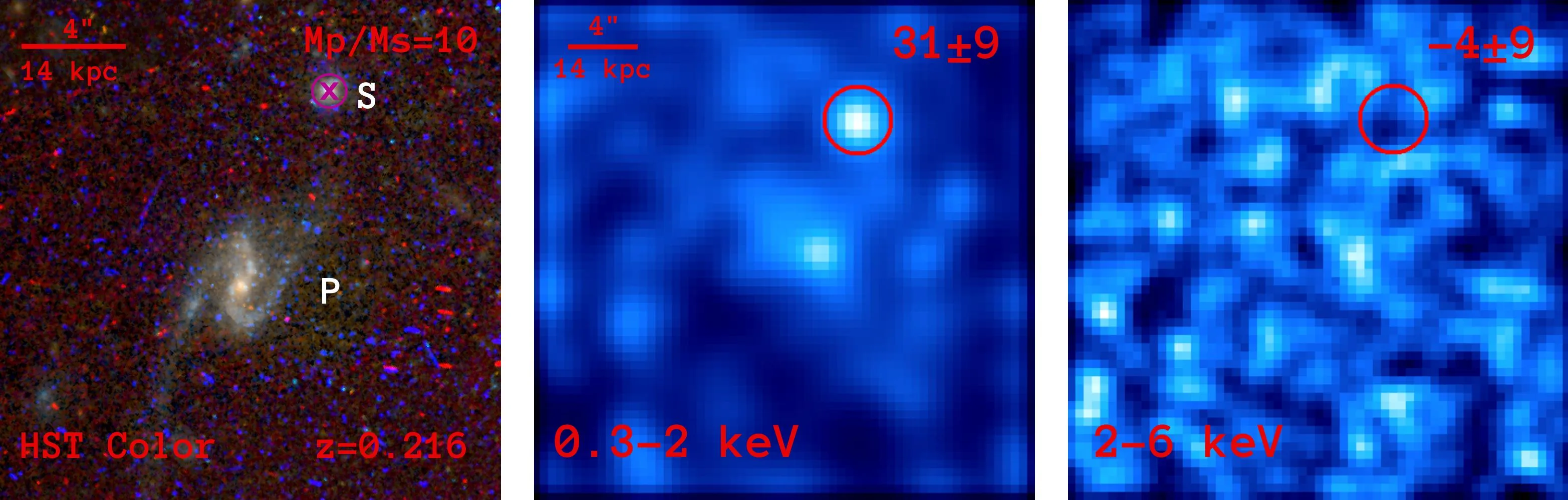
We used archival data from the Chandra X-ray Observatory: more than 100 individual observations from 1999–2016, combined into a total exposure of 6.6 million seconds. The source in the satellite galaxy at redshift z=0.216 appeared only in the soft band 0.3–2 keV, with no significant photons above 2 keV. Because of the small number of counts (31±9), standard spectral analysis is impossible, so we applied the Bayesian Estimation of Hardness Ratios (BEHR) and simulations of physically motivated spectral models convolved with the instrument response. We compared three models: a multicolor disk (diskbb), a disk with intrinsic absorption, and a power law.
Results
The observed count rates and hardness ratios are reproduced by a thermal accretion disk spectrum with an inner-edge temperature kT_in = 0.18–0.30 keV (rest frame) and luminosity log($L_X$/erg/s) = 40.5–41.2. Interpreting this within the standard thin disk model gives a black hole mass M ≈ 8×$10^2$–5×$10^3$ M_⊙ and an accretion rate of ≈0.2–0.5 Eddington. Alternative scenarios (ultraluminous X-ray sources, ultraluminous supersoft sources) are ruled out by luminosity, temperature, lack of variability, and the low star formation rate in the host galaxy. The source showed no significant variability over 16 years of observations.
Implications
Unlike related works that mostly model or search for IMBHs in other contexts, here we provide the first observational confirmation of episodic rapid black hole growth in a satellite galaxy during a minor merger. This fills a gap between simulation predictions and observations, and indicates that minor interactions may be an important channel for assembling supermassive black holes in dwarf galaxies. The Bayesian hardness ratio method for low-count sources can be applied to other faint sources.
Future development
This topic could develop toward systematic searches for accreting IMBHs in dwarf galaxies involved in interactions. Future X-ray missions with high sensitivity (e.g., Athena) and deep surveys will help find more such sources and measure their statistics. Also promising is studying the evolution of such systems over time to test predictions of multiple accretion episodes at pericenter passages.
Impact
The results will affect models of black hole growth in the early universe and our understanding of supermassive black hole formation. They are also important for interpreting data from future X-ray surveys and for planning observations.
Next steps
The next step is to search for similar systems in other deep survey fields and to obtain additional multiwavelength data (optical, infrared) to confirm the nature of the source. Also, more detailed modeling of the accretion disk, including possible absorption, is needed.
Key open problems
This work directly relates to the unsolved problem of the origin of supermassive black holes: how they grew to billions of solar masses within the first billion years after the Big Bang. Finding an IMBH in a minor merger supports the hierarchical growth scenario through mergers and accretion, but the question remains how universal and sufficient this channel is.
The knowledge machine's view
This section is addressed to the author of the paper and their colleagues. Neighbouring works were found by meaning-based search across our archive, not by word overlap. We do not review: we show the field around the work.
What the work does
The study analyzed archival Chandra observations (6.6 million seconds) of a dwarf satellite galaxy in a minor merger. It revealed an ultraluminous soft X-ray source with a thermal accretion disk spectrum (kT_in ≈ 0.18–0.30 keV) and a luminosity of ~10^40.5–10^41.2 erg/s. This is interpreted as an intermediate-mass black hole (800–5000 M_⊙) accreting at 20–50% of the Eddington limit, supporting the scenario of episodic IMBH growth in minor mergers.
Where its strength is
This provides the first observational confirmation of episodic rapid IMBH growth in a satellite galaxy during a minor merger, bridging the gap between simulations and observations. The Bayesian hardness-ratio method for low photon counts allows extracting physical parameters from faint sources.
Where it could go next
- It might be interesting to compare the accretion rate and IMBH mass with models of black hole growth via gas accretion from dying stars in dwarf galaxies, to evaluate how well such a channel can explain the observed luminosity.based on: A vacuum cleaner at the heart of a dwarf: how a black hole gathers gas from dying stars arXiv:2608.25856v1
- A related work on quasistars (objects with a black hole inside a massive gas envelope) suggests that comparing the properties of the ultraluminous soft source with predictions for quasistars could help clarify the nature of the accretion flow.based on: Quasi-stars: Cocoons with a Black Hole Inside arXiv:2603.21714
- The archive contains an analysis of dark matter's influence on the formation of invisible stars; one could consider how the dark matter distribution in the dwarf satellite galaxy might have affected gas dynamics and the accretion rate onto the IMBH.based on: Triple Thread: How Vector Dark Matter Gives Birth to Invisible Stars arXiv:2607.18025v1
Worth trying
- Test how well the observed luminosity matches accretion models from stellar winds in dwarf galaxies.
- Compare the source's spectral parameters with theoretical quasar spectra.
- Assess the impact of dark matter on gas dynamics in the satellite galaxy using simulations.
Why this may matter
This discovery demonstrates that minor mergers could be an important channel for the growth of supermassive black holes, especially in dwarf galaxies, and the proposed method for analyzing faint sources can be applied to other objects.
Nearby works in our archive
- A vacuum cleaner at the heart of a dwarf: how a black hole gathers gas from dying starssimilarity 0.55
- Cosmic Kneading: Turbulent Amplification of Magnetic Fields in Newborn Neutron Starssimilarity 0.54
- Cosmic Hot Tap: How Primordial Black Holes Rewrite the Speed of the Universesimilarity 0.53
- Stellar Wanderers in the Mass Gapsimilarity 0.53
- Triple Thread: How Vector Dark Matter Gives Birth to Invisible Starssimilarity 0.52
- Cosmic Searchlight in the Fog: How Quasars Illuminate Their Halossimilarity 0.52
- Quasi-stars: Cocoons with a Black Hole Insidesimilarity 0.52
The archive is sparse around this work: the closest review is only 0.55, against a usual 0.64. It looks like few have drilled nearby.
Chandra's total exposure of 6.6 million seconds is equivalent to 76 days of continuous observation. Yet the source yielded only about 31 useful photons, roughly one photon every 2.5 days.
Intermediate-mass black holes are a popular subject in science fiction, for example in the series 'Stargate Universe', where the crew of the ship Destiny uses such a black hole for recharging. This paper describes a real candidate that may resemble those that inspire screenwriters.
Key numbers
- Chandra exposure: 6.6 million seconds (76 days)
- Disk temperature: 0.18–0.30 keV (about 2–3.5 million K)
- Black hole mass: 800–5000 solar masses
- Luminosity: 1040.5–1041.2 erg/s
- Accretion rate: 0.2–0.5 Eddington