How a Small Neighbor Feeds a Little Monster ✛
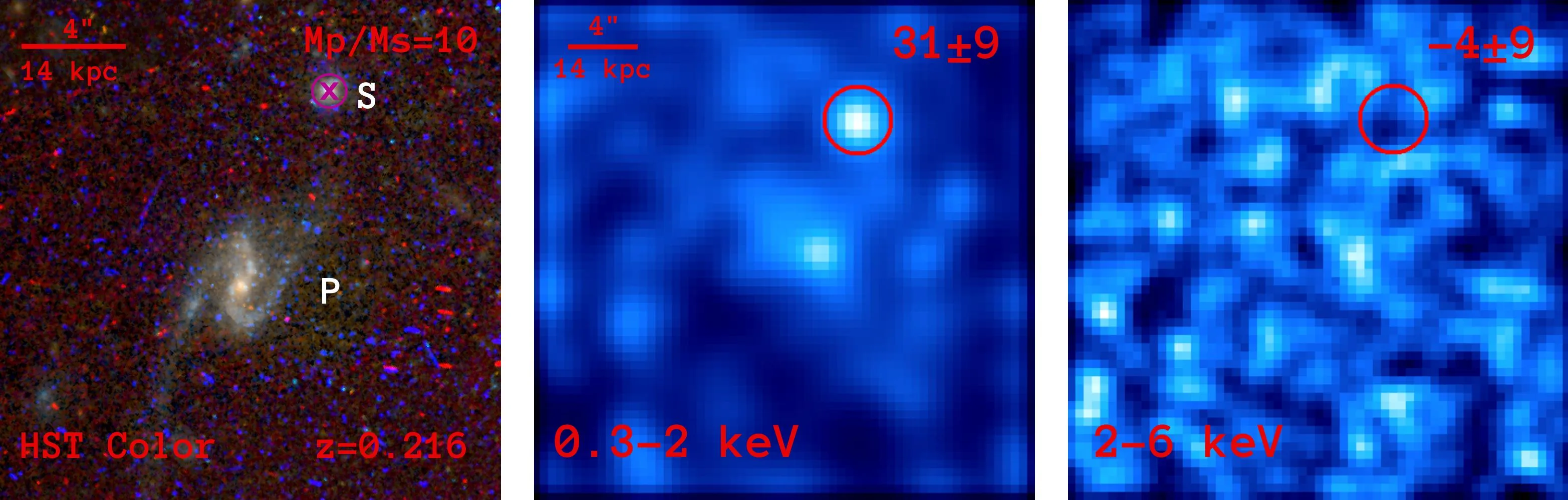
A little monster hides in a dwarf galaxy, and its neighbor feeds it. The satellite galaxy is slowly merging with a massive companion, and gas from the outer regions falls toward the center, where a black hole sits. By cosmic standards, it is not large: only 800 to 5000 solar masses, but its appetite is ferocious. The Chandra X-ray Observatory watched it for sixteen years and collected only about thirty-one photons, yet each one told a story.
The photons arrive only in the soft X-ray band, as if someone had switched on a lamp with warm light. The temperature of this lamp is about two to three million degrees, and its luminosity is a hundred billion times that of the Sun. This is how hot gas shines as it swirls around a black hole in an accretion disk before falling past the horizon. The disk is thin, hot at its inner edge, and its temperature lets you weigh the black hole itself.
The astronomers applied Bayesian hardness-ratio analysis to squeeze the most out of thirty-one photons. This method compares how many photons arrive in different energy bands and fits a physical model that best explains the data. It turned out that a simple power-law spectrum does not fit, but an accretion disk model fits perfectly. So this is not a pulsar or a supernova remnant, but a disk around a black hole.
The proximity of the massive galaxy is no coincidence. Numerical simulations have long predicted that during minor mergers, gas can flow into the center of the satellite and trigger accretion outbursts. Now we have a real example: the little monster gets its food from its big neighbor. This explains how black holes in dwarf galaxies could grow rapidly in the early universe, accumulating mass for future supermassive giants.
The method used for this faint source will also be useful for other weak objects. Deep surveys by future X-ray missions such as Athena will find hundreds of similar systems, and then we can gather statistics on black hole growth. For now, Chandra holds an archive in which even thirty-one photons can reveal a new monster.
Chandra's total exposure of 6.6 million seconds is equivalent to 76 days of continuous observation. Yet the source yielded only about 31 useful photons, roughly one photon every 2.5 days.
Intermediate-mass black holes are a popular subject in science fiction, for example in the series 'Stargate Universe', where the crew of the ship Destiny uses such a black hole for recharging. This paper describes a real candidate that may resemble those that inspire screenwriters.