Ion Liquid: How a Trap Revealed the Transition to Gas ✛
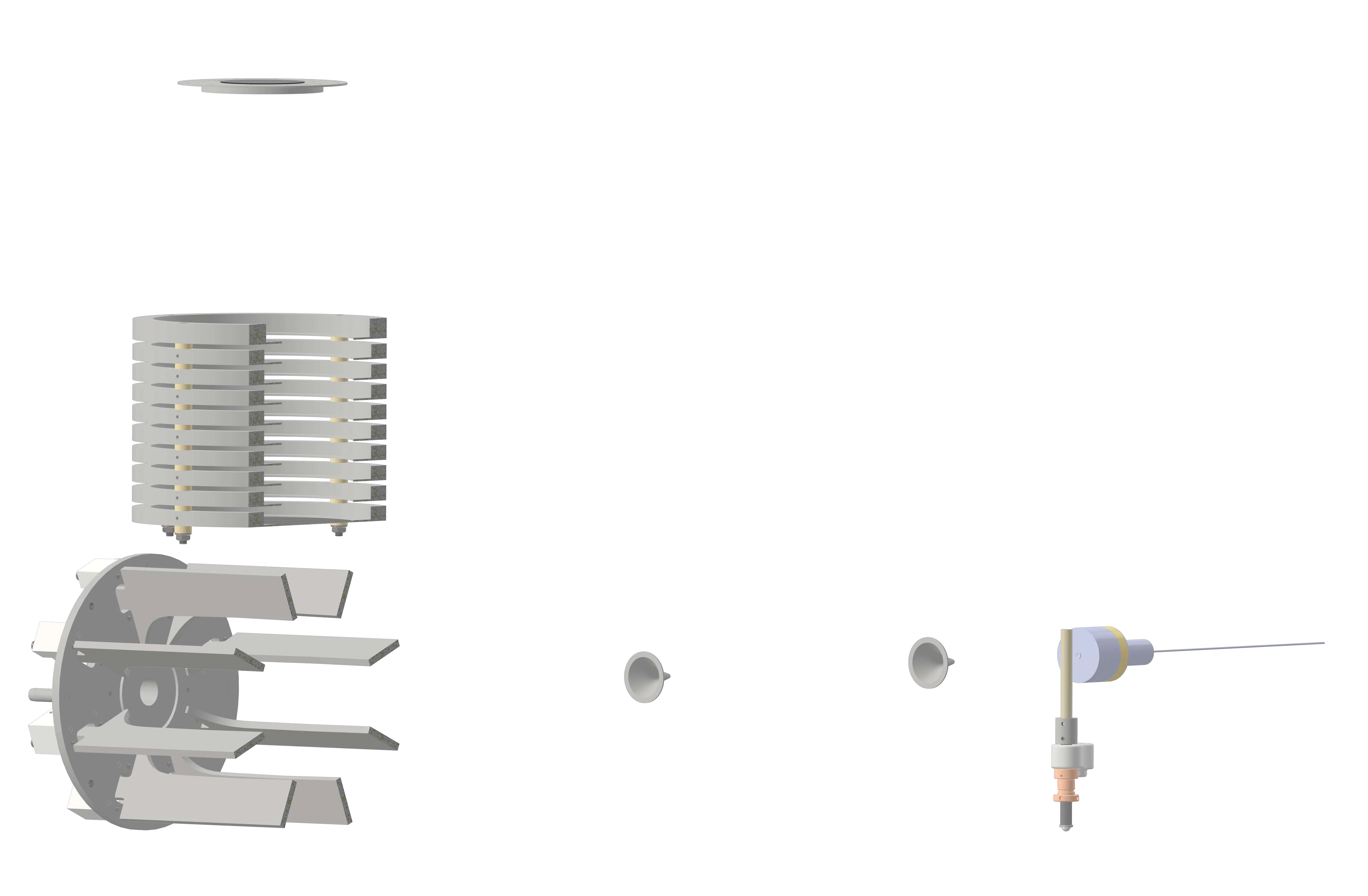
In the dark chamber of the trap, thousands of charged particles dance under electric fields. At first they move freely, like a crowd in a square, but cool the cloud and the dance slows: ions begin to sense each other, their steps become constrained. At some point, motion freezes entirely, and the cloud turns into something like a liquid, where each particle jiggles in place but cannot drift far. This transition from gas to liquid has now been observed directly for the first time, by measuring the velocities of all ions simultaneously.
For a long time, the liquid phase of ion clouds existed only in computer simulations. Experimenters could create a dilute gas, where ions barely interact, and a crystal, where they are locked into a rigid lattice. The intermediate state, resembling a liquid, remained elusive: to catch it, one must measure the velocities of thousands of particles in an instant without destroying the cloud. The Technion group solved this by building a trap with eight electrodes and a velocity detector that ejects ions onto a luminescent screen.
The key trick of the experiment is that the ejection field is uniform: it shifts all velocities equally without distorting their spread. The physicists laser-cooled ytterbium-174 ions, then let the cloud heat up for intervals ranging from one millisecond to nearly eight seconds. After each interval, they took a "snapshot": they ejected the ions into the detector and obtained a velocity map. The width of this map revealed how strongly the ions interacted.
In hot clouds, ions moved independently, like a gas, with an oscillation frequency of about 6.3 kilohertz, meaning an ion completes six thousand full swings per second. As the cloud cooled, mutual repulsion slowed the motion, and the frequency dropped. At the lowest temperatures, it fell to zero: ions became stuck in place, retaining only collective jitter. That is the birth of the liquid. The transition occurred at a coupling parameter of Γ = 0.6(1), whereas simulations typically predicted Γ ≈ 2. In other words, the liquid appears earlier than expected.
Additionally, the authors found a density threshold: when heating beyond 510 milliseconds, the rate of temperature increase changed its power-law exponent from 0.485(4) to 0.316(2). This means that below the threshold, the density is nearly constant, while above it, the cloud expands like a gas. That same dance, which began as the free movement of a crowd, ends with particles drifting apart, losing contact with one another.
The oscillation frequency of ions in the trap is about 6 kilohertz, meaning an ion completes six thousand full swings per second. At the lowest temperature, this frequency drops to zero: ions literally freeze in place, even though the temperature is not absolute zero.
In Arthur C. Clarke's novel 'Rendezvous with Rama,' dense clouds of charged particles behave like a liquid. Experiments with ion traps bring such exotic phenomena closer to laboratory reality.