Ion Liquid: How a Trap Revealed the Transition to Gas ✛
Context
Ion clouds in traps serve as working tools for precision clocks, quantum computing, and simulating collective phenomena. Two extreme states are well studied: a dilute gas, where ions barely interact, and a crystal, where they are arranged in a rigid lattice. The intermediate liquid phase, important for understanding the interiors of white dwarfs and plasmonic effects in nanophotonics, has so far been described mainly by computer simulations. Direct experiments have been stymied by the lack of a way to measure ion velocities without destroying the cloud. This work stands apart: neighboring studies in the archive address ion dynamics in traps, quantum simulators, and plasma waves, but none have traced the liquid–gas transition itself through internal velocities.
Methods
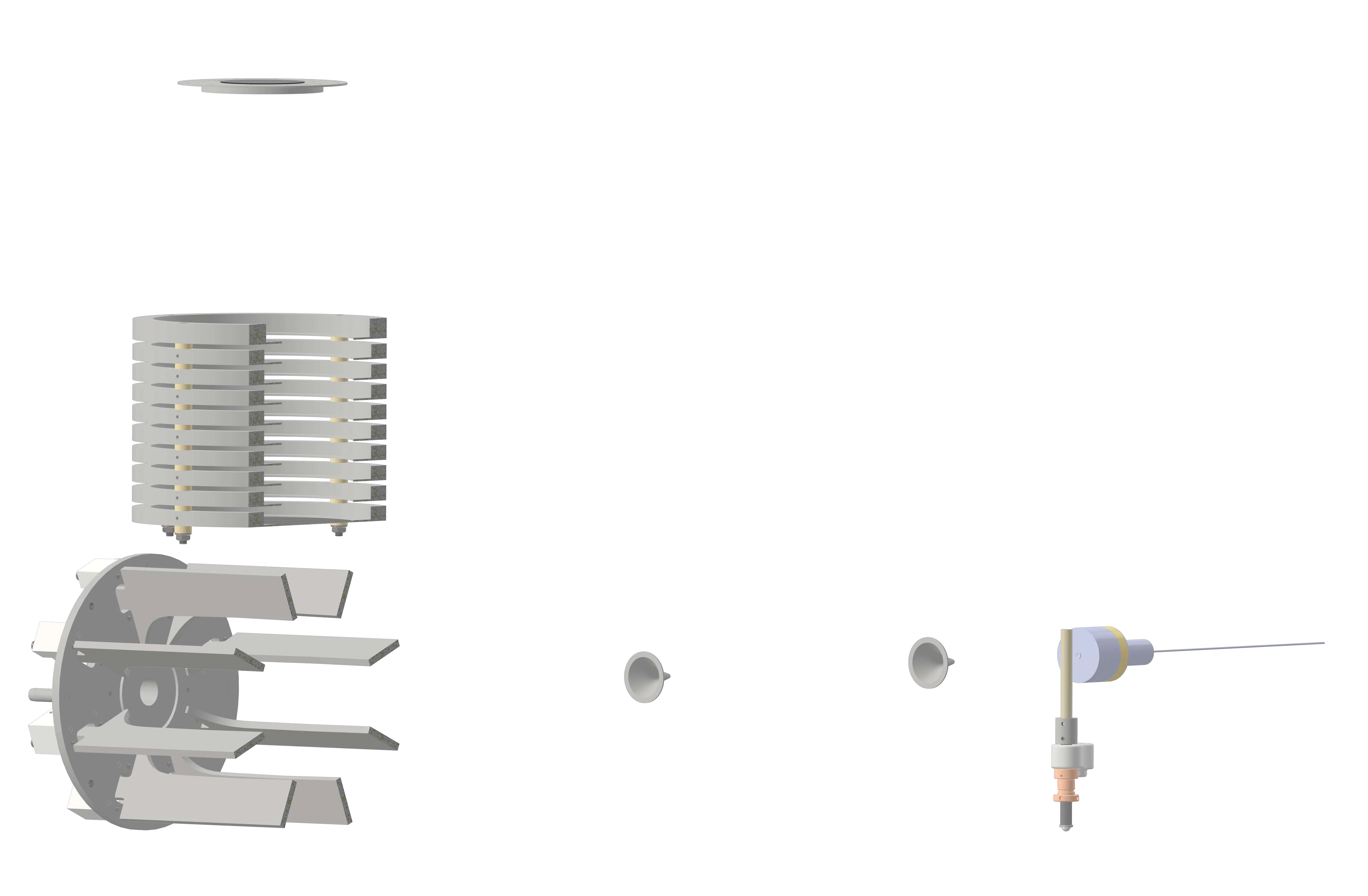
The researchers built a radio-frequency trap with eight electrodes that can quickly switch from confinement mode to a uniform expulsion field. Ytterbium-174 ions were laser-cooled for 450 milliseconds, then the cloud was allowed to passively heat for a set time. After that, the cloud was expelled into a velocity detector that maps the velocity distribution onto a luminescent screen. The key trick is that the expulsion field is uniform: it shifts all velocities equally without distorting their spread. By varying the heating time from 1 millisecond to 7.75 seconds, the authors obtained a series of 'snapshots' of the cloud at different temperatures.
Results
The width of the velocity distribution proved to be a sensitive indicator of the cloud's internal dynamics. In hot clouds, ions moved independently, like a gas, with an oscillation frequency of about 6.3 kilohertz. As they cooled, mutual repulsion slowed their motion, and the frequency dropped. At the lowest temperatures, the frequency fell to zero: ions became stuck in place, retaining only collective jitter. That is the birth of a liquid. The transition occurred at a coupling parameter Γ = 0.6(1), whereas simulations typically predicted Γ ≈ 2. Additionally, the authors found a density threshold: when heating beyond 510 milliseconds, the rate of temperature increase changed its power-law exponent from 0.485(4) to 0.316(2). This means that below the threshold, density is nearly constant, while above it, the cloud expands like a gas.
Implications
Direct velocity measurement revealed what was previously accessible only to models. Unlike neighboring studies, where the liquid phase was inferred from indirect signs such as fluorescence or cloud shape, here the transition was tracked through internal ion motion. The result shifts the boundary of the liquid state toward smaller values of the coupling parameter, which is important for astrophysical estimates of dense plasma. The method also sets a new standard of resolution: achieving an accuracy of 8.5 meters per second while simultaneously registering thousands of ions.
Future development
The next step could be studying photodissociation of molecular ions, where a velocity map of reaction products would reveal internal quantum states. The method's resolution in such experiments would be higher than here, since it is not limited by the spot size from thousands of ions. Another direction is cold collisions of molecular ions, where precise velocity information before and after interaction is crucial. In the longer term, the technique could be used to search for parity violation in chiral molecular ions.
Impact
The results will influence models of dense plasma in astrophysics and understanding of electron hydrodynamics in metals for nanophotonics. Technically, the method will be in demand in quantum chemistry and precision spectroscopy.
Next steps
Plans include applying the trap with a velocity detector to molecular ions to map quantum states via photodissociation. Also, collisions of cold molecular ions with velocity control will be studied.
Key open problems
For ultracold plasma physics, the exact boundary between liquid and gas behavior under different trap parameters remains an open question. It is unclear how the transition depends on ion number and the shape of the confining potential. Also unsolved is the microscopic description of viscosity in ion liquids.
The knowledge machine's view
This section is addressed to the author of the paper and their colleagues. Neighbouring works were found by meaning-based search across our archive, not by word overlap. We do not review: we show the field around the work.
What the work does
The authors built a radio-frequency trap with eight electrodes that switches rapidly into a uniform push-out field mode, and paired it with a velocity detector. By laser-cooling a cloud of ytterbium-174 ions and then letting it heat passively, they captured a series of snapshots of the velocity distribution at different temperatures. From the width of the distribution, they tracked the transition from gas-like to liquid-like behavior, finding that it sets in at a coupling parameter Γ ≈ 0.6, lower than simulation predictions, and that the cloud's density jumps abruptly at a certain temperature.
Where its strength is
Directly measuring ion velocities without distorting their spread made it possible to see the internal dynamics of the transition, which until now had been accessible only to models. This provides a new tool for studying phase transitions in systems with long-range interactions.
Where it could go next
- The uniform push-out and velocity detection method can be applied to more complex ion mixtures, to trace how different masses and charges affect the position of the liquid-gas transition. Closely related is work on how a silver ion captures oxygen in a trap, where the interaction dynamics of different particles in a confining field were studied.based on: How a Silver Ion Traps Oxygen in a Trap arXiv:2601.09862
- The observed density jump on heating resembles phase transitions in other systems with long-range interactions, such as vortex lattices in superconductors, where coexistence of solid and liquid phases is also seen. Analogies from that work might help interpret the threshold behavior of the ion cloud.based on: Vortices in a Superconductor: Solid and Liquid arXiv:2601.18247
- To connect with astrophysical applications such as dense plasma in white dwarfs, it may be useful to compare the results with studies of plasma waves in inhomogeneous media, where collective effects and local parameters similar to the coupling parameter are important.based on: How Plasma Waves Learn to Live with Inhomogeneity arXiv:2607.16779
Worth trying
- Check whether the found value Γ ≈ 0.6 for the transition holds when the number of ions or the trap shape is changed.
- Use the method to study mixtures of ions with different masses, to see how phase separation depends on composition.
- Compare the density jump with the behavior of vortex matter in superconductors, where there is also a transition from an ordered lattice to a liquid.
Why this may matter
Direct velocity measurements in ion clouds open the way to experimentally testing theories of phase transitions in systems with long-range interactions, which matter for understanding dense plasma in astrophysics and for controlling quantum simulators.
Nearby works in our archive
- How a Silver Ion Traps Oxygen in a Trapsimilarity 0.56
- Pair Tango Inside the Protonsimilarity 0.55
- How Plasma Waves Learn to Live with Inhomogeneitysimilarity 0.54
- A Jump Instead of a Smooth Slide: How Neutron Stars Give Themselves Awaysimilarity 0.54
- Bubbles Trapped in Icesimilarity 0.53
- Light Atoms Get Stuck in a Dense Gassimilarity 0.53
- Vortices in a Superconductor: Solid and Liquidsimilarity 0.52
The archive is sparse around this work: the closest review is only 0.56, against a usual 0.64. It looks like few have drilled nearby.
The oscillation frequency of ions in the trap is about 6 kilohertz, meaning an ion completes six thousand full swings per second. At the lowest temperature, this frequency drops to zero: ions literally freeze in place, even though the temperature is not absolute zero.
In Arthur C. Clarke's novel 'Rendezvous with Rama,' dense clouds of charged particles behave like a liquid. Experiments with ion traps bring such exotic phenomena closer to laboratory reality.
Key numbers
- ion oscillation frequency in gas phase: 6.3 kHz
- liquid-state threshold by coupling parameter: Γ = 0.6(1)
- maximum-density threshold by coupling parameter: Γ = 0.06(1)
- heating time to density threshold: 510(40) ms
- velocity resolution: 8.5 m/s