S. Han

5 articles · 30 co-authors · latest: 2026-08-21
7,051 citations · h-index 41 · 588 papersData: Semantic Scholar

We have retold 5 papers by this author. most often about: quark, Standard Model, neutrino. 30 co-authors across our retellings.

Links in the knowledge graph
HEP Experiment2026-03-301 minarXiv:2603.28456express
Two-Charm Baryon Caught for the First Time
In proton collisions at the Large Hadron Collider, physicists have for the first time caught a particle with two charm quarks. It is called Ξcc+ (pronounced "ksi-ksi-plus") and resembles a bead with not one but two heavy nuclei.
High Energy2026-04-091 minarXiv:2604.07702express
The Neutrino Sky Sentinel
Deep beneath Japan's Mount Ikeno sits a tank holding 50,000 tons of the purest water. Inside, it catches neutrinos — ghostly particles that zip through Earth as if it weren't there. When a star explodes in our galaxy, neutrinos arrive first, hours before the light.
HEP Experiment2026-04-131 minarXiv:2604.10975express
The Hunt for Proton Decay
Inside every atom lives a proton. For a long time, it was considered as eternal as matter itself. But theories that unify all forces of nature predict that, sooner or later, the proton will decay. The only question is how long we have to wait. In the Japanese detector Super-Kamiokande — a giant tank of ultra-pure water — physicists searched for signs of such a decay.
HEP Experiment2026-08-172 minarXiv:2608.16063express
How Neutrinos Play Billiards with Protons in Water
Neutrinos are nearly elusive particles that pass through Earth without noticing it. But sometimes one slams into an atomic nucleus in water, and a whole shower of particles is born: muons, protons, pions. Catching that moment is like photographing a bullet hitting an apple from a kilometer away.
HEP Experiment2026-08-211 minarXiv:2608.21082express
How a Heavyweight Particle Decays
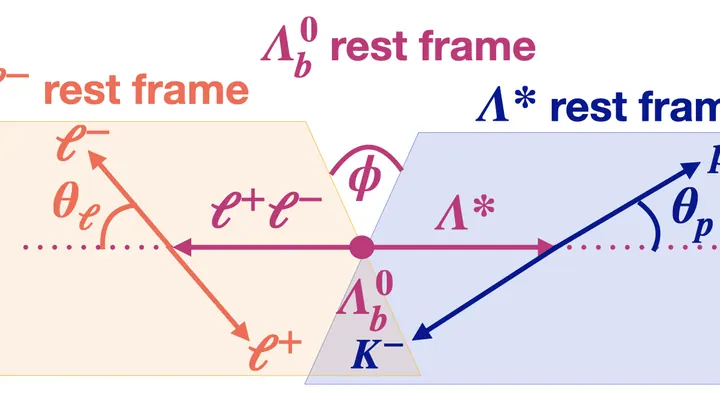
At the Large Hadron Collider, protons are smashed together, and among the debris, a heavyweight particle, the lambda baryon, sometimes appears. It lives for a tiny fraction of a second before decaying into other particles.