The η_c (eta-c) meson is a charmonium state, meaning it is composed of a charm quark and its antiquark, just like the J/ψ, but with different quantum numbers. Specifically, the η_c is the spin-singlet ground state of charmonium, with spin 0 and negative parity, while the J/ψ is the spin-triplet state with spin 1. The η_c is a short-lived particle, with a lifetime of about 2×10⁻²³ seconds, decaying predominantly via the strong force into lighter hadrons. Its rare decays, such as into two photons, are of particular interest because they proceed via electromagnetic interactions and can be calculated with high precision in the Standard Model, making them sensitive probes for new physics.
History
The η_c was first observed in 1980 at the SLAC and DESY laboratories, following the discovery of the J/ψ. Its identification was part of the systematic exploration of charmonium states predicted by the quark model.
How it works
The η_c is produced in particle collisions, often through the decay of heavier charmonium states like the ψ(2S) or in B-meson decays. Its decays are reconstructed by detecting the final-state particles, such as photon pairs or hadronic jets. The branching fraction for η_c → γγ (two photons) is predicted by the Standard Model to be around 2.45 per 10,000, and measuring this rate accurately tests our understanding of quark-antiquark bound states and the role of the strong force. Any significant deviation from the predicted value could indicate contributions from new particles or interactions.
In practice
The η_c is used in precision tests of quantum chromodynamics (QCD), the theory of the strong force, and in searches for physics beyond the Standard Model, particularly in experiments at B-factories like Belle II and LHCb.
Fun fact
The η_c is sometimes called the 'charmonium ground state' because it is the lowest-energy bound state of a charm quark and its antiquark, even though it is heavier than the J/ψ in mass due to its different spin configuration.
In 1946, proposed a method that revolutionized archaeology: determining age by the decay of radiocarbon. The clock ticks: every 5730 years, half of the atoms vanish. But why so slowly? For a light nucleus, this is an anomaly — typical lifetimes are millions of times shorter. The mystery held for seven decades.
Holding a phone number in your head while people shout and slam doors around you is nearly impossible. That's roughly the life of a quantum bit, a qubit, in an ordinary material: the nuclei of neighboring atoms, like tiny magnets, constantly jostle it and erase information. To keep a qubit from forgetting, you need to find it a quiet spot.
Quarks are the tiny building blocks that make up protons and neutrons. Usually, they stick together in pairs: a particle and its mirror-image antiparticle. But sometimes quarks form more exotic combinations, which physicists call exotic states.
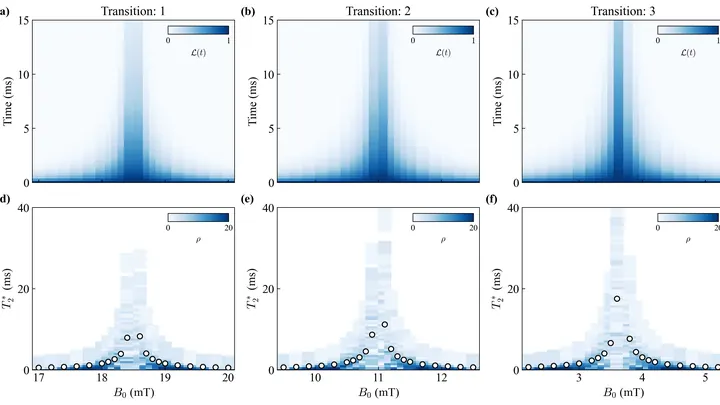
A spinning top, set in motion on a perfect surface, topples from the slightest tremor. Likewise, a quantum bit, created at a defect in a diamond, has its state destroyed by magnetic disorder from impurities and external interference.
In proton collisions at the Large Hadron Collider, physicists have for the first time caught a particle with two charm quarks. It is called Ξcc+ (pronounced "ksi-ksi-plus") and resembles a bead with not one but two heavy nuclei.
In the BEPCII accelerator, electrons and positrons collide, producing billions of particles. Among them is the J/ψ meson, which lives for less than a billionth of a second. Its decay sometimes yields an eta meson (ηc), an even shorter-lived clump of quarks.
At a particle accelerator in Beijing, electrons collide with positrons, and for a fleeting moment, a particle called eta-c is born. It lives for a tiny fraction of a second and then decays into other particles. One of the rarest paths is to split into two photons, particles of light. Until now, no one could say exactly how often this happens.
A magnetic compass in a test tube sounds like a magic trick, but it's pure physics. In a solution of fumarate (a salt of malic acid), carbon-13 nuclei behave like tiny spinning tops.
In 1976, Gerard 't Hooft noticed that the vacuum of a gauge theory is not as simple as it seems: it possesses a topological structure that manifests itself in a nonzero topological susceptibility.
A tuning fork cut from a perfect metal rings at a single frequency. Its sound is as pure as a mathematical formula. But clamp it in a vise or dip it in a viscous liquid, and the tone smears, picks up noise, and loses its sharpness. The nucleus of scandium-45 behaves much the same way when placed in a crystal lattice.