Tansu Daylan

4 articles · 30 co-authors · latest: 2026-06-24
3,980 citations · h-index 32 · 126 papersData: Semantic Scholar

We have retold 4 papers by this author. most often about: exoplanet atmosphere, exoplanet, red dwarf. 30 co-authors across our retellings.

Links in the knowledge graph
Exoplanets2025-10-061 minarXiv:2510.04863express
The Invisible Planet in a Carbon Cocoon: How a Hot Neptune Cheated Death
Astronomers couldn't understand why the 'hot Neptune desert' — a region right next to stars — has almost no Neptune-sized planets. It was thought that there they are doomed: the star's proximity boils off the atmosphere, leaving a bare rocky core. But the exoplanet LTT-9779 b, 29 times heavier than Earth and with a 19-hour orbit, survived.
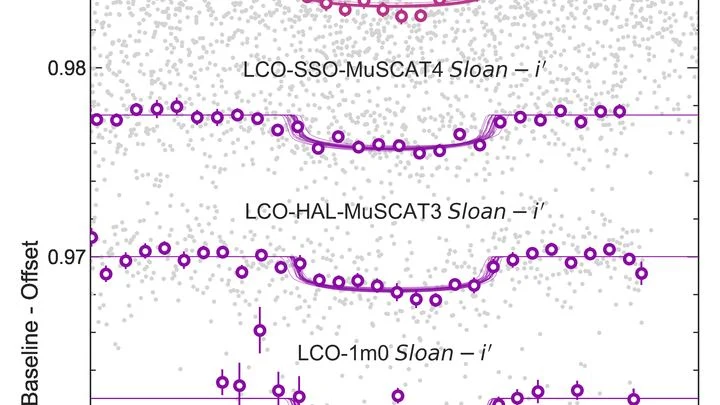
Exoplanets2026-01-092 minarXiv:2601.05799express
A Warm Belt Around Red Dwarfs
Two new planets are circling dim red stars. One is nearly the size of Earth, the other is three and a half times larger. Both lie in what astronomers call the warm zone: a region where starlight doesn't scorch the surface but also doesn't leave it in perpetual cold. The host stars are red dwarfs, the most common stars in the galaxy.
Exoplanets2026-01-161 minarXiv:2601.11280express
Cold Jupiters: Invisible Giants on the Outskirts
Jupiter is a colossal ball of gas that sits five times farther from the Sun than Earth. Now imagine a similar ball, but around another star, at a distance tens of times greater. These are called cold Jupiters, and they remain a puzzle: how did they get there? Astronomers studied four such planets around distant stars.
Exoplanets2026-06-241 minarXiv:2606.26075express
A Mirror Planet in the Neptunian Desert
Hundreds of light-years away, there's a planet that looks like a giant mirror. LTT9779b reflects most of the light that hits it — far more than you'd expect from a Neptune-sized body. Astronomers have long debated what makes it so shiny: a thick carbon-rich haze or a layer of clouds. The James Webb Space Telescope has helped settle the debate.
