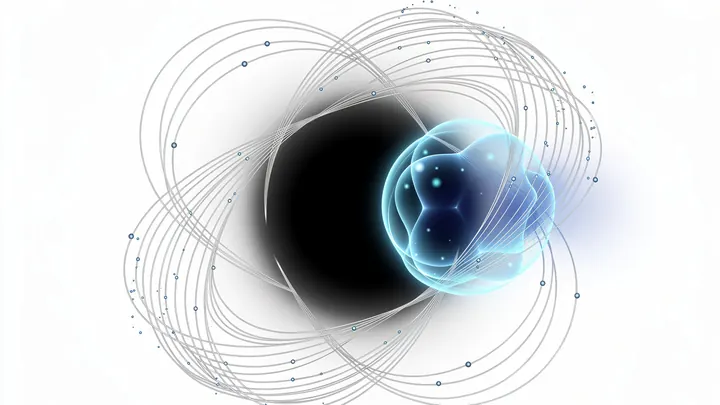
Black hole light echoes are the delayed, reflected signals of light that was originally emitted near a black hole's event horizon. When a burst of radiation, such as from a flare or an accretion event, occurs close to a black hole, some of that light escapes directly, but some is bent by the extreme gravity and can be reflected off the surrounding material or even loop around the black hole before reaching an observer. This creates a series of 'echoes' — repeated, fainter copies of the original signal arriving with time delays. These echoes carry detailed information about the black hole's mass, spin, and the geometry of the surrounding space-time, as well as the structure of the accretion disk or any reflective material nearby.
History
The concept of light echoes around black holes was first explored in the 1970s, but it gained significant attention in the 2010s with the detection of quasi-periodic oscillations in X-ray flares from stellar-mass black holes, which were interpreted as echoes.
How it works
The mechanism is a combination of general relativity and geometry. Light passing near a black hole follows curved paths due to gravitational lensing. Some photons can be deflected by more than 90 degrees, effectively bouncing off the gravitational well and returning to the observer after traveling a longer path. If there is a reflective surface, such as a disk of hot gas or a companion star, the light can also physically reflect off that material. The time delay between the direct signal and the echo depends on the distance the light traveled, which is set by the black hole's mass and spin. By measuring these delays, astronomers can map the warped space-time around the black hole, much like using sonar to map a cave.
In practice
Light echoes are used to measure the properties of black holes, including their spin and the structure of their accretion disks, and to test predictions of general relativity in strong-field regimes.
Fun fact
The 'echo' of a black hole can be thought of as a 'gravitational mirror' — the black hole itself bends light so strongly that it can reflect radiation back toward the source, creating a natural time-delayed feedback loop.
A numerical factor that depends on the frequency integration limits and the specific definition of 'average' (e.g., over the full spectrum). — proportionality constant = 2.701
k_B
constant
Fundamental constant converting temperature to energy scale — boltzmann constant= 1.380649e-23joule per kelvin
⟨ ⟩
operator
Statistical average over the photon distribution — ensemble average
Space is full of invisible waves — ripples in the fabric of spacetime left behind by cataclysms like black hole mergers. An ordinary black hole swallows everything without a trace. But there are hypothetical exotic objects — ultradense clumps of matter without an event horizon (a surface from which not even light can escape).
The Universe is a giant concert hall, where instead of walls and balconies, invisible clouds of dark matter float. This architectural ensemble is not static: it refracts and scatters the 'music' rushing through it — gravitational waves from merging black holes.
In a close binary system, the hot star, like a searchlight, illuminates its cooler companion. Some of the light scatters off free electrons in its atmosphere — this is Thomson scattering — and acquires linear polarization. As the stars orbit each other, this polarization rotates, like the hand of a peculiar cosmic metronome.
Two dead stars circle in a final dance. Their approach creates ripples in space — gravitational waves. But there may be a third, invisible partner in this dance. Its gravity accelerates the pair, and the signal changes pitch slightly, like the siren of a passing car.
A black hole is not a frozen void, but a living magnetic engine. Its 'heart'—the accretion disk, pulsates: inhale, matter spirals into the funnel, exhale — magnetic reconnection tears the field lines, and plasma shoots away from the horizon.
A giant black hole tore apart a star, leaving behind a lopsided disk of scorching gas — like a vinyl record warped by the heat. Now a tiny black hole (or a star) zips around and repeatedly pierces that disk. Each puncture is a bright X-ray flare.
Place two identical alarm clocks on a table and set them off at the same time. If one is on a slippery surface and starts to slowly slide, its timing will be thrown off, and within a minute they'll ring out of sync. That's roughly how the new method proposed by astrophysicists for supermassive black holes works.
Einstein and Rosen imagined a bridge connecting two sheets of reality. Wheeler gave it a name — wormhole, and Thorne with Morris proved: the tunnel is traversable if you fill it with exotic matter.
The black hole GRS 1915+105 usually hides behind a dense gas curtain: its X-ray emission is heavily absorbed on its way to us. But in April 2023, it suddenly flared: the X-ray flux jumped nearly tenfold.
Hidden in the heart of the Alps is the Large Hadron Collider. From time to time its detectors register sudden bursts — scientists call them UFOs (Unidentified Falling Objects). According to one theory, these are not equipment malfunctions at all, but traces of dark matter.
An ordinary black hole is an abyss into which everything falls irretrievably. But a new model paints a different picture: at its edge, time freezes, and the hole becomes a frozen whirlpool. Light and matter don't fall in but stick fast to the surface — causing a bright spot to appear within the shadow.
Dark energy and dark matter are the invisible conductors of the cosmos. Usually considered independent, new research proposes seeing them as dance partners. The lead — dark energy — changes the mass of dark matter particles. Like a dancer who lifts and lowers their partner, dark energy increases or decreases the weight of dark matter.
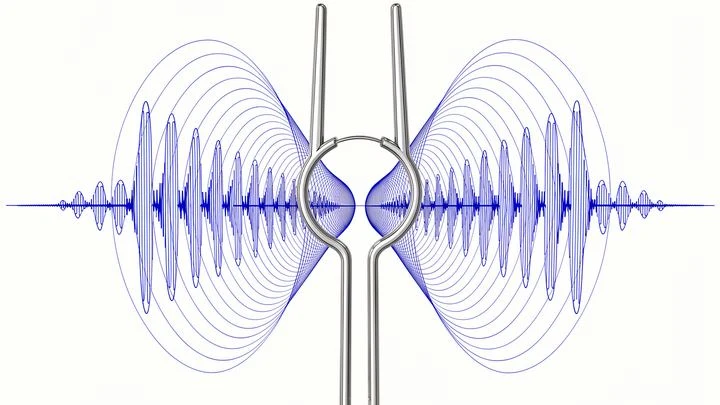
If you briefly flash light near a black hole, it will respond with a long echo, like a bell that keeps ringing after being struck. The light gets trapped near the hole, bouncing repeatedly off an invisible boundary: the photon sphere, where rays circle around like sound in a metal.
The Sun’s gravity creates an invisible goblet, in which dark matter of a special kind — ultralight — doesn’t splash around chaotically, but occupies strict energy steps, like transparent layers of liquid. So around the Sun, a natural spectroscope emerges, sorting the invisible substance into levels, just like electrons in an atom.