Hydrogen — the simplest atom — does not glow randomly, but in strictly defined colors: red, cyan, and several violet lines. The frequencies of this light obey a clear mathematical rule, similar to the difference of two simple fractions. It is like a combination lock of the atom: only certain number combinations are allowed. This regularity became the first hint that completely new laws operate inside the atom, not the usual mechanics.
History
In 1885, Johann Jakob Balmer, a mathematics teacher in Basel, derived a simple formula for the four known lines in the visible region of hydrogen (Hα, Hβ, Hγ, Hδ). He wrote it as λ = h · m²/(m² − n²), where h = 364.56 nm, n = 2, m = 3,4,5,6. Just three years later, Johannes Rydberg, working at Lund University, proposed a more convenient form in terms of wavenumbers (1/λ = R (1/n₁² − 1/n₂²)) and showed that it is applicable to alkali metals if integers are replaced by non-integer 'spectral terms'. At the beginning of the 20th century, Bohr's model provided a theoretical basis, and the fine structure of lines required relativistic corrections, which were taken into account by Arnold Sommerfeld.
How it works
The Rydberg formula is a working tool for spectroscopists and astrophysicists. For hydrogen, it predicts the position of lines with an accuracy of fractions of an angstrom, allowing calibration of spectrographs. It is used to calculate energy levels, determine ionization potentials, and analyze the composition of stellar atmospheres and gaseous nebulae. Using the Rydberg constant, quantum electrodynamics is tested and fundamental constants are refined. The formula is strictly valid only for isolated atoms in the absence of external fields. In the presence of an electric (Stark) or magnetic (Zeeman) field, the levels split, and the simple formula ceases to work — perturbation theory is required.
Fun fact
Mathematics teacher Johann Balmer, being infinitely curious, in 1885 managed to fit the four visible lines of hydrogen into one short formula, without even suspecting the existence of other series. Later it turned out that his formula is a special case of a more general relation that 'plays' the entire symphony of hydrogen, from ultraviolet to radio waves.
Rydberg molecules are like a pair of dancers holding hands at arm's length. One partner is an ion, the other is an atom, and the bond between them is as weak as an invisible thread. Such a pair can exist for only an instant, but that instant stretches into microseconds — an eternity by the standards of the microworld.
The James Webb Space Telescope peered into the era when the expansion of the Universe stretched the light of distant objects into the red, and found a scattering of strange sources — 'little red dots'. Their spectra broke the usual patterns: they are blue in the ultraviolet, but deep red in the optical, as if seen through a cherry veil.
A big sticky ball thrown onto a dusty shelf bounces off and kicks up a cloud of dust, but if you roll it slowly, it picks up every bit. Rydberg excitons behave just like that — they're giant 'atoms' inside a crystal, named after Johannes Rydberg.
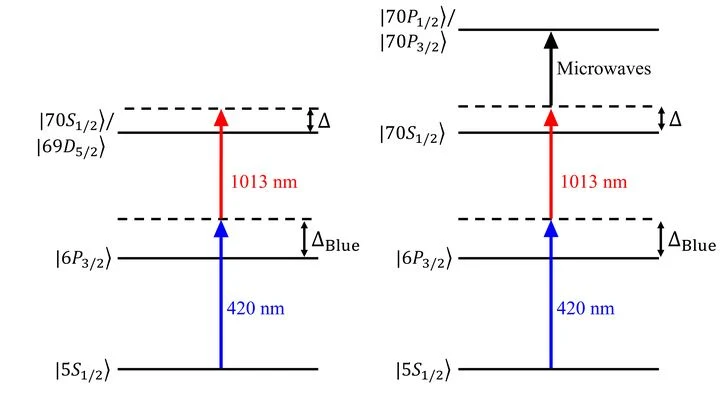
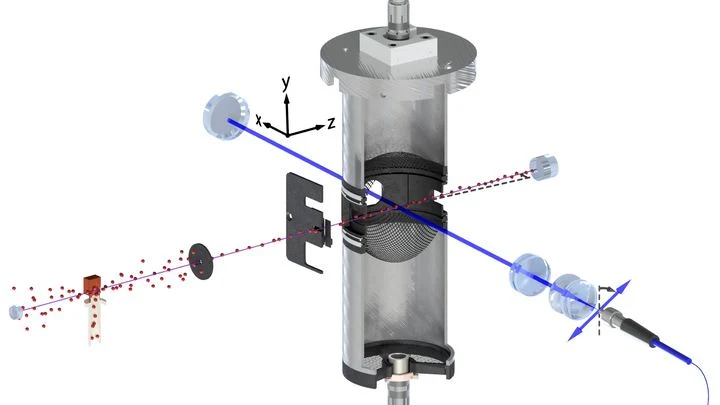
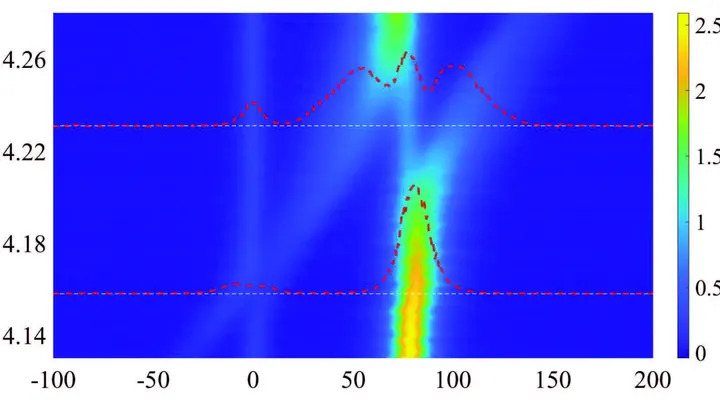
A laser is tuned to a frequency at which a rubidium atom normally does not get excited. But if an excited atom is already nearby, it shifts the energy levels of its neighbor, and the neighbor starts absorbing light. So the pair of atoms acts like a duo: one helps the other light up.
In some materials, atomic magnetic moments: their tiny 'arrows'—refuse to freeze even at ultra-low temperatures. Instead of conventional order, they form a spin liquid: a state where spins constantly flicker but do so coherently, like dancers in an intricate routine.
A water molecule resembles a tiny dumbbell: two hydrogen atoms attach to an oxygen atom at an angle. This dumbbell doesn't stay still: it stretches, compresses, and rotates. Each such motion has its own energy, like steps on a ladder.
In the dark chamber of the detector, argon waits. When an invisible particle (say, a dark matter candidate) flies through, it gives the argon nucleus a gentle shove. The nucleus is knocked out of place, and charges are born around it. Exactly how many charges is no trivial question: physicists use that number to tell what kind of visitor dropped by.
The hydrogen atom is like a tiny clock, ticking with a precision engineers can only dream of. When an electron jumps between orbits, it absorbs or emits light at a strictly defined frequency: that's the 'tick.' In the new work, physicists caught one such transition, between the 2S and 6P states, and measured its frequency with an…
A rubber band is stretched, and suddenly snaps. In the atomic world, a similar picture emerges: the string binding particles can break. In a new study, physicists took a chain of Rydberg atoms and tracked how such a string breaks.
Under weak tension, the string breaks completely, and the system splits into several independent pieces, as if a rubber band shattered into segments.
A regular radio receiver picks up waves with a metal antenna. Here, the antenna is a single atom with an electron boosted to a distant orbit, like a satellite in a high orbit around Earth. Such atoms are called Rydberg atoms.
The antiproton is a mirror twin of the proton: same mass, but negative charge. When it approaches an atomic nucleus, the particles can annihilate, turning into radiation.
The light of a star is stretched into a rainbow band. Dark lines — scars from absorbed elements, bright peaks — traces of hot gas. That’s a spectrum, the astronomer’s key piece of evidence. Cecilia Payne-Gaposchkin was the first to read that almost all stars are made of hydrogen.
Ordinary light scatters in all directions, but physicists turned it into something like a conveyor belt — a one-way stream that doesn't turn back. To do this, they sent two counter-propagating beams through a cloud of Rydberg atoms, bloated to the size of a tiny dust speck.