A picometer is a unit of length equal to one trillionth of a meter (10⁻¹² meters). To put that in perspective, a picometer is to a meter what a millimeter is to the distance from Earth to the Sun. It is the scale at which atoms and their internal structures operate: the diameter of a hydrogen atom is about 100 picometers, and the distance between atoms in a crystal lattice is typically a few hundred picometers.
History
The prefix 'pico-' was adopted by the International System of Units (SI) in 1960, derived from the Spanish 'pico' meaning 'beak' or 'small amount'. The unit itself is a straightforward application of this prefix to the meter.
How it works
The picometer is defined by the metric system's prefixes: 'pico-' denotes a factor of 10⁻¹². It is used as a practical unit in physics and chemistry because it matches the natural scale of atomic and subatomic phenomena, avoiding unwieldy decimal fractions when describing bond lengths, atomic radii, or X-ray wavelengths.
In practice
Picometers are used in crystallography to describe atomic positions, in spectroscopy for X-ray wavelengths, and in semiconductor manufacturing to specify atomic-scale layer thicknesses.
Fun fact
The diameter of a proton is roughly 0.84 picometers, making it one of the smallest objects routinely measured in physics.
Systems:SIA unit of length equal to 10^-12 meters, used for atomic-scale measurements.
A stone falls into water, and ripples spread in all directions. Throw a handful of stones at once, and the ripples overlap: you can no longer tell which ripple came from which stone. A neutron beam hitting a detector looks much the same: a bright spot blurred by many causes.
Hydrogen is the most common element. Its atoms are like antennas: they emit and absorb light at very specific frequencies. Einstein predicted that spacetime can ripple: these are gravitational waves.
A tiny ball weighing a fraction of a milligram, suspended in a magnetic field and cooled to near absolute zero, oscillates for 110 hours without stopping: this is record isolation. The energy loss is so small that the system's entropy barely increases, making any external influence noticeable.
Vacuum is not silent emptiness, but a boiling cauldron of quantum fluctuations, born from nothing and vanishing in billionths of a second. This invisible symphony acts like a constant wind, pressing an atom against a wall — as if a powerful bass note pushes a light ball.
The hydrogen atom is like a tiny clock, ticking with a precision engineers can only dream of. When an electron jumps between orbits, it absorbs or emits light at a strictly defined frequency: that's the 'tick.' In the new work, physicists caught one such transition, between the 2S and 6P states, and measured its frequency with an…
A thin film of silicon nitride is stretched over a frame like the skin of a drum. The slightest nudge from gas molecules makes it tremble. A laser beam delivered through a glass fiber picks up that trembling and turns it into a pressure reading. The whole setup fits in a pocket, not on an optical table.
A tiny crystal flake rests on a substrate like an autumn leaf on a palm. It's thinner than a human hair, yet inside it quantum effects are simmering: superconductivity, magnetic order, quantum spin liquid.
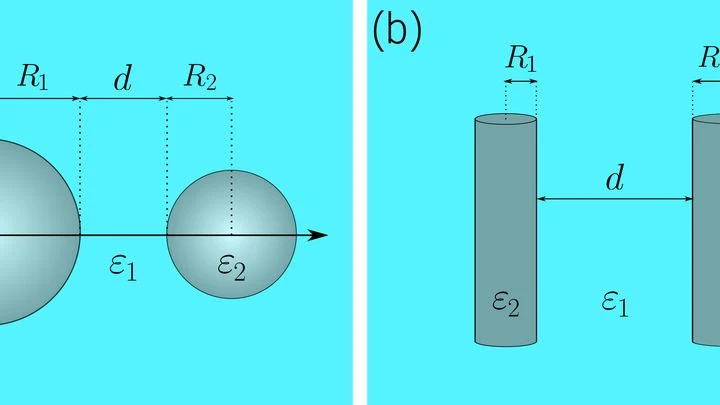
In a glass of salty water, even if it sits perfectly still, something is always happening. Tiny salt particles, ions, float and collide, sending ripples through the water. These ripples are invisible, but they create a force that attracts or repels nearby objects.
Previously, it was thought that this force only acts over very short distances, as if it quickly fades out.