The Cosmic Loom: The Puzzle of Missing Antimatter and Inflation ✛ ✎ ✦
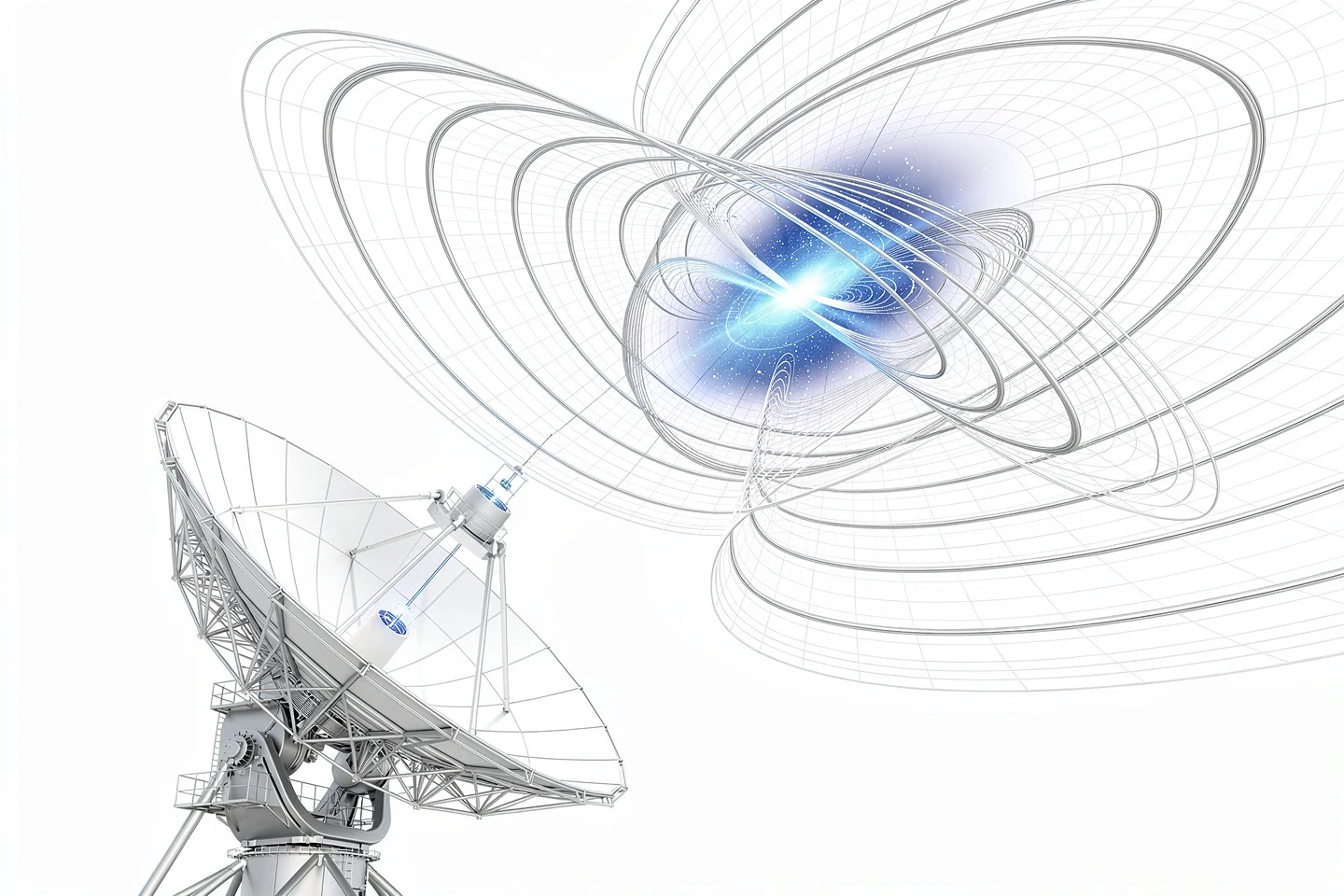
The mystery of the missing antimatter has haunted physics since the mid-20th century. The Big Bang should have created equal amounts of matter and antimatter, yet today's world is almost entirely matter. The Standard Model is powerless to explain this baryon asymmetry — we need new particles and mechanisms beyond it. Traditional thermal leptogenesis, relying on decays of super-heavy neutrinos in a hot plasma, is hard to test. A non-thermal alternative exists: the very expansion of the Universe in its infancy pulls particles straight out of the quantum void, like a weaver stringing warp threads on a grand cosmic loom.
In focus are heavy Majorana neutrinos with masses around $10^{13}$ GeV. They are born not in a hot plasma, but thanks to the very inflationary expansion. As inflation ends and the field enters a kination (kinetic domination) phase, the monstrous stretching rate of curved spacetime forces them to materialize. A striking coincidence: the natural neutrino mass scale nearly matches the Hubble parameter at the end of inflation, $H_e$ ~ $10^{13}$ GeV. Right in this resonance, gravitational production is maximally efficient. A fine-tuning on which everything hinges: shift the neutrino mass by an order of magnitude, and the cosmic loom would either fail to string the threads or snap them. Thus it achieves exact tension: no tighter, no looser, just that which later echoes in the relic hum.
The asymmetry builds up in a cascade. Neutrino decays and inverse decays in the expanding plasma create a lepton excess, and sphaleron processes convert it into a baryon one. The output is the observed value $Y_B$ ≈ $10^{-10}$, arising at a reheating temperature ~$10^9$ GeV and a few e-folds of kination. But the model's trump card is its link to relic gravitational waves. The same parameter $H_e$ sets the amplitude of tensor perturbations, characterized by the ratio r. The range of r stretches from 2×$10^{-4}$ to 0.034, and over 90% of this window is accessible to next-generation CMB telescopes — Simons Observatory and LiteBIRD. The whole drama of matter's birth is imprinted in the polarization maps of the microwave sky. If the r signal is found, it will directly confirm the scenario: the inflationary echo will speak.
The scenario opens up a thrilling vista. If inflationary gravitational waves are detected, we not only confirm inflation but read the history of leptogenesis in its spectrum. Moreover, the kination phase boosts the high-frequency tail of gravitational waves, potentially making them visible to space-based interferometers LISA and DECIGO. This connection extends to neutrino oscillations: the CP violation needed for asymmetry may echo the violation sought by experiments like DUNE and Hyper-Kamiokande. Thus a unified tapestry emerges, where threads from Alan Guth, who conceived inflation, stretch to the foresight of Kip Thorne about gravitational-wave astronomy, weaving together an explanation of why we exist at all. The cosmic loom turns out to be not a metaphor but a working model: we watch its operation through the trembling of spacetime, stretched to the scale of the entire visible Universe.
Gravitational production is when the expansion of spacetime pulls particles out of the vacuum. Today's Hubble scale is too small, but at the end of inflation it was enough to make the void spark with real particles.