The Dust That Blurs the Birth of the Universe express
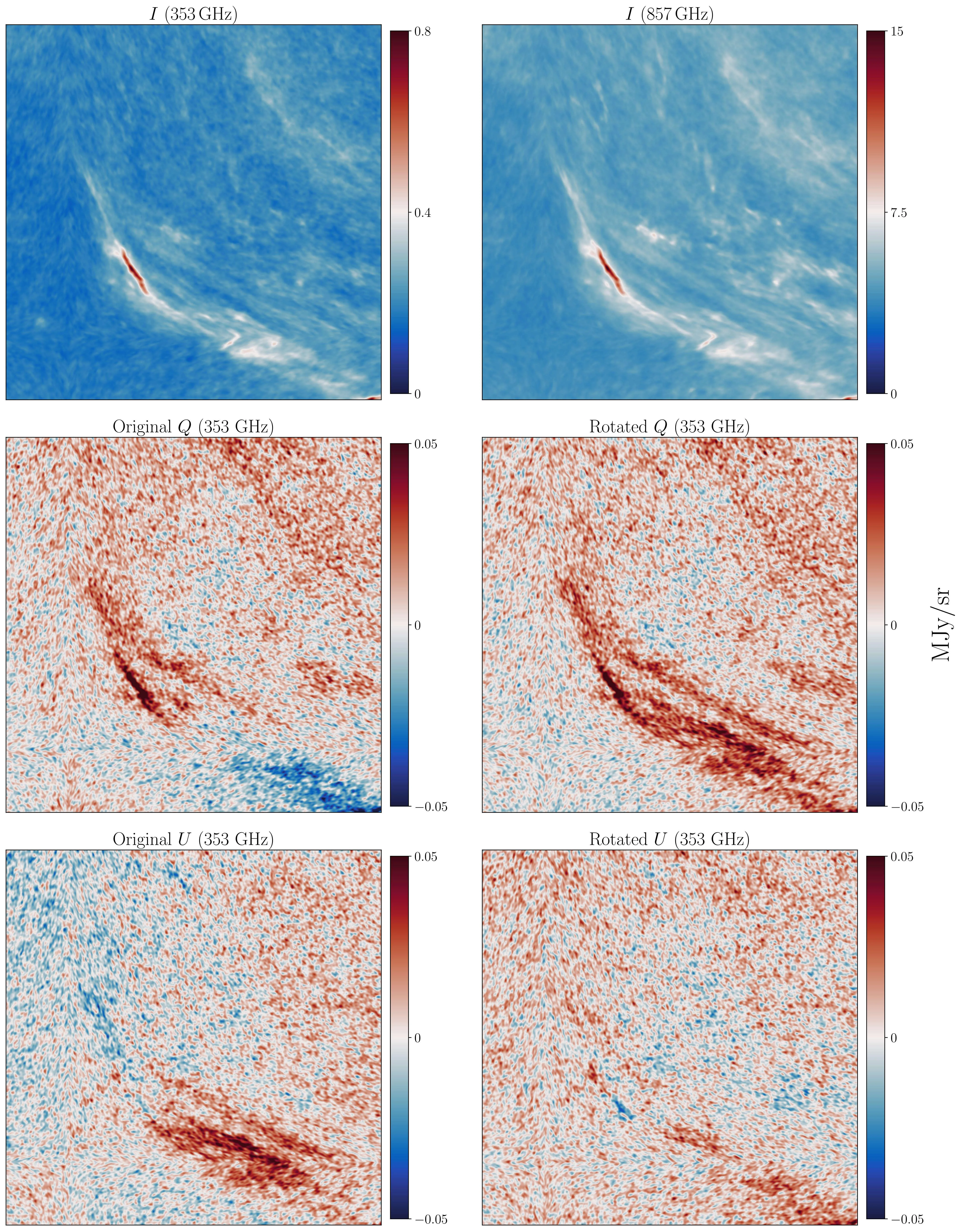
The cosmic microwave background is a faint glow left over from the Big Bang, like the cooling embers of a campfire. It encodes gravitational waves that may have arisen in the first fractions of a second, when the universe inflated faster than light. But between us and this ancient light hangs the dust of our galaxy. It, too, emits polarized radiation — light whose waves oscillate in a particular direction. And the result is a mess: you look at the sky, and there you have a mix of the dust signal and the cosmic microwave background signal.
Scientists have tried removing the dust before, but the maps came out noisy: where there is little dust, random noise overwhelmed the weak signal. The new method works differently. Instead of looking at each point individually, it looks at how dust forms filaments and clumps, like a spider web in the corner of a room. To do this, it uses a mathematical tool that decomposes the image into textures of different sizes and orientations. Then it fits a dust map whose statistics match the Planck telescope observations. It's like assembling a puzzle without knowing the picture, but knowing the pieces must form a certain pattern.
A test on a bright patch of sky showed that the new method recovers fine details of dust clouds better than older maps. This matters because fine details are exactly what could masquerade as a gravitational-wave signal. If you confuse them, you might mistakenly think you've found traces of the Big Bang when it's just dust.
Now astrophysicists have two sets of maps: one that accounts for random noise, and another that is deterministic, showing only reliable structures. Both will help subtract the dust from the data and get to the clean cosmic microwave background. And then, perhaps, we'll be able to see how the universe inflated in its first moments — faster than light could cross it.
Original abstract
as written by the authors arXiv:2602.04528
Polarized dust emission is a major astrophysical foreground contaminant of the cosmic microwave background polarization (CMB), which must be accurately measured to look for the faint primordial polarization B-modes of inflationary origin. The available maps to date, obtained from Planck space mission data, are noise-dominated in the high Galactic latitude regions that are most relevant for CMB observations. The goal of this work is to obtain better dust polarization maps from Planck observations, by exploiting both the dependence between polarization and total intensity, as well as the non-Gaussian filamentary structure of the dust emission. To this end, we use scattering transforms, which provide a stable and interpretable representation of complex non-Gaussian textures, allowing for a data-driven analysis approach requiring no explicit priors on dust. The analysis is performed locally on Cartesian patches of sky, where Stokes linear polarization parameters, redefined in a local reference frame, are modeled as the sum of a signal of interest and a nuisance term. Using multiple realizations of the random nuisance term, we recover the polarized dust maps by minimizing a composite objective function that enforces multiple statistical constraints in scattering space. The proposed algorithm reconstructs maps of polarized dust emission whose statistics are consistent with those expected from the Planck data once random nuisance realizations are added. This is confirmed in a validation test using a high signal-to-noise sky region as a test case. Comparisons with existing dust polarization maps and models show that our approach better recovers small-scale polarized dust emission, and that our reconstructed power and cross-spectra closely match those of the dust polarization maps. A second set of maps that deterministically reproduce the features of the dust polarized emission is also produced.
Polarization of light is like the direction of vibration of a rope when you send a wave down it. Dust in the galaxy aligns its particles along the magnetic field, which makes its light polarized.
In Arthur C. Clarke's novel "The Light of Other Days," telescopes see through any barrier, but here scientists battle cosmic dust to glimpse the very beginning.