Wavescattering is the process by which waves—such as light, sound, or matter waves—are deflected, reflected, or diffused when they encounter an obstacle or inhomogeneity in their medium. This phenomenon is fundamental to many areas of physics, from the blue color of the sky (Rayleigh scattering of sunlight) to the way radar detects aircraft. Scattering can be elastic, where the wave's energy is conserved, or inelastic, where energy is transferred to the scattering object, altering the wave's frequency.
History
The study of wavescattering dates back to the 19th century, with Lord Rayleigh's explanation of why the sky is blue. The theory was further developed by Gustav Mie, who in 1908 provided a complete solution for scattering by spherical particles, now known as Mie scattering.
How it works
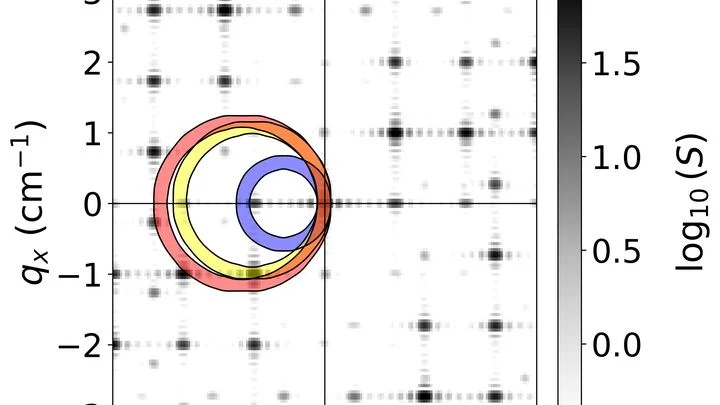
When a wave encounters an obstacle, it interacts with the material's properties, such as its refractive index or density. The wave's amplitude and phase are modified, and it radiates outward in new directions. The exact pattern of scattering depends on the size and shape of the obstacle relative to the wavelength, as well as the material's properties. For small obstacles, the scattering is often isotropic, while larger obstacles can produce complex angular patterns, such as the diffraction rings seen in X-ray crystallography.
In practice
Wavescattering is used in medical imaging (ultrasound), remote sensing (radar and lidar), and materials science (X-ray diffraction) to probe the structure of matter.
Fun fact
The phenomenon of 'Anderson localization' shows that in a disordered medium, waves can become completely trapped due to multiple scattering, turning a conductor into an insulator.
Waves on the water's surface usually break against any obstacle — a rock, a piling, an island. But what if you arrange obstacles so cleverly that the wave barely notices them? In a new study, scientists assembled a pattern of many points on the water, arranged according to special mathematical rules, and sent waves through them.
A beam of light enters frosted glass and fades — nothing unusual. But physicists have long known how to make light pass through without losing a single photon. This trick is called electromagnetically induced transparency: two light waves cancel each other at the right point, and absorption disappears. Now a similar feat has been pulled off with atoms.
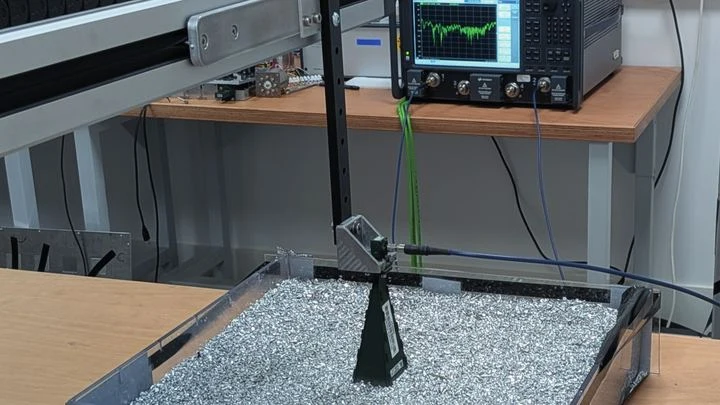
Physicists have achieved three-dimensional Anderson localization of electromagnetic waves — a phenomenon where waves become permanently entangled in a random labyrinth of metal particles and cease to propagate.
A stone drops into a pond, and ripples spread across the water. If a protruding branch blocks the ripples' path, part of the wave reflects, and part bends around the obstacle. Gravitational waves, ripples in spacetime itself, behave similarly when passing by galaxy clusters or black holes.
A pebble tossed into a pond sends ripples spreading in all directions. Now imagine the pond itself suddenly turning into jelly — instantly, faster than the wave can complete a single crest. Some ripples would keep spreading but change their spacing, while others would unexpectedly turn around and run back toward the point of impact, as if time were flowing backward for them.
When light passes through a turbid medium, like a glass of milk or frosted glass, it scatters in all directions. But sometimes, instead of spreading out, it gets trapped in tiny 'pockets' inside the material. Physicists call these pockets localized modes: light falls into them as if into a trap and cannot escape.
Sound in a thin plate behaves like ripples on water: it travels, reflects off edges, and changes shape. But sound has a peculiar trait: it can pass through places where waves are forbidden to exist. It's as if ripples on a pond suddenly vanished before a stone barrier and reappeared on the other side, without going around it.