J. Park

7 articles · 30 co-authors · latest: 2026-08-12
6,726 citations · h-index 34 · 95 papersData: Semantic Scholar

We have retold 7 papers by this author. 1 of them with a full read. most often about: black hole merger, neutron star merger, lepton. 30 co-authors across our retellings.

Links in the knowledge graph
HEP Experiment2026-02-102 minarXiv:2602.09800express
Rare Meson Decay: Hunting for Neutrinos
Inside the accelerator, particles collide, and for a fleeting moment a B meson is born — a heavy particle that lives for less than a billionth of a second. Usually, it decays into a shower of debris, but sometimes it transforms into just two particles: a muon and a neutrino. This rare path is like a lottery where the winning ticket appears once in every two million draws.
HEP Experiment2026-02-141 minarXiv:2602.13569express
Hunting Ghost Particles: What Belle II Saw
At Japan's KEK laboratory, electrons and their antimatter counterparts, positrons, collide inside the Belle II detector. In such collisions, new particles are born for a fleeting moment. Among them is J/ψ, a bound state of a charm quark and its antiquark.
The Liquid That Catches Ghosts
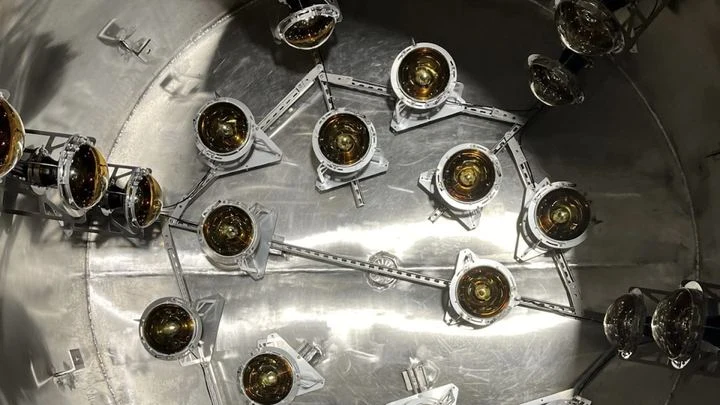
In a dark tank holding thirty tons of water, the liquid glows when a ghostly particle streaks through. Neutrinos barely interact with matter, but occasionally they bump into atoms, and a flash is born. To catch it, a special substance, a liquid scintillator, is added to the water to amplify the light.
General Relativity2026-03-261 minarXiv:2603.25938express
Tuning Into the Hum of Spinning Stars
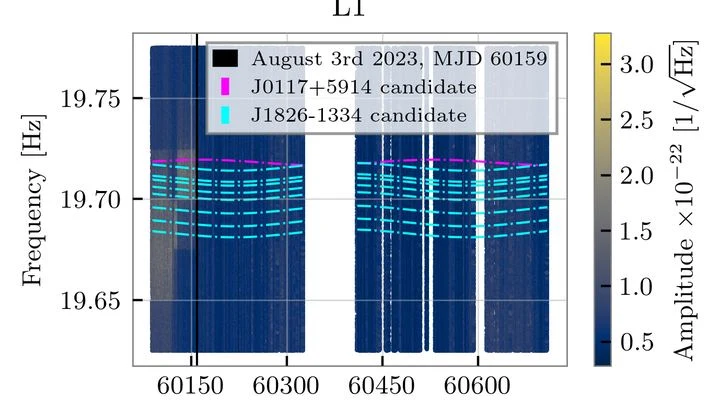
After a supernova explosion, a neutron star neutron star remains: a city-sized ball of unimaginably dense matter, spinning hundreds of times per second. Any tiny bump on its surface would make it wobble like an off-balance spinning top, humming faintly through the fabric of space.
Nuclear Experiment2026-04-282 minarXiv:2604.25107express
Tin Nucleus Reveals Its Size
Two tin nuclei collide at about two-thirds the speed of light. For an instant, a hot, dense cloud forms, and protons fly out in all directions. If you catch pairs of protons and measure how often they fly off in the same direction, you can work out the size of that cloud. This method is called femtoscopy: it works like a microscope for nuclear scales.
Instrumentation2026-08-122 minarXiv:2608.11673express
Gravitational Hearing: How to Catch the Whisper of Merging Black Holes
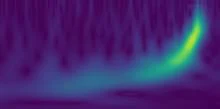
Gravitational-wave detectors are like extremely sensitive ears: they pick up the trembling of space when black holes or neutron stars collide somewhere in the universe. But even the most sophisticated "ears" cannot hear everything. The new LIGO A# project is like replacing the eardrum with a thinner, more sensitive membrane.