Popular

Berry phaseeffect

29 Related articles
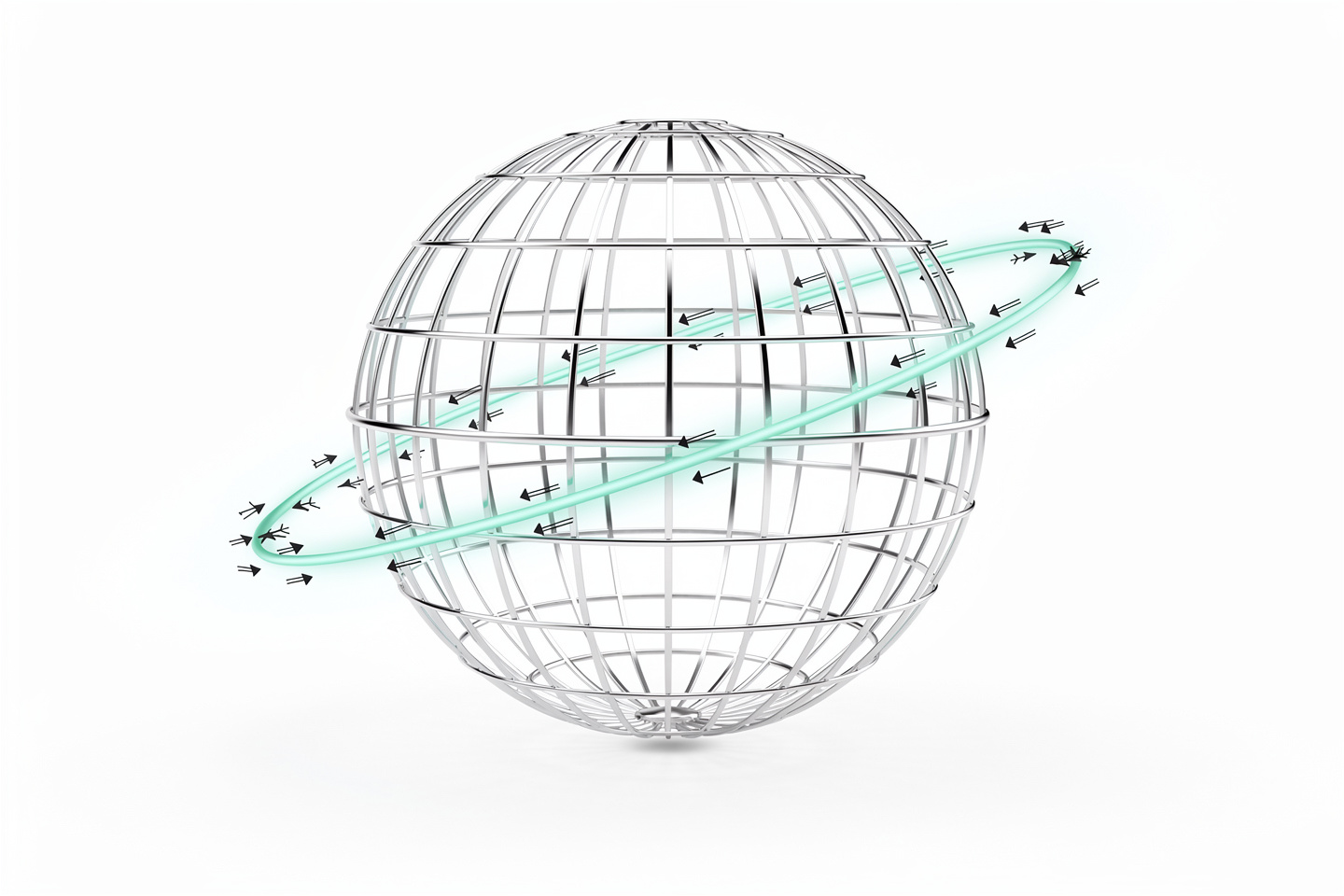
In 1984, British physicist Michael Berry generalized an old idea about a phase accumulated during adiabatic (slow) changes of parameters. It turned out this phase is geometric: its magnitude is determined not by time or speed but by the curvature of parameter space. Earlier partial manifestations had been noticed before Berry, but he showed their universality and connection to gauge fields.

How it works

The Berry phase appears in the Aharonov-Bohm effect, molecular spectroscopy, and condensed matter physics. For example, it explains why some crystals conduct electricity only on the surface while remaining insulators inside.

💡 The famous Foucault pendulum, which rotates its swing plane due to Earth's rotation, is a classical analogue of the Berry phase: the pendulum 'senses' geometry, not just forces.
\gamma = i \oint_C \langle n(\mathbf{R}) | \nabla_{\mathbf{R}} n(\mathbf{R}) \rangle \cdot d\mathbf{R}
γ — geometric Berry phase; i — imaginary unit; ∮_C — integral over closed contour C in parameter space; ⟨n(R)| — bra-vector of an eigenstate of the Hamiltonian depending on parameters R; ∇_R — gradient with respect to parameters; |n(R)⟩ — ket-vector of the same state; dR — contour element. The quantity A = i⟨n|∇_R n⟩ is called the Berry connection.
Links in the knowledge graph 1
Discovered by
Alexei KitaevFrank WilczekMichael Berry
Related concepts
wave functionquantum entanglement
Related laws
Aharonov-Bohm effectquantum Hall effect

Related articles

The Skyrmion Dance: How a Magnetic Vortex Conducts the Quantum Orchestra

A hybrid quantum system has been proposed, combining long-lived spin memory, a fast superconducting processor, and a topologically protected mediator — a magnetic skyrmion. Its oscillations bridge the atomic world of defects with macroscopic circuits, overcoming the scale chasm. Calculations promise
arXiv:2505.00266v1 · 2025-05-01

Light in a Cryostat: How Imperfect Converters Build Quantum Bridges

Superconducting quantum computers hit a cooling wall: a single cryostat can't hold millions of qubits. The solution is optical channels, but they need microwave-to-optical converters, which are still far from perfect. The authors showed that with feedback protocols, parallel attempts, and quantum di
arXiv:2505.00542v1 · 2025-05-01

Quantum Measurement as a Deformation of Perception: The Bloch Sphere and the Birth of Categories

A deep connection between quantum measurement and categorical perception: how a continuous spectrum turns into discrete concepts. On the Bloch sphere, wave function collapse deforms distances—pure states 'fall' into mixed ones, distances within a category shrink, and those between categories stretch
arXiv:2505.00777v1 · 2025-05-01

Maximum Quantum Entanglement: Hidden Symmetry and the Mirror Universe

Researchers found that if Higgs particle collisions are required to always produce maximally entangled states, the Higgs potential automatically extends its global symmetry. This leads to an exact symmetry U(2)×U(2), spontaneously broken to U(1)×U(1), giving rise to six massless Goldstone bosons. A
arXiv:2505.00873v1 · 2025-05-01

Quantum Symphony from Noise: How Spontaneous Emission Gives Birth to Entanglement

Contrary to the entrenched view of spontaneous emission as an incoherent process that destroys quantum entanglement, a team of physicists has theoretically demonstrated the possibility of generating near-perfect bipartite entanglement between two bright light fields. The scheme is based on a four-le
arXiv:2505.00919v1 · 2025-05-01

Quantum Tuning Fork: Noise Speeds Up the Search for Single Emitters

Brute-force photon counting from a single emitter gets bogged down in noise, like digging a tunnel with a shovel. But introduce a coherent reference beam and let quantum interference kick in — and the picture changes dramatically: the noisier the environment, the faster the verdict. The extended Hon
arXiv:2505.00950v2 · 2025-05-02

Death and Rebirth of Quantum Echo: A Hierarchy of Temporal Correlations in a Qubit

Physicists made a superconducting qubit forget its past—and saw how three types of temporal correlations (non-macrorealism, temporal steering, temporal non-separability) arrange themselves into a logical ladder. These echoes die at different noise levels and can resurrect when the environment briefl
arXiv:2505.01379v1 · 2025-05-02

Radical Dance, Frozen by Chirality: How Birds See the Magnetic Field

The work shows how chirality—the property of a molecule not coinciding with its mirror image—turns a weak magnetic signal into a reliable compass. Chirality does not merely create quantum coherence, but induces spin polarization, forcing the system to endlessly 'freeze' in one state. This amplificat
arXiv:2505.01519v1 · 2025-05-02

Quantum Boomerang: Fugue in a Detuned Orchestra

Disordered quantum systems usually stifle any transport, but new simulations have revealed a quantum boomerang: in a discrete walk, the wave packet returns, only not to the starting point, but to the opposite end. The internal state of the coin particle creates an asymmetry without external force—li
arXiv:2505.01532v1 · 2025-05-02

A Glass Loom for Light: 99.7% Fidelity Across 24 Quantum Threads

Researchers from Ephos and the Polytechnic University of Milan inscribed a 24-mode universal photonic processor into glass, using femtosecond lasers like a sewing machine needle. Operating at 925 nm—ideal for quantum-dot single-photon sources—the device is controlled by microheaters and uses less po
arXiv:2505.01609v2 · 2025-05-02

Quantum Wallet: Energy Teleportation Between Five Qubits

Imagine a shared wallet: one person deposits their paycheck, and the others take turns withdrawing, with the first grabbing the largest bill. In the quantum world, this is how energy teleportation works in a W state — a special kind of multipartite entanglement. Experiment on the IBM Lagos processor
arXiv:2505.01863v1 · 2025-05-03

Conductor of Heat Death: The Charge Palette of a Quantum Bath

The Mpemba effect, familiar from the paradoxical behavior of water, gains a quantum dimension: in isolated systems, a more non-equilibrium state sometimes relaxes faster. New research reveals the mechanism — the key lies in the symmetry structure of the thermostat's initial state. The wider the ener
arXiv:2505.02040v2 · 2025-05-04

Quantum Internet: How Entanglement Became a Data Packet

Superconducting qubits and optical photons are separated by a five-order-of-magnitude frequency gap. Direct qubit translation is an engineering dead end, but an architectural trick inspired by packet switching turns weak transducers into entanglement generators. Thus the quantum internet transforms
arXiv:2505.02057v4 · 2025-05-04

Gravitational Duet: How Entangled Masses Listen to the Whisper of Other Dimensions

Extra dimensions have long evaded detection due to electromagnetic noise. The protocol of quantum-induced entanglement of masses turns two microscopic bodies in superposition into gravitational tuning forks, accumulating a phase shift exquisitely sensitive to deviations from Newton's law. Analysis o
arXiv:2605.00749v1 · 2026-05-01

Improvisation beneath the horizon: quantum bounce turns a black hole into a white hole

The event horizon of a black hole conceals not a point of infinite curvature, but a zone of quantum transformation, where time itself changes roles. New research in quantum gravity shows: the singularity vanishes thanks to relational dynamics — one of the metric variables serves as a clock, and the
arXiv:2605.01576v1 · 2026-05-02

Phantom Chords of Gravity: Boson Stars as Keepers of Quantum Memory

Quantum systems typically evolve toward equilibrium, losing all memory of their initial state. But occasionally, 'scars' are born — anomalously stable, weakly entangled states that challenge thermalization. New research shows that boson stars in anti-de Sitter space realize such scars, combining cha
arXiv:2605.02446v2 · 2026-05-04

Alchemy of the Void: Nonlocal Magic of Particle Birth

Schwinger pair production in gauge fields reveals the unexpected depth of the vacuum: instead of simple entanglement, nonlocal magic arises—correlations that cannot be described without a full-fledged quantum computer. Holographic duality links this magic to the geometry of strings and black holes,
arXiv:2605.04210v1 · 2026-05-05

Gravitational Shadows: How Mass Splits Reality

Matter interferometry creates a Schrödinger's cat for macroscopic masses, opening the path to quantum gravity. A mass in superposition generates two clouds of coherent gravitons — gravitational shadows. Their contrast drops exponentially with increasing mass, signaling the growing entanglement betwe
arXiv:2605.05153v1 · 2026-05-06

Ashes of Inevitability: The Quantum Singularity of Evaporating Black Holes

The legacy of Penrose and Hawking asserted: the collapse of massive stars begets a singularity. But quantum evaporation casts doubt on the classical conditions, making us wonder if the core of a black hole is blurred by quantum fog. Engelhardt and Nagar put an end to it: by relaxing causality requir
arXiv:2605.05326v1 · 2026-05-06

The Singularity That Never Was: How Quantum Tango Erases the Beginning of the Universe

In quantum cosmology, the Big Bang singularity turns out to be a mirage. Using relational time emerging from entanglement between subsystems of the universe, physicists have shown: the probability of zero volume is strictly zero. The Page-Wootters formalism transforms a static wave function into an
arXiv:2605.06093v1 · 2026-05-07

When Gravity Knits Quantum Lace: Lessons from the Schrödinger–Newton Model

The hybrid Schrödinger–Newton equation for the first time analytically disentangled two faces of gravity: self-interaction and mutual attraction. It turns out that self-gravity does not alter the Schmidt spectrum, and hence the measure of quantum entanglement; however, the pairwise potential activel
arXiv:2605.06577v1 · 2026-05-07

Quantum Tremor of Parallel Worlds: Gravity on a Laboratory Table

A new theoretical work unites quantum mechanics and general relativity, showing that two parallel atomic lasers, unperturbed in the classical world, begin to diverge under the influence of quantum fluctuations of spacetime. Vacuum tremors of the metric give rise to an irreducible spread of trajector
arXiv:2605.11035v1 · 2026-05-11

Cosmic Spinning Top: Gravity vs. Quantum Superpositions

Mass currents have now been introduced into the Diósi–Penrose wave function collapse model for the first time, adding post-Newtonian corrections from general relativity. It turns out that moving mass generates gravitomagnetic noise, causing angular momentum decoherence. The most dramatic effects app
arXiv:2605.12172v1 · 2026-05-12

Gravitational Echo: How Black Holes Weave a Quantum Web of Gravitons

Quantum gravity eludes experiments due to the Planck scale. But the 2026 Gravity Research Foundation award-winning work points to a natural super-amplifier: superradiant axion clouds around rotating black holes. This cosmic mechanism generates squeezed states with up to 10⁷ correlated gravitons, cre
arXiv:2605.14797v1 · 2026-05-14

Quantum Tide from the Future: Accelerating the Universe Without Dark Energy

A new study offers a bold explanation: the accelerating expansion of the Universe isn't the result of mysterious dark energy, but a consequence of quantum boundary conditions imposed from the distant future. In a radiation-dominated model with zero cosmological constant, a final state in the form of
arXiv:2606.02514v1 · 2026-06-01

A Five-Dimensional Trace in the Cosmic Microwave Background

What lies beyond three dimensions? Theories with extra spatial dimensions predict the birth of massive particles in the young Universe. Using the cosmic microwave background as a kind of 'spectrograph,' scientists analyzed data from the Planck satellite looking for imprints of Kaluza–Klein gravitons
arXiv:2607.02651v1 · 2026-07-02

The Universe's Dance Floor: When Dark Matter Breaks into a Quantum Rhythm

Scientists have constructed a rigorous quantum-kinetic theory of gravitational instability for the fuzzy dark matter model—ultralight bosons with a mass on the order of 10⁻²² eV. By applying the Wigner equation and the Landau method, they derived a dispersion relation that revealed a sharp crossover
arXiv:2607.04893v1 · 2026-07-06

Symphony of Dark Energy: From Heavy Adagio to Explosive Allegro

In the standard cosmological model, two epochs of the Universe speak different languages: the temperature of the cosmic microwave background demands one expansion rate, while supernova explosions demand another. The discrepancy has surpassed the five-sigma threshold, becoming a true crisis. The ECDM
arXiv:2607.05044v1 · 2026-07-06

Symphony of Shadows: Neutrino Telescopes Catch the Whisper of Dark Matter

Using 13 years of data from the ANTARES telescope, scientists have set stringent limits on the interaction of dark matter with ordinary matter across mass scales from keV to GeV. Collisions of cosmic rays with dark matter particles in the Galactic Ridge produce neutrinos that are detected by deep-se
arXiv:2607.05335v1 · 2026-07-06