Symphony of Dark Energy: From Heavy Adagio to Explosive Allegro ✛ ✎
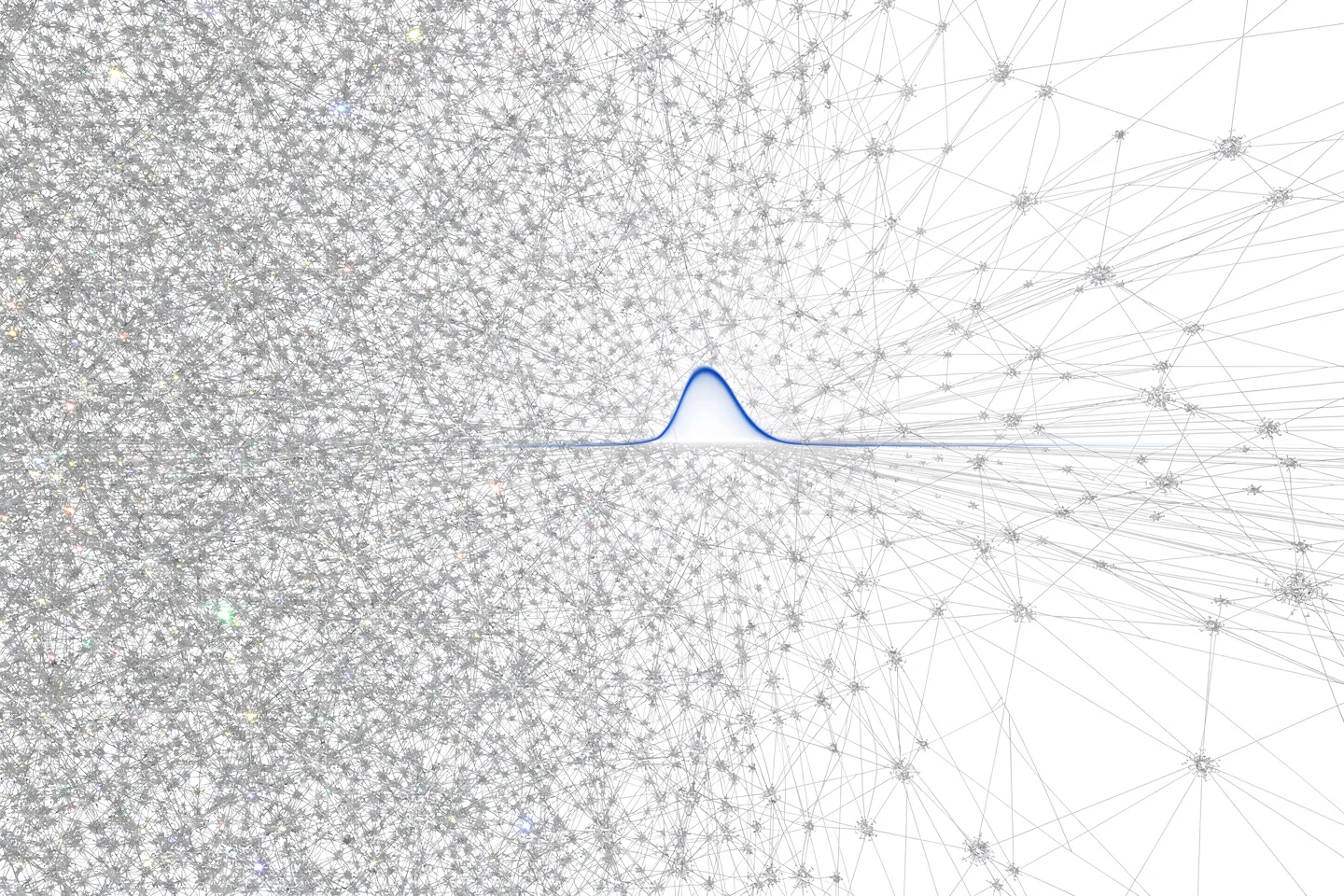
A drama is brewing in cosmology: two principal musical instruments, the orchestra of the early Universe and the chamber ensemble of the modern cosmos, play the same symphony of expansion at different tempos. Measurements of the relic radiation (cosmic microwave background) yield a Hubble constant of about 67.4 km/s per megaparsec, while local observations, relying on the Hubble Space Telescope and Cepheid calibration, insist on 73.0 km/s. This discrepancy of more than 5σ is not a minor false note but a threat of disintegration to the entire elegant picture of ΛCDM, where dark matter and the cosmological constant hold sway.
A new score, called ECDM, introduces an unexpected conductor: dark energy that changes its behavior from attraction to repulsion. Imagine a symphony that begins with a somber adagio — dark energy with a minus sign brakes expansion more strongly than ordinary matter, as if the universe is wading through viscous molasses. Then, about 3–4 billion years ago, a smooth transition occurs: the sign of the energy density flips, and the adagio gives way to an explosive allegro — accelerated expansion. Physically, this is described by a smooth error function: \\[ \\rho_d(x) = \\rho_{d0} \\frac{\\operatorname{erf}(\\eta (x - x_\\dagger))}{\\operatorname{erf}(-\\eta x_\\dagger)} \\] Here \\( x = \\ln a \\) is the logarithm of the scale factor, \\( x_\\dagger \\) is the transition moment, and \\( \\eta \\) is its rapidity. Negative values of erf for \\( x < x_\\dagger \\) yield negative density, creating additional gravitational attraction; after the transition, the density becomes positive, causing repulsion.
Testing the model required a virtuoso statistical analysis. Astrophysicists used a full arsenal of data: maps of the relic radiation from the Planck satellite and ACT/SPT telescopes, baryon acoustic oscillations imprinted in the distribution of galaxies (DESI survey), and light curves of type Ia supernovae from the Pantheon+ catalog. The difficulty is that at the transition moment, the equation of state diverges, and standard perturbation equations break down; they had to develop renormalized variables and run millions of Markov chain Monte Carlo realizations. The result: for the full dataset, the Hubble constant comes out to about 69.3 km/s/Mpc, where the speed of light plays a fundamental role in determining distances — significantly closer to local measurements, reducing the tension to 2–3σ. The WAIC criterion (an analog of the information criterion) drops by 15 units, showing strong preference for ECDM over ΛCDM. Moreover, the data reject an ultra-fast transition, favoring a smooth one, like a trombone smoothly changing pitch, not a light switch click.
This work is not just a technical trick. It questions the staticity of the dark sector and hints at a deep connection with quantum theory. If the density of dark energy can change sign, its source could be scalar fields, quintessence, or even the landscape of string vacua, where transitions between states of different energy are possible. Such fluctuations could have left an imprint in the lensing of the relic radiation and structure growth, and future missions like Euclid and the Vera Rubin Observatory will allow us to see these traces. Moreover, this brings us closer to unraveling eternal questions: why the cosmological constant is so small, why the matter and dark energy densities are nearly equal today, and whether these coincidences are related to quantum correlations in the multiverse. In the symphonic picture, we have only begun to distinguish the instruments and tonalities, but it is already clear that the score is far richer than it seemed.
The physics of dark energy has always balanced on the edge between the observable and the imaginable. The new ECDM model transforms it from a static background into a dynamic player capable of changing its appearance. The former disharmony between the early and late cosmos, which seemed like a crack in the foundation, becomes, through this interpretation, the key to a deeper symphony, where attraction and repulsion are just two sides of a single melody. Testing this hypothesis will require next-generation observations, but it is already clear: our cosmic orchestra is tuned for change, and the conductor’s baton may be in the hands of quantum gravity.
In the era of negative dark energy, the expansion of the Universe was braked as if the cosmos had been laced into a gravitational corset. This phase lasted several billion years and gave way to acceleration only 3–4 billion years ago — around the time Earth was forming in the Solar System.
The concept of sign-changing dark energy resonates with the flip of physical constants in Liu Cixin's Three-Body Problem trilogy and with the temporal fields in Dan Simmons' Hyperion: there, too, fundamental forces prove malleable, and their change reshapes the universe.