Phantom Chords of Gravity: Boson Stars as Keepers of Quantum Memory ✛ ✎ ✦
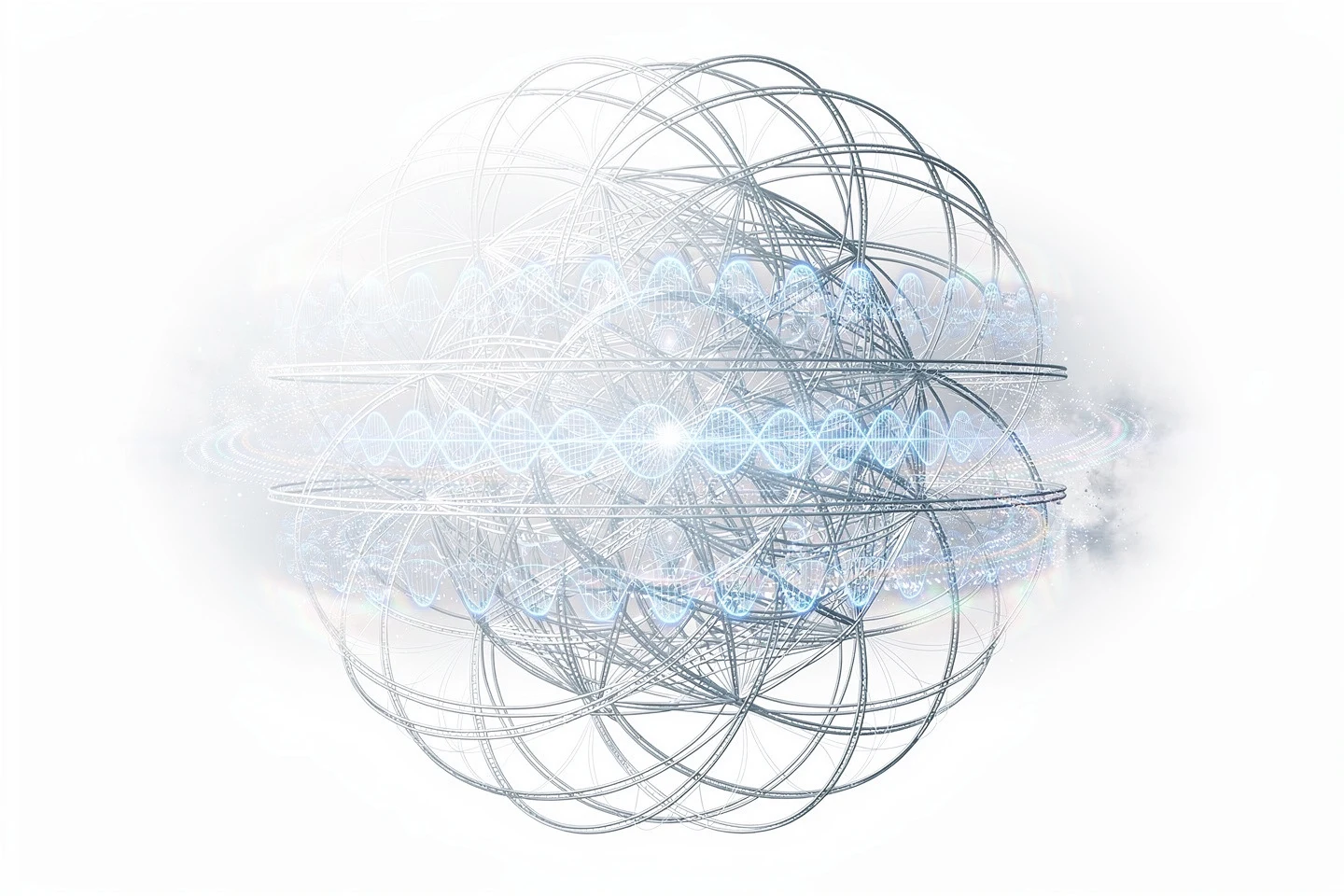
Every isolated quantum system inevitably moves toward thermal equilibrium — a state where all details of the past are erased. It’s like an orchestra: instead of a symphony, it starts playing white noise — random but statistically predictable notes. Yet sometimes, stubborn melodies pierce through this cacophony — 'many-body scars.' These are rare states with anomalously low entanglement and robust dynamics, as if a few instruments remember the score and repeat the same motif, defying the growing chaos. Their existence boldly challenges the Eigenstate Thermalization Hypothesis (ETH) — a cornerstone of quantum statistical mechanics. Such scars were first observed in ultracold atomic gases: they lived tens of times longer than thermalization dictates — genuine islands of order in a boiling sea of randomness.
To see scars in gravity, scientists turned to holographic AdS/CFT duality — a bridge between quantum theory on the boundary and curved geometry in the bulk. In this dual picture, black holes are absolute chaos: their entropy, predicted by Bekenstein and Hawking, is maximal, and the energy spectrum obeys random matrix statistics. But there are other objects — without an event horizon. These are boson stars, woven from a self-gravitating condensate of a scalar quantum field in curved spacetime. In new work, researchers constructed mini-boson stars in anti-de Sitter space and studied their linear perturbations, hunting for hidden order.
The analysis revealed a striking duality. At low energies, the level spacing distribution followed random matrix statistics (GOE/GSE) — a sure sign of global chaos. But as frequencies rose, distinct branches with a nearly equidistant spectrum emerged, reminiscent of harmonic oscillator quantum numbers. This coexistence is a direct spectral signature of scars. Even more striking is the entanglement entropy: computed via the Ryu–Takayanagi formula, for a boson star it turned out to be about 70% lower than that of a black hole of the same mass. Unlike black holes, where Penrose's theorems guarantee a singularity, boson stars lack a horizon and allow passage through them. Quantum information seems locked inside, not spreading throughout the whole volume as in a thermalized system. A dynamic confirmation came from Krylov complexity revivals: instead of the monotonic growth typical for a black hole, here it periodically returns to initial values, with a period set by time dilation in the strong gravitational field and the star's own oscillation frequency. It’s like the same melody being played over and over by an old gramophone.
The discovery bridges the physics of many-body scars, quantum chaos, and horizonless gravity. It demonstrates that non-thermal, 'memory-bearing' states can acquire geometric embodiment, and that a superposition of such scarred configurations can reliably store information despite relentless thermalization. This forces a fresh look at the black hole information paradox: if scars form stable evolution channels, perhaps information does not vanish without a trace but is encoded in the fine structure of such objects. The future holds the search for a whole zoo of scarred geometries: rotating stars, fermionic clumps, and even wormholes. Perhaps the Universe guards its deepest secrets in such cosmic scars — quiet but indelible imprints of primordial harmony.
Boson stars — hypothetical objects made of a self-gravitating condensate of ultralight bosons — could make up part of dark matter, and their observable signatures (microlensing, gravitational waves) are actively sought.
In Interstellar, a black hole is a trap with no return; a boson star, however, is transparent: you can pass through it, like a labyrinth of light, and come back — no horizon, no singularities, almost a wormhole.