Gravitational Echo: How Black Holes Weave a Quantum Web of Gravitons ✛ ✎ ✦
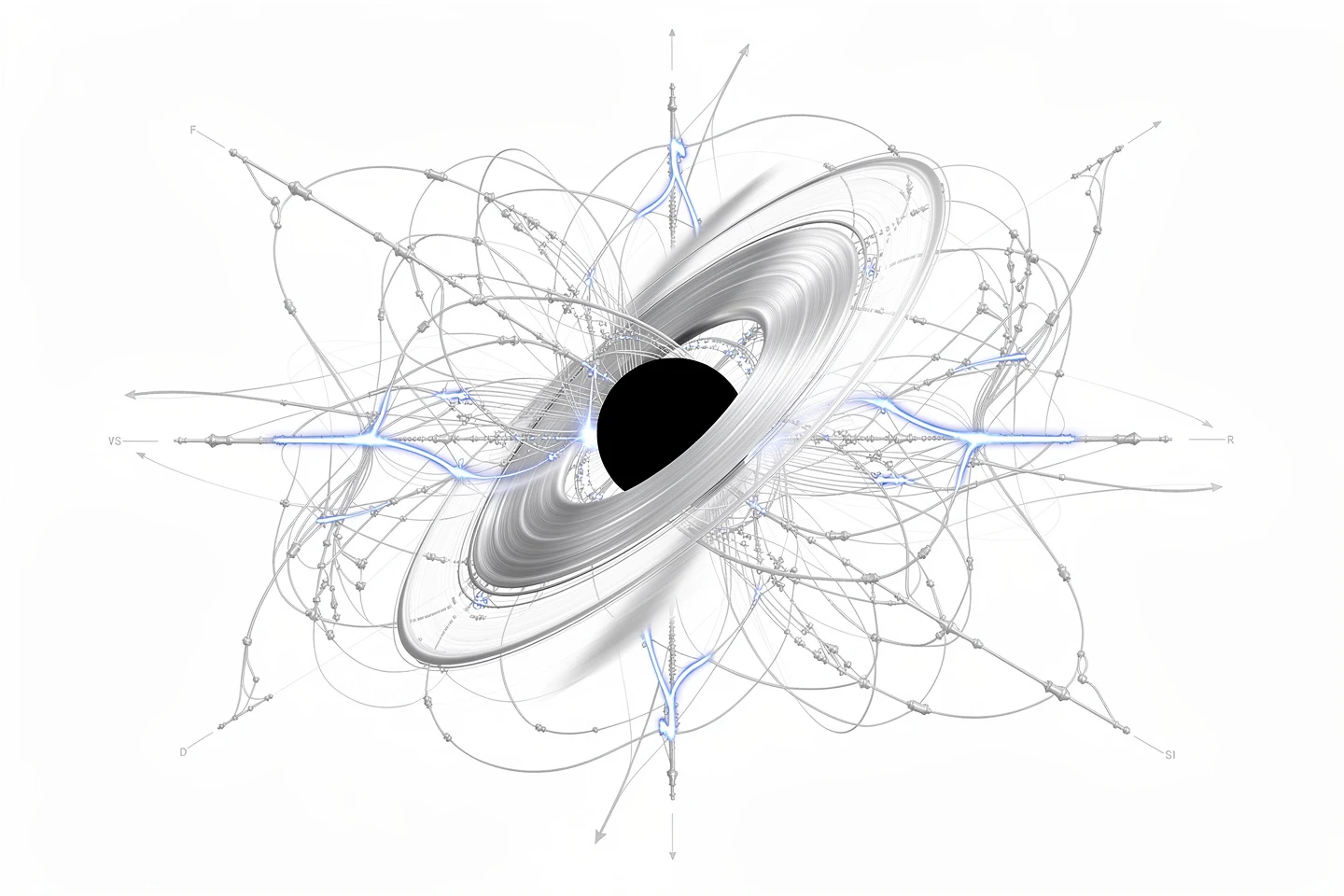
A single graviton, a quantum of spacetime, is incredibly weak. For detectors like LIGO, built by Rainer Weiss and colleagues, quantum effects are suppressed by a factor of 10⁻³⁸: it's like trying to hear a grain of sand changing the wind's direction in a hurricane. The idea of bridging this gap by merging gravitons into collective states goes back to work by Frank Wilczek. Nature has already done it: a rotating black hole, surrounded by a cloud of ultralight axions, candidates for dark matter, becomes a quantum loom.
Imagine a cosmic spinning wheel. At its heart lies a black hole, whose rotation (angular momentum) serves as the axle. Superradiance, predicted by Roger Penrose, extracts energy from the rotation, feeding the growth of the axion cloud. This cloud is a supply of raw threads, drawn from the primordial fabric of gravity. When two axions from the condensate collide, the nonlinearities of the Einstein field in quantum field theory act like a shuttle, weaving them into a single paired thread — an entangled pair of gravitons. This process, gravitational four-wave mixing, is known in quantum optics, but here its power is enormously enhanced by the cloud's giant lifetime. Moreover, the topological Chern-Simons term, a mathematical “curl” predicted by string theory, lets the axion directly decay into a pair of gravitons, as if a thread splits by itself into two perfectly symmetric fibers.
The resulting fabric is not chaotic. Entanglement between the graviton spins (polarizations) arranges into strict patterns: mainly, pairs are born with opposite helicities — the configuration |RL⟩+|LR⟩, reminiscent of the ideal Einstein-Podolsky-Rosen quantum correlations, but in a gravitational performance. The Chern-Simons contribution twists this fabric into antisymmetric Bell states, adding an extra pattern. In other words, the black hole doesn't just weave gravitational threads: it embroiders a deterministic quantum ornament into the fabric of spacetime. This ornament is unique to each system, like a fingerprint, and can reveal the axion mass and the hole's spin.
Next-generation ground-based interferometers like the Einstein Telescope and Cosmic Explorer will be able to recognize such handiwork. Cross-correlations between distant detectors will allow true quantum noise to be separated from thermodynamic fluctuations, and measuring higher-order moments will confirm the sub-Poissonian statistics of squeezed states. Each detected (or ruled out) black hole–axion system becomes a unique laboratory for quantum gravity, testing predictions of general relativity, string theory, and dark matter models. Even the absence of a signal is already constraining the lifetime of axion clouds, forcing theories to be revised.
In quantum optics, squeezed light already boosts interferometer precision: LIGO uses this trick to catch gravitational waves. Now scientists are hunting for self-gravitational squeezing — the quantum whisper of black holes, capable of revealing the quantum nature of spacetime itself.