Maximum Quantum Entanglement: Hidden Symmetry and the Mirror Universe ✛ ✦
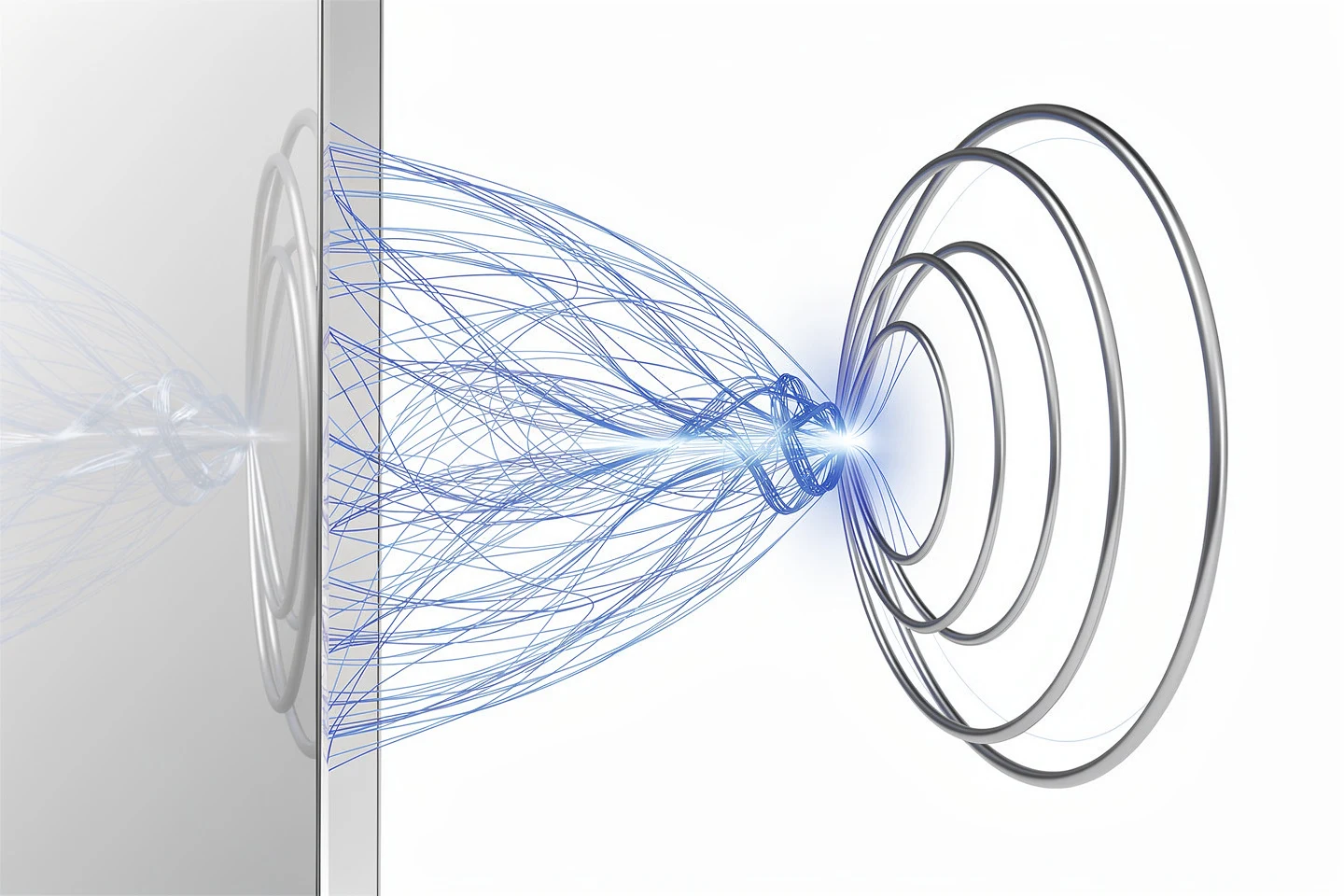
In the silent heart of creation, where particles converge and part, an act of pure harmony is born. Two Higgs bosons meet and for a fleeting moment form a single whole — and if one demands that their quantum entanglement always reaches its limit, like a tuning fork setting a perfect pitch, then the equations suddenly light up with a new symmetry. Just as an orchestra finds its tune without a conductor's baton, the particles dictate the laws of their ensemble, doubling the symmetry and giving rise to a mirror world.
Each Higgs doublet is like a qubit, an elementary cell of quantum information. Their flavor space becomes a stage where a play about entanglement unfolds. By requiring scattering amplitudes to always produce states with a concurrence of exactly one (a measure of quantum entanglement), the authors derived a condition as simple and elegant as a mathematical chord: λ₁ = λ₂ = λ₃ = λ₄ = ±λ₅, with λ₆ = λ₇ = 0. This equation forces the U(2) symmetry to split into U(2)×U(2), and what was once a soft breaking, after spontaneous electroweak symmetry breaking, solidifies into an exact law.
The physical spectrum responds to the newfound symmetry with six massless Goldstone bosons — one for each broken generator — and two massive scalar twins. The 125-GeV Higgs boson we observe, predicted by Peter Higgs, becomes automatically aligned: its couplings to W and Z coincide with the Standard Model predictions without fine-tuning. This is not a fudge but an inevitable consequence, like a shadow cast by the demand for maximal entanglement. And that shadow extends further — it brings with it a mirror dark sector. To preserve entanglement when gauge fields and fermions are included, a complete twin of the known particles is needed, invisible yet inextricably linked: dark matter ceases to be a hypothesis, becoming an architectural necessity.
This work builds a bridge from entropic measures of entanglement to the origins of symmetries. Emmy Noether's theorem linked symmetries with conservation laws but remained silent on where symmetries themselves come from. Now quantum information claims a role as the prime cause: symmetry is not postulated but imposed by the demand for maximal entanglement. And this prompts a thought: what if all physical laws are merely shadows cast by quantum information onto the screen of spacetime? Just as in thermodynamics the growth of entropy dictates the arrow of time, here quantum correlations dictate the very form of the laws. Perhaps fundamental physics is information seeking its most stable forms, and the Standard Model is just one local minimum in the landscape of quantum correlations.
Ahead lies generalization to grand unified theories and cosmological scenarios. If maximal entanglement was a condition in the hot early universe, then symmetries could have emerged dynamically, leaving behind relic particles detectable in future colliders or cosmic rays. Perhaps we stand on the threshold of 'entropic phenomenology,' where particle scattering experiments directly measure concurrence and test how closely nature adheres to maximal entanglement. The analogy with quantum computers goes deeper than mere metaphor: error correction codes that protect fragile qubits may be woven into the very fabric of reality. Erwin Schrödinger, who proclaimed entanglement the essence of quantum mechanics, could hardly have foreseen that it would forge symmetries and, perhaps, build a bridge to a mirror world.
The demand for maximal entanglement acts as postselection in a quantum repetition code: the system automatically discards states not invariant under a Z₂ symmetry — as if nature programs symmetries directly at the qubit level.
The idea of a mirror world with dark twins of all particles, familiar from 'Star Trek' and Asimov's novel 'The Gods Themselves,' where twin universes communicate through fundamental forces, now gains theoretical footing.