The Universe's Dance Floor: When Dark Matter Breaks into a Quantum Rhythm ✛
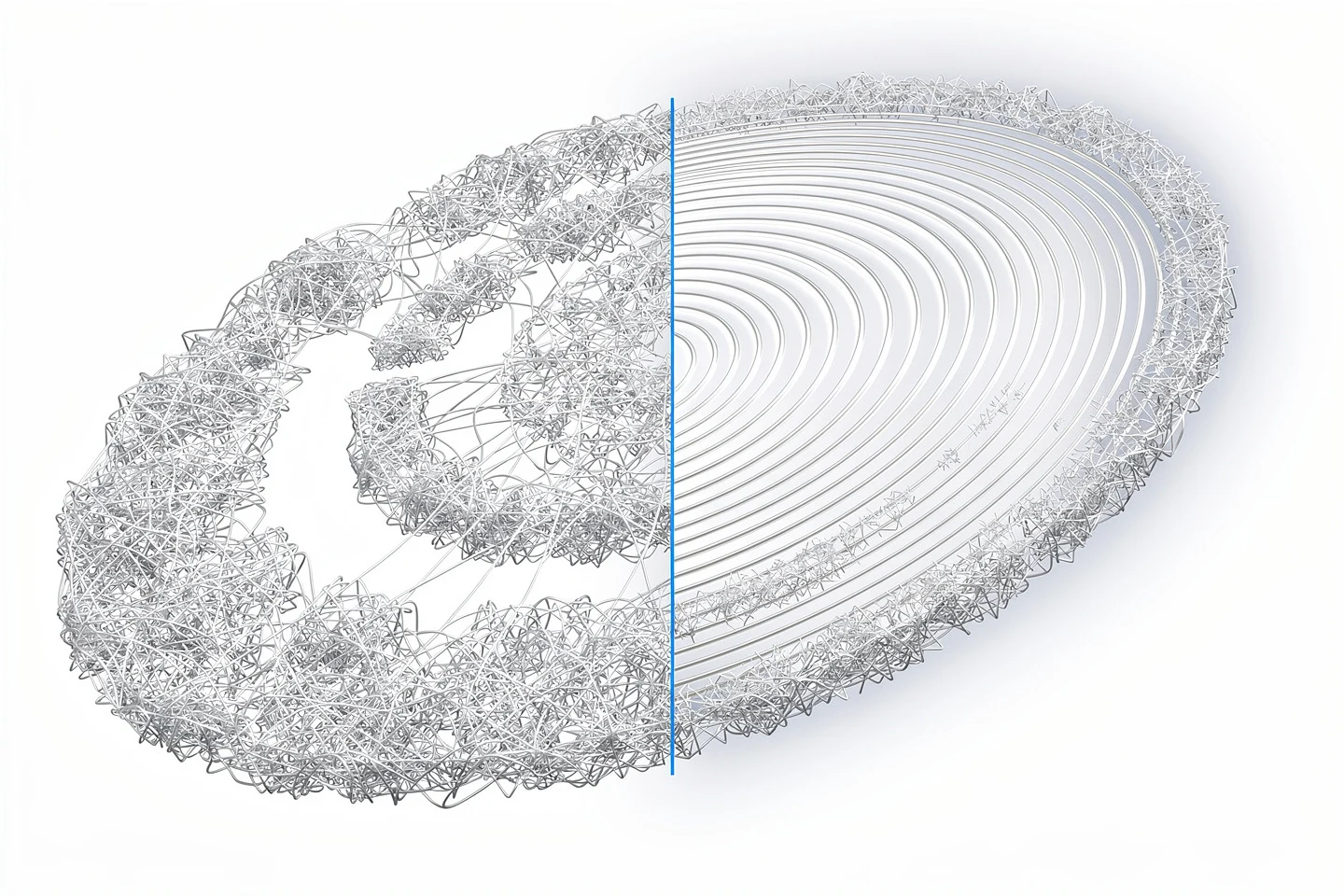
Ever since Fritz Zwicky noticed that galaxy clusters were moving too fast, and Vera Rubin measured the rotation of spiral arms, dark matter has remained cosmology's greatest mystery. The standard model of cold dark matter successfully reproduces the large-scale web of the Universe, but stumbles at the scale of dwarf galaxies: instead of steep density peaks in the centers, we see a shallow core. This discrepancy, the cusp-core problem, hints that dark matter might not be as cold as we thought.
Imagine the early Universe as a giant dance floor right after the Big Bang. Dark matter particles are dancers whose random motions (thermal velocity dispersion) create the noise of the crowd, while quantum pressure is like a DJ's console, imposing a unified rhythm through the wave nature of these particles. No quantum entanglement is needed: it's enough that each particle is described by a single wave function obeying Schrödinger's equation in a gravitational field. For a long time, astrophysicists couldn't tell who was leading: the chaotic foxtrot or the strict quantum beat. The new work establishes, for the first time, a precise crossover parameter α, the ratio of quantum to thermal Jeans wavenumbers, and shows that at α ≈ 0.5, a sharp change of regime occurs.
The theory is based on the Wigner equation, the quantum cousin of the Boltzmann distribution. Using the Landau method, physicists derived a dispersion relation whose solution reveals a razor's edge: the growth rate of fluctuations is cut off at a wavenumber $k_c$. If α > 2, thermal damping dominates — fast particles smear out any clumps, like impatient dancers rushing in different directions. But when α drops below 0.5, quantum pressure kicks in, and the cutoff becomes sharp, as if a DJ cranks up a filter. The power spectrum graph breaks, changing its slope. The quantum Jeans wavenumber is given by: $k_{qJ}$ = (16πGm²ρ₀/ħ²)^{1/4}. It says: if gravity pulls while quantum uncertainty pushes back, equilibrium occurs at this scale. And the parameter α = $k_{qJ}$/$k_J$ is that very crossover, where $k_J$ is the thermal Jeans scale.
This transition is more than a mathematical curiosity. It provides an observational key: the shape of the small-scale power spectrum depends simultaneously on the particle's mass and its velocity dispersion. Calculations show that the key events unfolded at a redshift of z ~ 99, when the Universe was compressed to the size of a soccer ball compared to today, and the very concept of redshift reminds us of the finite speed of light. By studying the spectroscopy of distant quasars, where hydrogen paints a picket fence of absorption lines, the Lyman-alpha forest, we can measure the cutoff scale and slope, and thus simultaneously constrain both parameters for the first time. It’s like listening to the dance floor sound to determine not just the beat but also the temperature of the crowd.
Next up are nonlinear simulations on supercomputers that will combine quantum kinetics and gravity. The Wigner-Vlasov equation will replace the simplified Schrödinger-Poisson approach and show how coherent soliton cores, those very shallow profiles in dwarf galaxies, are born from an initial incoherent fog. This is a step toward solving not only the cusp-core problem but also the too-big-to-fail mystery, and perhaps toward directly determining the nature of dark matter. Thus, the DJ console of quantum mechanics puts cosmology on a new track, where the mass and speed of the particles intertwine into a single rhythm of structure formation.
If dark matter consisted of particles with a mass of 10⁻²² eV, its de Broglie wavelength would be about 1 kiloparsec — the typical size of a dwarf galaxy. Such a particle would be 10²⁸ times lighter than a proton.