Popular

spectral theoremtheorem

31 Related articles
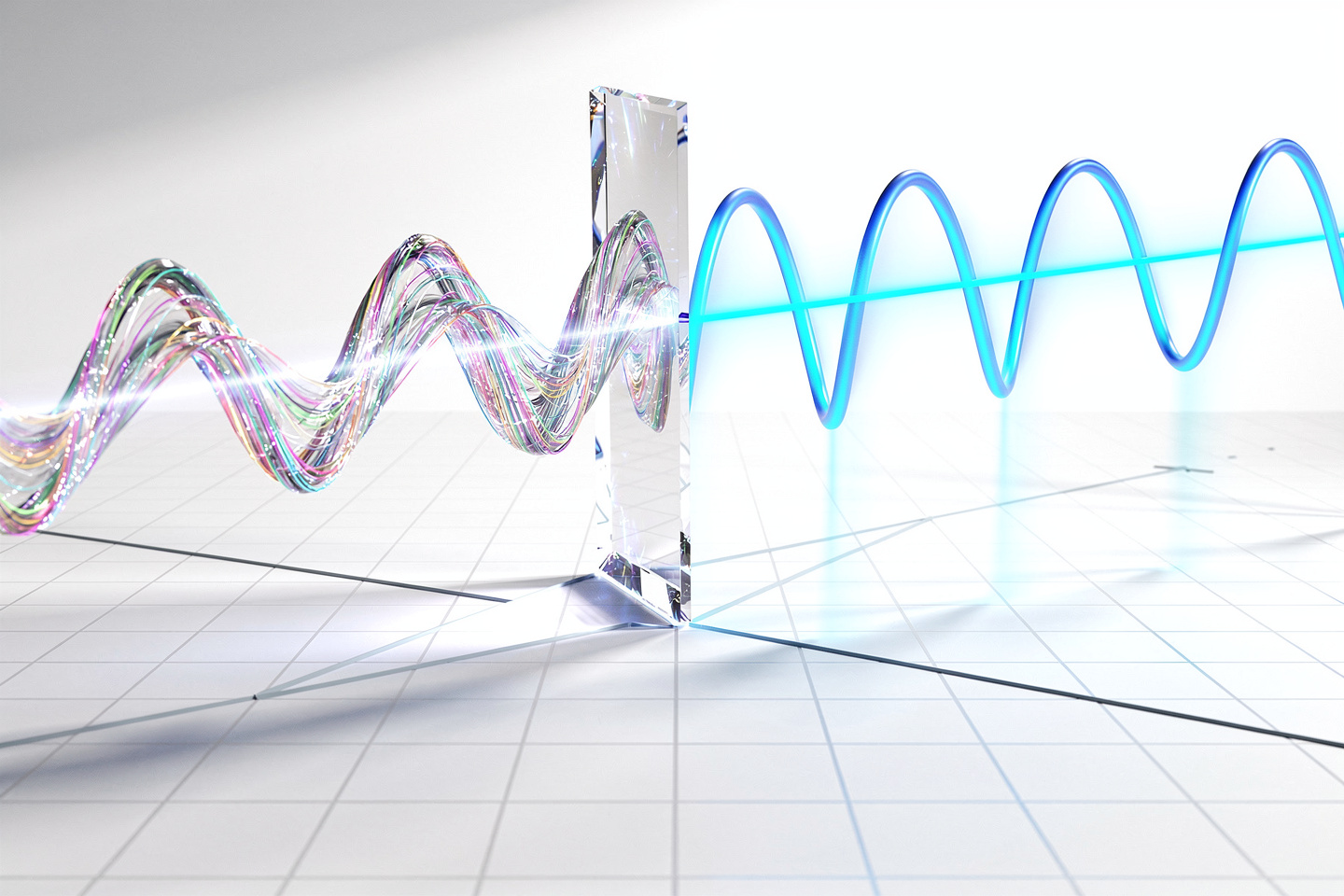
Born in the depths of functional analysis through the efforts of David Hilbert and John von Neumann in the 1920s-30s, the spectral theorem became a bridge between algebra and quantum mechanics. It states that any Hermitian operator (named after Charles Hermite), describing an observable quantity, can be diagonalized: represented as a sum (or integral) over its spectral projections, each corresponding to a specific instrument value. If you have a set of color filters, then any beam can be decomposed into pure colors and then reconstructed by mixing them. The spectral theorem does the same in infinite-dimensional spaces, guaranteeing that for any observable there is a 'set of filters'—spectral projectors—allowing the decomposition of a quantum state into components with definite values.

How it works

MRI works because the energy levels of hydrogen nuclei are eigenvalues of a spin operator, and the spectral theorem guarantees precise separation of signals from different tissues. In JPEG and MP3 compression, the signal is decomposed into a basis; without the mathematical guarantee of completeness and orthogonality provided by the theorem, the decomposition would be unreliable.

💡 Without the spectral theorem, the Schrödinger equation would have remained a mathematical abstraction—it is precisely this that links the electron's wave function to the real spectrum lines we see in a rainbow or in the light of distant stars.
\hat{A} = \sum_n a_n |n\rangle\langle n|
 — operator of the observable, a_n — possible values (eigenvalues), |n⟩ — eigenvectors, ⟨n| — conjugate vector; the sum is taken over all states n (continuous spectrum is replaced by an integral)
Links in the knowledge graph 1
Discovered by
David HilbertJohn von Neumann
Related concepts
Banach spaceeigenvalueFourier seriesfunctional analysisHilbert spacequantum measurementsuperposition
Related laws
Born rulesuperposition principleSchrödinger equation

Related articles

The Skyrmion Dance: How a Magnetic Vortex Conducts the Quantum Orchestra

A hybrid quantum system has been proposed, combining long-lived spin memory, a fast superconducting processor, and a topologically protected mediator — a magnetic skyrmion. Its oscillations bridge the atomic world of defects with macroscopic circuits, overcoming the scale chasm. Calculations promise
arXiv:2505.00266v1 · 2025-05-01

Quantum Debts: When a Photon Has Negative Presence

For the first time, physicists operationally measured how a single photon physically distributes between two paths of an interferometer. It turned out that in the port with destructive interference, 'superlocalization' occurs: the probability of presence in one arm exceeds unity, while in the other
arXiv:2505.00336v2 · 2025-05-01

Symphony of Imaginary Frequencies: Quantum Decay of the Inverted Well

A classical particle rolls off a hilltop, nudged by gravity; its quantum twin is pushed down by the uncertainty principle itself. A new work provides a rigorous solution for the inverted potential well: energy becomes purely imaginary, E = iℏω(n+½), and states decay exponentially. Yet in coherent su
arXiv:2505.00475v2 · 2025-05-01

Cosmic Tango: How Spins Dance with Dark Matter

Armed with a quantum magnetometer that reads nuclear spins with incredible precision, scientists hunted for exotic forces that break mirror symmetry. A tandem of rotating lead masses and a cloud of neon atoms improved previous constraints by a thousandfold. The setup works like a miniature gravitati
arXiv:2505.00483v1 · 2025-05-01

Light in a Cryostat: How Imperfect Converters Build Quantum Bridges

Superconducting quantum computers hit a cooling wall: a single cryostat can't hold millions of qubits. The solution is optical channels, but they need microwave-to-optical converters, which are still far from perfect. The authors showed that with feedback protocols, parallel attempts, and quantum di
arXiv:2505.00542v1 · 2025-05-01

Quantum Measurement as a Deformation of Perception: The Bloch Sphere and the Birth of Categories

A deep connection between quantum measurement and categorical perception: how a continuous spectrum turns into discrete concepts. On the Bloch sphere, wave function collapse deforms distances—pure states 'fall' into mixed ones, distances within a category shrink, and those between categories stretch
arXiv:2505.00777v1 · 2025-05-01

Dance of the Octopus Electron: What Quantum Tunneling Says About the Nature of Reality

Quantum tunneling is not just a trick that lets electrons seep through impassable barriers. It’s a window into the deepest mysteries of reality. It turns out that an electron behaves not as a point, but as a distributed entity—something like an octopus squeezing its tentacles through a crack. This v
arXiv:2505.00872v4 · 2025-05-01

Maximum Quantum Entanglement: Hidden Symmetry and the Mirror Universe

Researchers found that if Higgs particle collisions are required to always produce maximally entangled states, the Higgs potential automatically extends its global symmetry. This leads to an exact symmetry U(2)×U(2), spontaneously broken to U(1)×U(1), giving rise to six massless Goldstone bosons. A
arXiv:2505.00873v1 · 2025-05-01

Quantum Symphony from Noise: How Spontaneous Emission Gives Birth to Entanglement

Contrary to the entrenched view of spontaneous emission as an incoherent process that destroys quantum entanglement, a team of physicists has theoretically demonstrated the possibility of generating near-perfect bipartite entanglement between two bright light fields. The scheme is based on a four-le
arXiv:2505.00919v1 · 2025-05-01

Quantum Tuning Fork: Noise Speeds Up the Search for Single Emitters

Brute-force photon counting from a single emitter gets bogged down in noise, like digging a tunnel with a shovel. But introduce a coherent reference beam and let quantum interference kick in — and the picture changes dramatically: the noisier the environment, the faster the verdict. The extended Hon
arXiv:2505.00950v2 · 2025-05-02

Death and Rebirth of Quantum Echo: A Hierarchy of Temporal Correlations in a Qubit

Physicists made a superconducting qubit forget its past—and saw how three types of temporal correlations (non-macrorealism, temporal steering, temporal non-separability) arrange themselves into a logical ladder. These echoes die at different noise levels and can resurrect when the environment briefl
arXiv:2505.01379v1 · 2025-05-02

The Rydberg Waltz: How a Dance of Losses Amplifies Quantum Sensitivity

Quantum sensors based on Rydberg atoms can detect minuscule electromagnetic fields, but optical readout usually destroys almost all signal photons. Physicists from Warsaw went against the grain and deliberately enhanced nonlinear losses through dipole-dipole collisions of excitations. This paradoxic
arXiv:2505.01506v2 · 2025-05-02

Radical Dance, Frozen by Chirality: How Birds See the Magnetic Field

The work shows how chirality—the property of a molecule not coinciding with its mirror image—turns a weak magnetic signal into a reliable compass. Chirality does not merely create quantum coherence, but induces spin polarization, forcing the system to endlessly 'freeze' in one state. This amplificat
arXiv:2505.01519v1 · 2025-05-02

Quantum Boomerang: Fugue in a Detuned Orchestra

Disordered quantum systems usually stifle any transport, but new simulations have revealed a quantum boomerang: in a discrete walk, the wave packet returns, only not to the starting point, but to the opposite end. The internal state of the coin particle creates an asymmetry without external force—li
arXiv:2505.01532v1 · 2025-05-02

A Glass Loom for Light: 99.7% Fidelity Across 24 Quantum Threads

Researchers from Ephos and the Polytechnic University of Milan inscribed a 24-mode universal photonic processor into glass, using femtosecond lasers like a sewing machine needle. Operating at 925 nm—ideal for quantum-dot single-photon sources—the device is controlled by microheaters and uses less po
arXiv:2505.01609v2 · 2025-05-02

Seven Lives of a Photon: Exceptional Points Control Spontaneous Emission

By combining lithium niobate and gallium arsenide, scientists created a chip. In it, quantum dots interact with microresonator modes, and electro-optic tuning of the feedback phase drives the system to an exceptional point. At this singularity, two modes coalesce, and the spectral density of states
arXiv:2505.05490v1 · 2025-05-02

Quantum Wallet: Energy Teleportation Between Five Qubits

Imagine a shared wallet: one person deposits their paycheck, and the others take turns withdrawing, with the first grabbing the largest bill. In the quantum world, this is how energy teleportation works in a W state — a special kind of multipartite entanglement. Experiment on the IBM Lagos processor
arXiv:2505.01863v1 · 2025-05-03

Quantum Ghosts in the Hall of Mirrors

Usually, nonclassical states of motion require clever tricks. But new research reveals that the intrinsic nonlinearity of an optical trap itself sculpts quantum 'ghosts' from mechanical vibrations — states with a negative Wigner function. No probabilistic schemes needed, even in unresolved sidebands
arXiv:2505.01942v2 · 2025-05-03

Conductor of Heat Death: The Charge Palette of a Quantum Bath

The Mpemba effect, familiar from the paradoxical behavior of water, gains a quantum dimension: in isolated systems, a more non-equilibrium state sometimes relaxes faster. New research reveals the mechanism — the key lies in the symmetry structure of the thermostat's initial state. The wider the ener
arXiv:2505.02040v2 · 2025-05-04

Quantum Internet: How Entanglement Became a Data Packet

Superconducting qubits and optical photons are separated by a five-order-of-magnitude frequency gap. Direct qubit translation is an engineering dead end, but an architectural trick inspired by packet switching turns weak transducers into entanglement generators. Thus the quantum internet transforms
arXiv:2505.02057v4 · 2025-05-04

Gravitational Duet: How Entangled Masses Listen to the Whisper of Other Dimensions

Extra dimensions have long evaded detection due to electromagnetic noise. The protocol of quantum-induced entanglement of masses turns two microscopic bodies in superposition into gravitational tuning forks, accumulating a phase shift exquisitely sensitive to deviations from Newton's law. Analysis o
arXiv:2605.00749v1 · 2026-05-01

Improvisation beneath the horizon: quantum bounce turns a black hole into a white hole

The event horizon of a black hole conceals not a point of infinite curvature, but a zone of quantum transformation, where time itself changes roles. New research in quantum gravity shows: the singularity vanishes thanks to relational dynamics — one of the metric variables serves as a clock, and the
arXiv:2605.01576v1 · 2026-05-02

Phantom Chords of Gravity: Boson Stars as Keepers of Quantum Memory

Quantum systems typically evolve toward equilibrium, losing all memory of their initial state. But occasionally, 'scars' are born — anomalously stable, weakly entangled states that challenge thermalization. New research shows that boson stars in anti-de Sitter space realize such scars, combining cha
arXiv:2605.02446v2 · 2026-05-04

Squeezed Gravitational Waves: How Quantum Optics Reveals the Voice of Black Holes

Black hole collisions transform the quantum whisper of spacetime into a roar that LIGO detectors can catch. Analysis shows that multi-particle graviton emission organizes into a generalized squeezed coherent state, exponentially amplifying fluctuations. Thanks to the double copy between QCD and grav
arXiv:2605.03038v1 · 2026-05-04

The Singularity That Never Was: How Quantum Tango Erases the Beginning of the Universe

In quantum cosmology, the Big Bang singularity turns out to be a mirage. Using relational time emerging from entanglement between subsystems of the universe, physicists have shown: the probability of zero volume is strictly zero. The Page-Wootters formalism transforms a static wave function into an
arXiv:2605.06093v1 · 2026-05-07

When Gravity Knits Quantum Lace: Lessons from the Schrödinger–Newton Model

The hybrid Schrödinger–Newton equation for the first time analytically disentangled two faces of gravity: self-interaction and mutual attraction. It turns out that self-gravity does not alter the Schmidt spectrum, and hence the measure of quantum entanglement; however, the pairwise potential activel
arXiv:2605.06577v1 · 2026-05-07

Quantum Tremor of Parallel Worlds: Gravity on a Laboratory Table

A new theoretical work unites quantum mechanics and general relativity, showing that two parallel atomic lasers, unperturbed in the classical world, begin to diverge under the influence of quantum fluctuations of spacetime. Vacuum tremors of the metric give rise to an irreducible spread of trajector
arXiv:2605.11035v1 · 2026-05-11

Cosmic Spinning Top: Gravity vs. Quantum Superpositions

Mass currents have now been introduced into the Diósi–Penrose wave function collapse model for the first time, adding post-Newtonian corrections from general relativity. It turns out that moving mass generates gravitomagnetic noise, causing angular momentum decoherence. The most dramatic effects app
arXiv:2605.12172v1 · 2026-05-12

Gravitational Radio Forest: How a Hydrogen Quantum Detector Reveals Dark Matter

Astrophysicists have proposed a new method for hunting dark matter — not searching for the black holes themselves, but listening to the quantum echo of gravity. In regions of ionized hydrogen, tidal forces from primordial black holes split the atomic level 2P₃/₂, turning a single 9.9 GHz absorption
arXiv:2605.13042v1 · 2026-05-13

Graviton Laser: Translating Gravity into the Language of Light

The main obstacle for a graviton laser is that gravitational waves cannot be reflected: they pass through any substance. The solution lies in the Gertsenshtein effect. Under a powerful magnetic field, gravity particles temporarily become photons, which are easily reflected by ordinary mirrors. The r
arXiv:2605.14050v1 · 2026-05-13

A Five-Dimensional Trace in the Cosmic Microwave Background

What lies beyond three dimensions? Theories with extra spatial dimensions predict the birth of massive particles in the young Universe. Using the cosmic microwave background as a kind of 'spectrograph,' scientists analyzed data from the Planck satellite looking for imprints of Kaluza–Klein gravitons
arXiv:2607.02651v1 · 2026-07-02