Dance of Bosons: From Chaos to a Checkerboard Pattern ✛
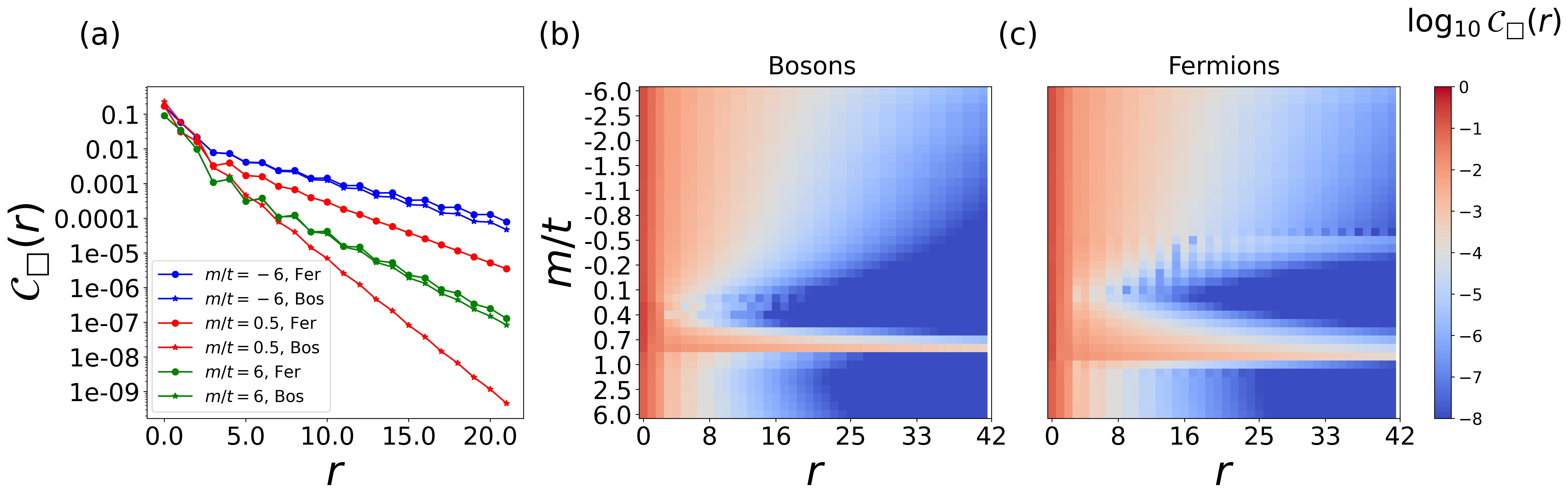
At the heart of the Standard Model, fields, like music, set the rhythm for particles. Previously, the dancers were fermions — loners, each keeping their distance. Hence, their movements were either as rigid as columns, disorderly, or froze into a shapeless mush. But once they were replaced with bosons (particles that love to crowd together, like atoms of helium in a superfluid), the dance transformed.
Where, by all calculations, a mess was expected, vortices with alternating directions appeared — a perfect checkerboard pattern. Behind it, a delicate film of fluid, and only then chaos sets in. It's astonishing that such a fragile structure emerged on its own, without any external hint, just from the change in the particles' 'character'.
This isn't just fun. Fermions are finicky in computations, while docile bosons simplify the modeling of fundamental forces. As Richard Feynman said, nature is not a mistake, but a feature. And entropy governs it all, the measure of disorder, the conductor of transformations.
Bosons are named after Satyendra Bose, who in 1924 sent Einstein a paper on the statistics of light. Together they predicted the Bose-Einstein condensate — a state where a mass of atoms merges into a single giant particle.