Bosons Instead of Fermions: Quantum Simulations of Gauge Theories ✛
Two actors on the same stage. One is a fermion, finicky and demanding, hard to make follow the rules of a quantum simulator. The other is a boson, easygoing and undemanding, ready to take any role. The director hopes the audience won't notice the substitution. And so on stage we have a quantum simulation of a gauge theory, with bosons taking the lead instead of fermions.
Gauge theories describe fundamental interactions, and their lattice versions are the main tool for studying strong interactions. But classical computers hit the sign problem. Quantum simulators promise to bypass this limitation. However, fermionic matter requires significant resources. The researchers numerically studied the phase diagram of the U(1) quantum link model (a lattice gauge field model) with bosonic matter and compared it with the fermionic case. They used the infinite density matrix renormalization group (iDMRG) method on cylinders with circumference 4 and infinite length. To enforce Gauss's law, they added a large energy penalty. Bond dimensions went up to 800.
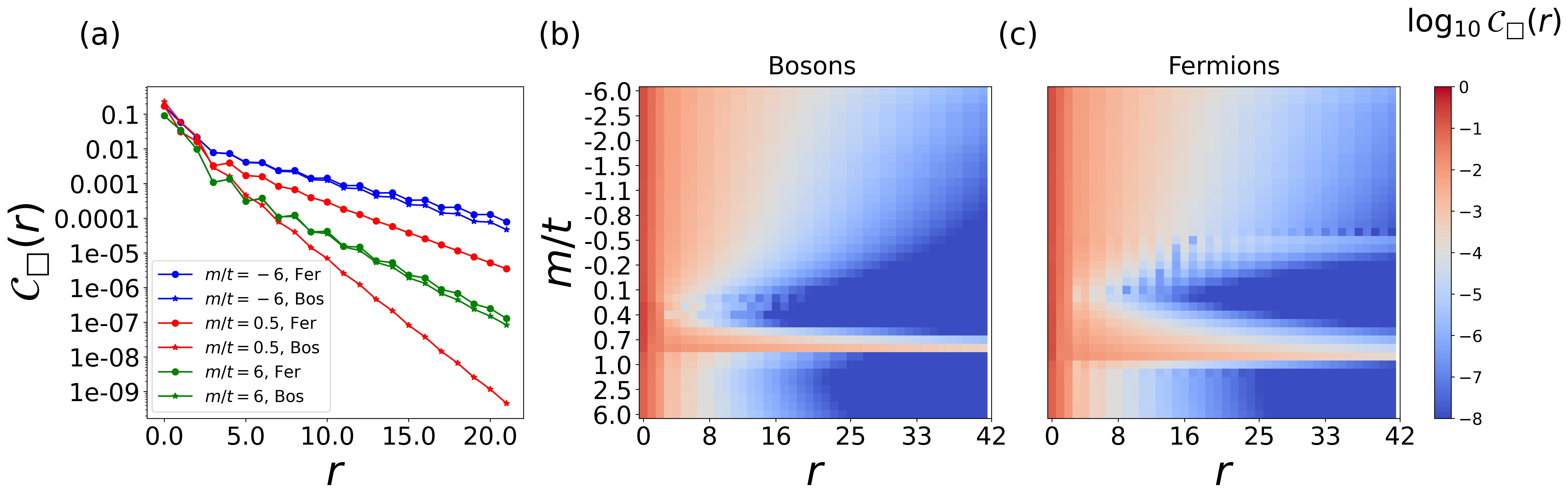
The results showed that the phase diagrams of bosons and fermions are qualitatively similar: both have a transition from a columnar phase to a resonating valence bond phase. However, near zero matter mass, bosons exhibit a sharp drop in entanglement entropy (a measure of quantum correlations in the system) and a peak in the order parameter (a quantity that distinguishes different phases), indicating a narrow ordered phase with alternating plaquette orientation (the elementary cell on the lattice). This phase is absent for fermions. In the confinement phase (a state where charges cannot separate), the correlation functions of both statistics nearly coincide.
The practical value of this work is that in the confinement regime, the statistics of matter does not matter. This opens the possibility of using bosons in quantum simulators of gauge theories, reducing the requirements for implementing fermionic degrees of freedom, which are difficult in cold-atom experiments and on digital quantum computers. Previously, it was unclear whether fermions could be replaced by bosons without losing physics. Now it is shown that in the confinement phase, bosons and fermions give identical results, and differences appear only near the phase transition. This comparison of phase diagrams and correlation functions for the two statistics, obtained with the iDMRG numerical method, simplifies the implementation of quantum simulators for gauge theories.
In the end, the two actors leave the stage, and the audience understands: for the main scene of confinement, it doesn't matter who played, boson or fermion. The substitution worked. And now directors of quantum simulators can confidently choose cheaper actors.
In one-dimensional systems, fermions and hard-core bosons are indistinguishable, but already on a cylinder of width 2, differences appear near zero mass.