Bosons Instead of Fermions: Quantum Simulations of Gauge Theories ✛
Context
Lattice gauge theories are the primary tool for studying strong interactions, but their dynamics on classical computers hit the sign problem. Quantum simulators promise to bypass this limitation, yet fermionic matter requires substantial resources. This work follows the search for more accessible alternatives: nearby research explores quantum algorithms, quantum error correction, and quantum information in the context of gauge models. This study tests how well bosons can replace fermions in such simulations.
Methods
The authors used the infinite density matrix renormalization group (iDMRG) method on cylinders with circumference 4 and infinite length. To enforce Gauss's law, they added a large energy penalty. Bond dimensions reached up to 800. Order parameters were studied: the chiral condensate for matter, and flipability and plaquette orientation operators for gauge fields. They also computed entanglement entropy and plaquette correlation functions.
Results
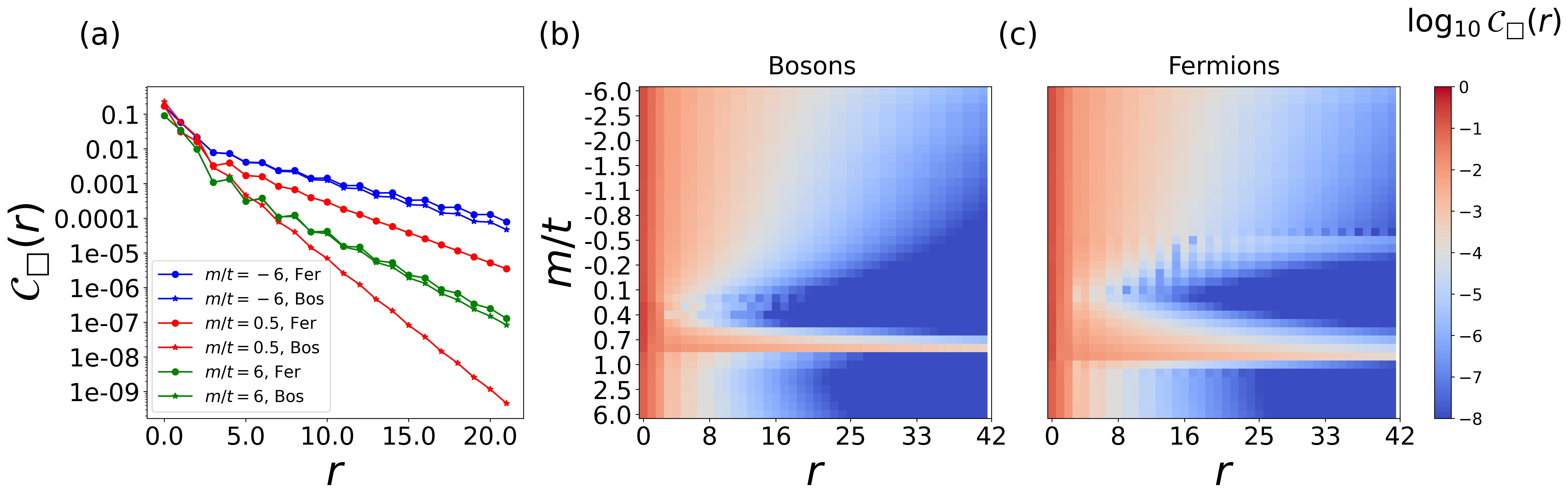
The phase diagrams for bosons and fermions are qualitatively similar: both show a transition from a columnar phase to a resonating valence bond phase. However, near zero matter mass, bosons exhibit a sharp drop in entropy and a peak in the order parameter, indicating a narrow ordered phase with alternating plaquette orientation. This phase is absent for fermions. In the confining phase, correlation functions for both statistics nearly coincide. Numerically, the transition for bosons is likely first-order, but second-order cannot be ruled out.
Implications
This work shows that in the confining regime, the statistics of matter does not matter, opening the possibility of using bosons in quantum simulators of gauge theories. This differs from neighboring works that focus on quantum algorithms and error correction; here the focus is on the physics of phase transitions. Practically, this reduces the requirements for implementing fermionic degrees of freedom, which are challenging in cold-atom experiments and on digital quantum computers.
Future development
The topic could evolve toward a more precise determination of the nature of the phase transition for bosons, as well as studies of dynamics and excited states. Extension to non-Abelian gauge groups and larger lattice sizes is possible. Experimental realizations on cold-atom platforms and ion traps could test the predictions.
Impact
The results will influence the design of future quantum simulators of gauge theories, especially for confinement and string-breaking problems. They are also useful for developing more efficient quantum algorithms.
Next steps
The next step is a detailed study of the nature of the phase transition for bosons and verification of the results on experimental platforms. It is also important to investigate dynamics and behavior at finite density.
Key open problems
This work is connected to the fundamental problem of understanding phase transitions in gauge theories and the role of particle statistics. It also touches on the question of which degrees of freedom are necessary to reproduce the physics of strong interactions in quantum simulators.
The knowledge machine's view
This section is addressed to the author of the paper and their colleagues. Neighbouring works were found by meaning-based search across our archive, not by word overlap. We do not review: we show the field around the work.
What the work does
The authors numerically studied the phase diagram of the U(1) quantum link model with bosonic matter using the iDMRG method and compared it with the fermionic case. In the confining phase, the physics is independent of the matter statistics, but near zero mass, bosons exhibit a narrow ordered phase with alternating plaquette orientations.
Where its strength is
The work shows that in the confinement regime, the statistics of matter is irrelevant, which opens the possibility of using bosons in quantum simulators of gauge theories, reducing the requirements for implementing fermionic degrees of freedom.
Where it could go next
- It might be interesting to look at the connection with the work where tensor networks are applied to field theory: it discusses how tensor methods capture properties of field theories, which could suggest new observables for distinguishing phases near the transition.based on: Spacetime Bricks: How Tensor Networks Catch an Elusive Field Theory arXiv:2607.03534
- Nearby lies a work on quantum error correction; it could be useful for assessing the feasibility of bosonic simulators on real hardware, especially in the context of suppressing noise when implementing gauge symmetries.based on: Why the Quantum Computer Isn't in a Hurry to Make Mistakes arXiv:2606.18396
- Another adjacent work discusses how to remove disturbances in a quantum simulator; its approach to error control could be adapted for bosonic link models to test the stability of the found ordered phase.based on: How to Clean Up Noise in a Quantum Simulator arXiv:2606.15518
Worth trying
- Test whether the narrow ordered phase persists when realistic noise is added, using methods from the work on disturbances in a quantum simulator.
- Use tensor networks to compute additional observables, such as topological invariants, to better characterize the transition in bosons.
- Estimate the resources needed to implement the bosonic model with error correction, drawing on schemes from the work on quantum correction.
Why this may matter
If bosons indeed reproduce the physics of confinement, this could greatly simplify quantum simulators of gauge theories, making them more accessible for cold-atom experiments and on digital quantum computers.
Nearby works in our archive
- One Neural Network for Two Worlds: Bosons and Topologysimilarity 0.52
- Spacetime Bricks: How Tensor Networks Catch an Elusive Field Theorysimilarity 0.51
- Why the Quantum Computer Isn't in a Hurry to Make Mistakessimilarity 0.51
- How to Clean Up Noise in a Quantum Simulatorsimilarity 0.50
- How to See Invisible Fermions with Chameleon Atomssimilarity 0.50
- Quantum First Aid for Power Gridssimilarity 0.49
The archive is sparse around this work: the closest review is only 0.52, against a usual 0.64. It looks like few have drilled nearby.
In one-dimensional systems, fermions and hard-core bosons are indistinguishable, but already on a cylinder of width 2, differences appear near zero mass.
Key numbers
- cylinder circumference: 4
- bond dimension: 800
- lattice size in recent Quantinuum experiment: 3×4
- entropy scaling exponent: 1/6