Quantum Geometry Imprints in the Black Hole Shadow ✛
Context
The paper sits at the crossroads of two research directions: loop quantum gravity (LQG) and dark energy models via quintessence. Neighboring works study LQG black hole shadows, their evaporation, ringdown, and light deflection, but rarely consider the combined influence of quantum corrections and the quintessence field. This work fills that gap by introducing a metric that unifies both effects.
Methods
The authors construct a metric for a spherically symmetric black hole, adding to the classical Schwarzschild solution the LQG quantum corrections (parameters α and B) and the quintessence contribution (parameters c and w). They then study horizons, geodesics, the shadow, quasinormal modes, and the light deflection angle both numerically and analytically. For light deflection, they apply a modified Gauss-Bonnet method, and for quasinormal modes, a sixth-order WKB approximation.
Results
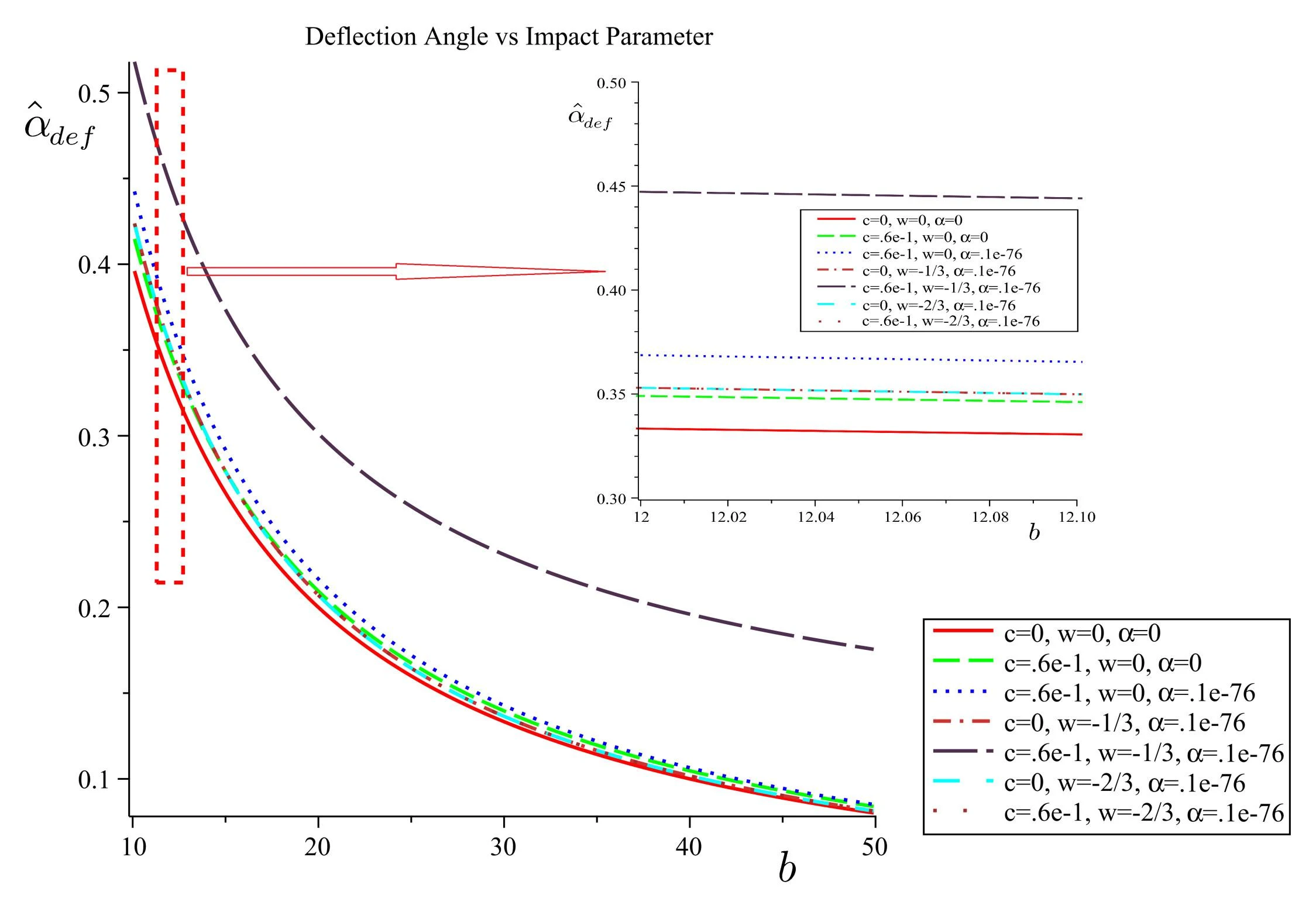
The main result is a triple horizon for w = -2/3, c = 0.06, and α = $10^{-77}$: horizons at r ≈ 0.66, 1.58, and 14.43. Quantum corrections always generate an inner horizon, while quintessence can add a distant cosmological horizon. The black hole shadow grows with increasing c and shrinks with increasing α and B. Quasinormal modes remain stable (imaginary part negative), with increasing α raising the frequency and slowing the damping, while increasing c does the opposite. The light deflection angle has a hierarchy of contributions: the classical term 4M/b, the quintessence term depending on w, and three quantum terms with higher powers of 1/b.
Implications
The work follows the general line of LQG black hole research but stands out by systematically including quintessence. Unlike neighboring works that treat quintessence or LQG separately, here their combined influence on all major observables is shown: horizons, shadow, quasinormal modes, and lensing. This is the first work where a triple horizon is obtained specifically for an LQG black hole with quintessence.
Future development
A natural extension is including rotation: a Kerr metric with LQG corrections and quintessence would provide a more realistic model. Also promising is studying the thermodynamics of such black holes, their evaporation, and gravitational-wave signals from mergers. Future observations by the Event Horizon Telescope or LISA might be able to distinguish the contributions of quantum geometry and dark energy.
Impact
The results could influence the interpretation of supermassive black hole shadow observations and models of gravitational lensing in galaxy clusters.
Next steps
The next step is generalizing to rotating black holes and computing gravitational-wave signals from mergers of such objects.
Key open problems
For black hole physics, the key unresolved problem is the fate of the singularity and information during evaporation. LQG offers a regular core, while quintessence changes the asymptotics; their combined action may shed light on the global causal structure.
The knowledge machine's view
This section is addressed to the author of the paper and their colleagues. Neighbouring works were found by meaning-based search across our archive, not by word overlap. We do not review: we show the field around the work.
What the work does
The authors constructed a metric for a spherically symmetric black hole that combines quantum corrections from loop quantum gravity (parameters α and B) with a quintessence field (parameters c and w). They investigated horizons, geodesics, shadow, quasinormal modes, and the light deflection angle both numerically and analytically; for the deflection they used a modified Gauss–Bonnet method, and for quasinormal modes a sixth-order WKB approximation. They found a triple horizon structure for w = -2/3, c = 0.06, and small α, as well as systematic dependencies of the observables on the parameters.
Where its strength is
For the first time, the combined influence of LQG quantum corrections and quintessence on all major observables—horizons, shadow, quasinormal modes, and lensing—has been systematically accounted for. This provides a comprehensive picture and opens the way for testing such models with observations.
Where it could go next
- It might be interesting to compare the shadow predictions with Event Horizon Telescope data, as done for LQG black holes without quintessence in the loop black hole and shadows paper.based on: A Black Hole of Loops and Shadows arXiv:2606.12698
- There is a nearby study of quasinormal modes for nonsingular black holes; perhaps their ringing analysis method could be applied to your metric with quintessence to isolate characteristic signatures of quantum corrections.based on: A Black Hole Rings Differently If There's No Singularity at Its Core arXiv:2605.11364
- In the archive there is a paper on how a black hole 'melts' during evaporation with quantum effects; it would be interesting to see how quintessence affects the evaporation process in your model.based on: How a Black Hole Melts Before Your Eyes arXiv:2605.13714
Worth trying
- Try applying the shadow calculation method from the loop black hole paper to your metric with quintessence and compare the parameter constraints.
- Use the quasinormal mode approach from the nonsingular black hole paper to search for specific frequencies sensitive to the triple horizon.
- Assess how the quintessence field changes the evaporation rate, following the methods of the paper on black hole 'melting'.
Why this may matter
Such models may yield observational signatures of the combined influence of quantum gravity and dark energy, which is important for future high-precision black hole observations.
Nearby works in our archive
- A Black Hole of Loops and Shadowssimilarity 0.57
- How a Black Hole Melts Before Your Eyessimilarity 0.57
- Whirlpools Around Black Holes: A Key to Dark Mattersimilarity 0.55
- Black Hole Shadows: Geometry in the Service of Gravitysimilarity 0.55
- A Black Hole Without a Breaking Pointsimilarity 0.54
- A Black Hole with a Curved Momentum Spacesimilarity 0.54
- A Black Hole Rings Differently If There's No Singularity at Its Coresimilarity 0.54
The archive is sparse around this work: the closest review is only 0.57, against a usual 0.64. It looks like few have drilled nearby.
The parameter α in the metric is proportional to the cube of the Barbero-Immirzi parameter, which in LQG is fixed from black hole thermodynamics and equals approximately 0.2375.
The idea of a triple horizon echoes the novel 'Light' by M. John Harrison, where black holes possess complex internal structure and quantum effects alter the very fabric of space.
Key numbers
- triple horizon: r ≈ 0.66, 1.58, 14.43 for M=1, w=-2/3, c=0.06, α=10-77
- Barbero-Immirzi parameter: γ ≈ 0.2375
- characteristic value of α: ~10-77 for a solar-mass black hole
- characteristic value of B: ~1038 for a solar-mass black hole