Quantum Geometry Imprints in the Black Hole Shadow ✛
The shadow of a black hole is not just a dark silhouette. It is an imprint of the entire spacetime geometry, including the subtlest quantum effects. When astrophysicists look at images of event horizons, they see not a black disk but a layered cake of curved space, exotic matter, and quantum foam.
A classical Schwarzschild black hole has a single horizon, beyond which lies the singularity. But if you add quantum corrections from loop quantum gravity, an inner horizon appears. And if you surround the hole with a quintessence field, a dynamic dark energy, an outer cosmological horizon may also emerge. Together they form a triple boundary, where light gets trapped between three surfaces, as in a maze.
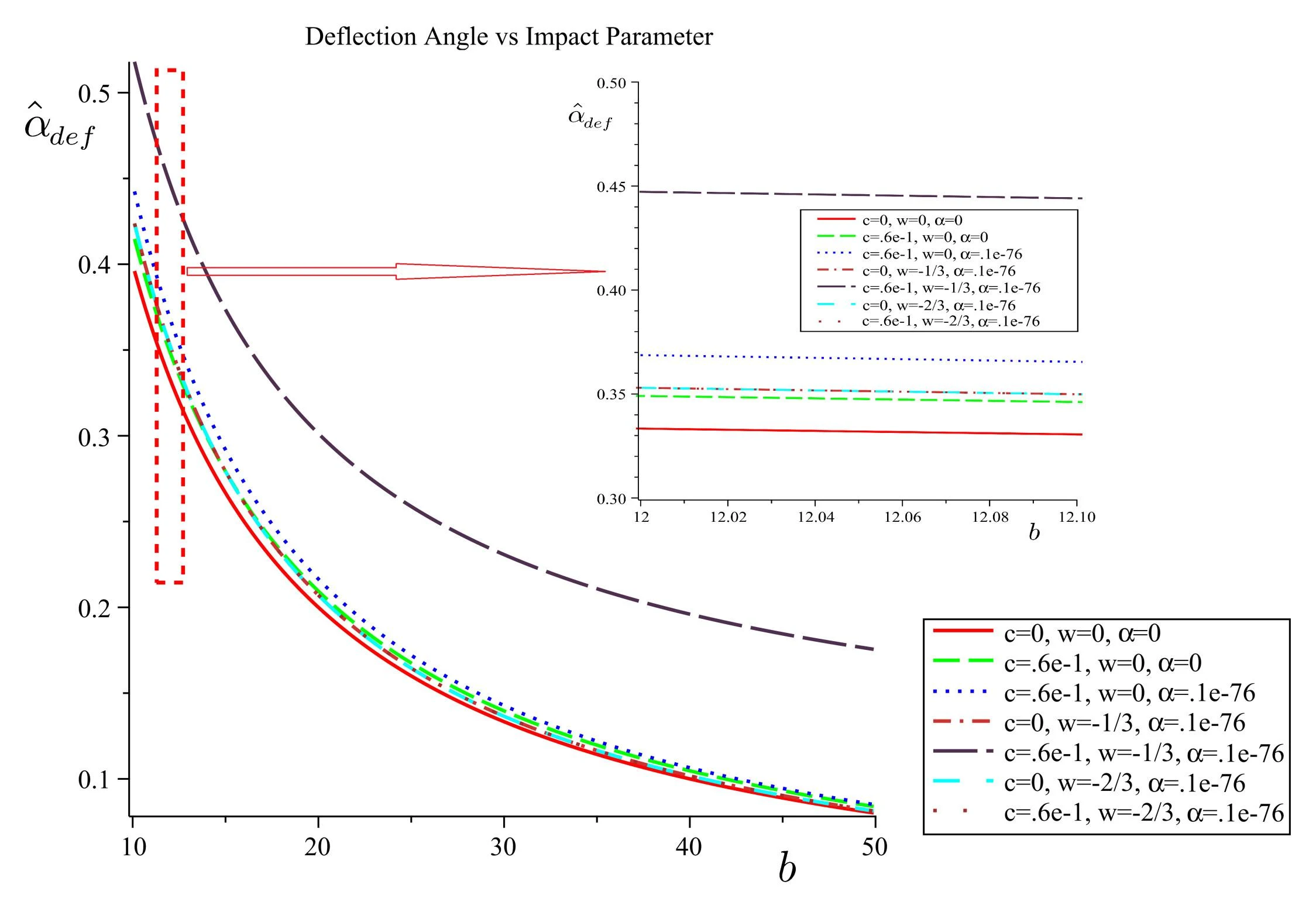
The researchers constructed a metric combining both effects and calculated what happens to the shadow, quasinormal modes, and light deflection. It turns out that quintessence enlarges the shadow, while quantum corrections shrink it. The oscillation frequencies of the black hole increase with stronger quantum effects, but they decay more slowly. The light deflection angle decomposes into a hierarchy of contributions: the classical, the quintessence, and three quantum terms.
This work is a step toward future observations. The Event Horizon Telescope already measures shadows of supermassive black holes, and gravitational-wave observatories like LISA could detect the ringdown of such objects. If quantum geometry and dark energy indeed leave traces in these signals, we will have a new way to test loop quantum gravity and the nature of dark energy.
The parameter α in the metric is proportional to the cube of the Barbero-Immirzi parameter, which in LQG is fixed from black hole thermodynamics and equals approximately 0.2375.
The idea of a triple horizon echoes the novel 'Light' by M. John Harrison, where black holes possess complex internal structure and quantum effects alter the very fabric of space.