Quantum Crossroads with No Turning Back ✛
In a chain of cold spins stretched along a single line, order and disorder can intertwine into a pattern that defies the usual rules. Two states of matter, two kinds of "order," are separated by a crossroads where the roads do not converge but diverge. It is exactly such a crossroads that the authors of the new work have built—and they showed that you can pass through it without a jump, continuously transforming one exotic phase into another.
The subject is irreversible symmetries. An ordinary symmetry is an operation that can be reversed: you rotate a square by 90 degrees, rotate it back, and you return. An irreversible symmetry is like multiplying by zero: it permutes states, but no inverse operation exists. Such symmetries have recently been discovered in simple models, and they impose strict constraints on possible phases. In one-dimensional spin chains, they allow states where order and disorder coexist—like two voices sounding simultaneously.
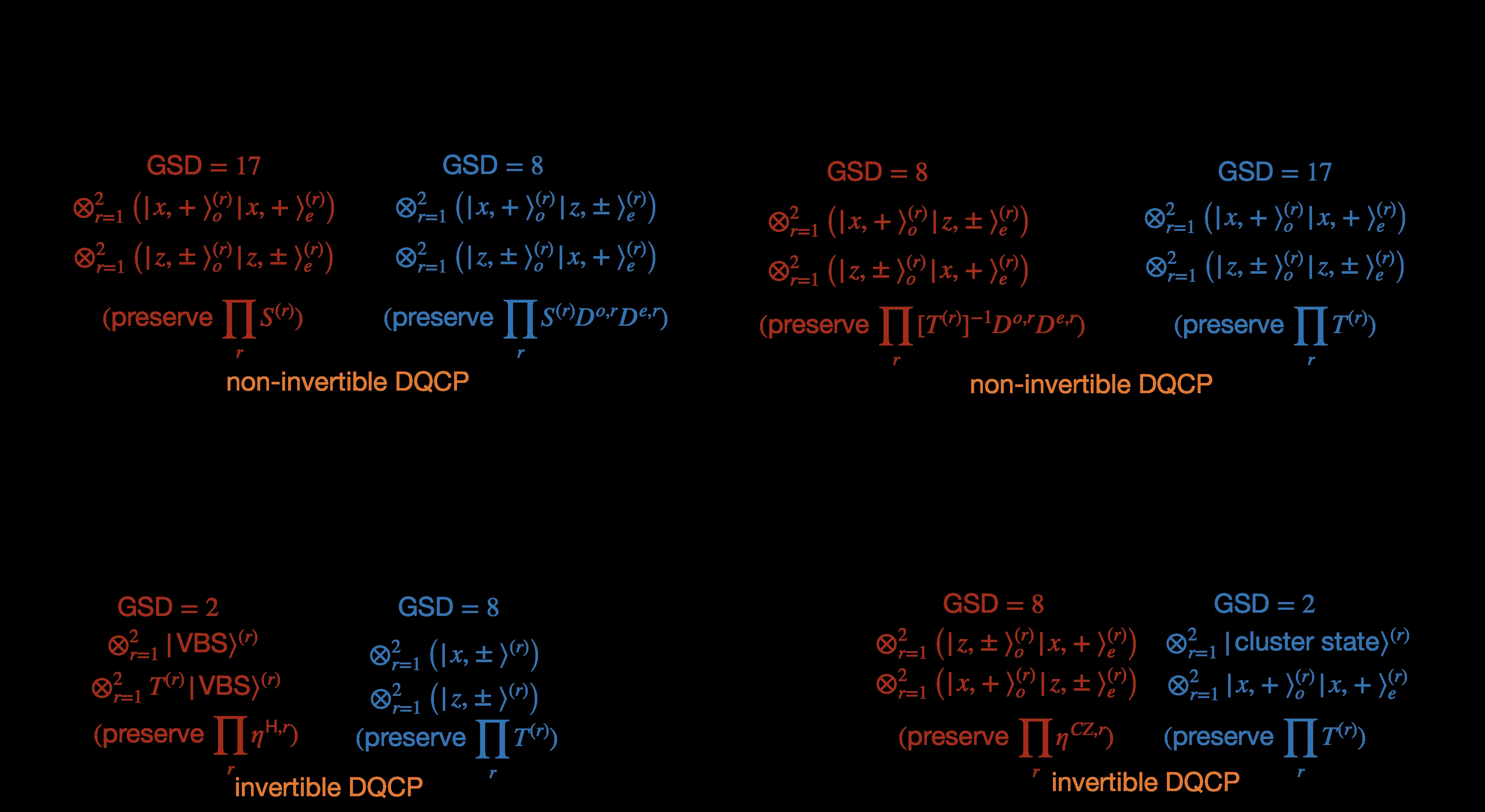
To see a transition between two phases with different irreversible symmetries, the authors took two identical spin chains and coupled them with a weak interaction. It turned out that by fine-tuning one quantity—the coupling parameter—you can go from a phase dominated by one irreversible symmetry to a phase with another, without encountering a forbidden gap. At the critical point, a new, emergent symmetry arises—the "cosine" symmetry—which swaps the order parameters of both phases. This guarantees that both phases look the same from the perspective of scaling properties.
Such a transition resembles deconfined quantum critical points—special points where two different ordered phases touch without a gap. Previously, these were constructed as exceptions, by tailoring models. Here, an analytic mechanism is proposed: irreversible symmetries of one system, when "gauged" (converted into ordinary ones), generate anomalies that create the deconfined transition. This is not just a finding for one model; it is a tool for classifying exotic quantum transitions.
Until now, it was unclear whether direct continuous transitions between phases breaking different irreversible symmetries could exist, and how to describe them analytically. Now it is clear: they can. An explicit model of two coupled spin chains has been constructed, where such a transition exists and is described by bosonization—a method that replaces spins with collective oscillations. The transition is shown to be robust to gauging, which allows generating whole families of new critical points. This approach can be used to search for and classify new quantum critical points in one-dimensional systems and to interpret numerical experiments.
The crossroads where roads diverge turned out not to be a dead end, but a fork. Standing at it, a physicist gains a map for traveling through the land of quantum phases, uncharted in standard atlases. Perhaps here lie the keys to new states of matter and future quantum technologies.
A non-invertible symmetry is like an operation that cannot be undone: it permutes states but has no inverse, much like multiplying by zero in arithmetic.