Quantum Transitions Without the Usual Symmetries ✛
Context
Quantum phase transitions are usually described by the breaking of ordinary group symmetries, as in Landau theory. However, recently discovered non-invertible symmetries, such as the Kramers–Wannier symmetry in the Ising model, impose stricter constraints on phase diagrams and allow exotic phases where order and disorder coexist. Alongside this work on the archive are studies of quantum memory, time crystals, and entanglement, but this paper stands apart: it is the first to build an analytic theory of a transition between two phases with different non-invertible symmetries in a one-dimensional system.
Methods
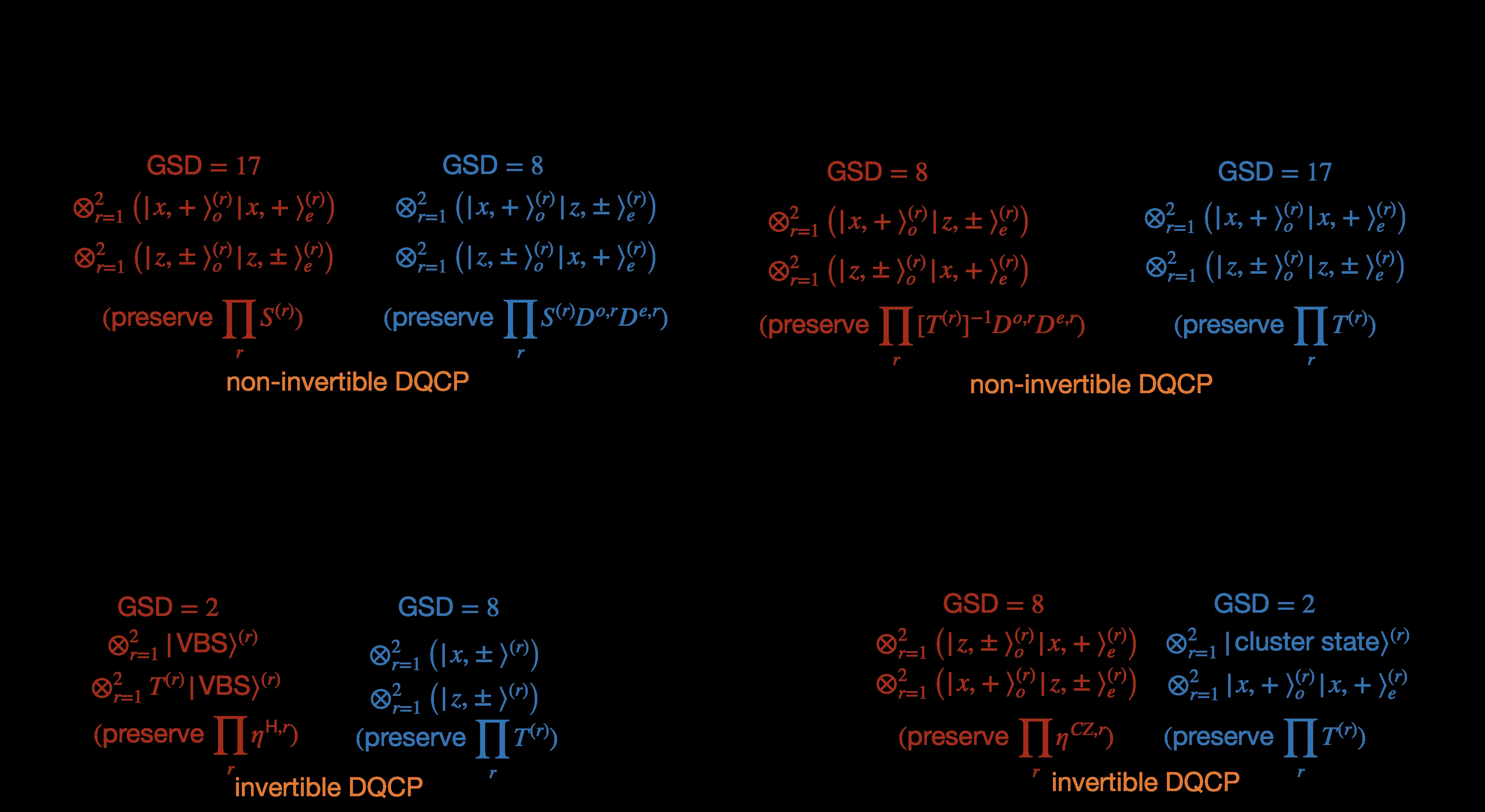
The authors use the Baxter transformation, a gauge for non-invertible symmetry that maps a model with non-invertible symmetries to one with only ordinary symmetries. Then bosonization is applied to describe the low-energy physics near the critical point. To obtain a transition between non-invertible phases, two coupled spin chains are considered with a copy-exchange symmetry. The interaction between chains generates relevant perturbations that destroy the intermediate gapless phase and lead to a direct continuous transformation.
Results
A one-parameter tuning is found for the transition between phases breaking different non-invertible symmetries: the (DoDe, SDoDe)-breaking and (S, DoDe)-breaking phases. At the critical point, an emergent continuous non-invertible 'cosine' symmetry appears, along with an enhanced Kramers–Wannier-like self-duality that swaps the order parameters of both phases. This guarantees equal scaling dimensions for the order parameters. The transition is shown to be robust to gauging spin symmetries, which allows generating families of new deconfined quantum critical points.
Implications
Unlike neighboring works that mostly investigate specific models numerically, here an analytic mechanism is proposed linking non-invertible symmetries to deconfined criticality. This provides a universal tool for constructing and classifying exotic quantum phase transitions. The result also shows how anomalies arising in the gauged system can manifest as emergent anomalies in the original model.
Future development
It is natural to look for simpler microscopic models with fewer symmetries that realize such transitions. Another direction is to investigate whether the combination of the emergent cosine symmetry and imposed symmetries forbids the existence of a symmetric gapped phase, which would give a transparent explanation of the deconfined transition. Also open is the question of whether analogous transitions are possible in higher dimensions.
Impact
The results could influence the theory of quantum criticality in condensed matter and the understanding of generalized symmetries in quantum field theory.
Next steps
Search for a minimal lattice model and test predictions with numerical methods such as DMRG.
Key open problems
This work is directly related to the open problem of classifying phase transitions beyond the Landau–Ginzburg–Wilson paradigm and to the question of how non-invertible symmetries constrain possible phase diagrams.
The knowledge machine's view
This section is addressed to the author of the paper and their colleagues. Neighbouring works were found by meaning-based search across our archive, not by word overlap. We do not review: we show the field around the work.
What the work does
The paper constructs a model of two coupled spin chains that realizes a continuous transition between phases with different non-invertible symmetries. Using the Baxter transformation and bosonization, the authors show that the transition is robust to gauging the spin symmetries, which allows generating families of deconfined critical points.
Where its strength is
The strong point is the explicit analytic construction of a transition between phases with different non-invertible symmetries, providing a universal mechanism for generating deconfined criticality.
Where it could go next
- It might be interesting to see how the emergent cosine symmetry and self-duality appear in other lattice realizations of non-invertible symmetries, for example in models with non-Hermitian perturbations.based on: How non-Hermitian impurities change the rules of the game arXiv:2608.04083v1
- A nearby direction connects symmetry anomalies to defect behavior: one can check how gauging non-invertible symmetries affects the properties of defect lines in two-dimensional systems.based on: A Family Affliction: Why Charged Lines Refuse to Respect Symmetry arXiv:2608.04248v1
- Perhaps the proposed mechanism admits a generalization to transitions without breaking any symmetries, where criticality arises from topological or other non-ordering parameters.based on: Phase Transition Without Symmetry Breaking arXiv:2603.22736
Worth trying
- Test the construction on lattice models with non-Hermitian terms to check the stability of the transition to complex perturbations.
- Investigate how the emergent anomaly manifests in the defect spectrum after gauging, possibly by computing the charge of a defect line.
- Look for analogous transitions between phases without symmetry breaking, using loop or string operators as the order parameter.
Nearby works in our archive
- How magnets change the nature of a quantum transitionsimilarity 0.52
- Phase Transition Without Symmetry Breakingsimilarity 0.52
- A Family Affliction: Why Charged Lines Refuse to Respect Symmetrysimilarity 0.52
- The Wandering Vacuum: How Quantum Divergences Become Classical Noisesimilarity 0.52
- How non-Hermitian impurities change the rules of the gamesimilarity 0.52
- Crackling in quantum processor silenced for secondssimilarity 0.51
The archive is sparse around this work: the closest review is only 0.52, against a usual 0.64. It looks like few have drilled nearby.
A non-invertible symmetry is like an operation that cannot be undone: it permutes states but has no inverse, much like multiplying by zero in arithmetic.
Key numbers
- number of chain copies: 2
- central charge of the critical point: 2
- scaling dimension of order parameters: equal to the Luttinger parameter K<1
- ground state degeneracy in one of the phases: 5
- spacetime dimension: 1+1