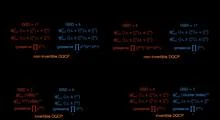
Hidden ordertransitions are phase transitions where the system's symmetry breaks in a way that is not immediately visible in simple measurements. Unlike familiar transitions like freezing or magnetizing, the new order parameter is subtle and often involves correlations between multiple degrees of freedom rather than a simple local quantity. This concept is central to understanding complex systems where apparent disorder masks an underlying, non-obvious structure.
How it works
In a hidden ordertransition, the system undergoes a change in its macroscopic state, but the order parameter—the quantity that becomes nonzero in the ordered phase—is not directly accessible through standard probes. Instead, it manifests through higher-order correlations or through indirect effects on other properties. The transition is driven by the competition between energy terms that favor different types of ordering, with the hidden order emerging from a delicate balance.
In practice
Understanding hidden ordertransitions is crucial for interpreting experiments in condensed matter physics, particularly in materials like heavy-fermion compounds and certain superconductors, where the nature of the ordered state remains debated.
Fun fact
In some systems, a hidden ordertransition can be detected only through measurements of the specific heat or thermal expansion, while the magnetic susceptibility remains completely featureless.
The universe is like a layered cake, and our layer (stars, planets, and people) is just one of many. In a neighboring layer, which physicists call the hidden sector, processes are boiling away. This work describes one such process: a first-order phase transition, where matter abruptly changes state, like water turning into ice.
Hot water sometimes freezes before cold: this is the Mpemba effect. In the quantum realm, a similar paradox appears: the more the equilibrium is disrupted, the faster it recovers. It's like fleeing from disorder (entropy) in reverse: the system rushes toward order, and a large initial imbalance only helps.
Every group has its unspoken trios: three friends who are always together. And there are pairs that exist on their own. It turns out that how much trios "contain" pairs determines how everything, from a virus to a new idea, spreads through the group.
Scientists introduced a measure they call the nesting coefficient.
An orchestra without a conductor is playing, and suddenly, without any visible cue, the violins grow louder and the woodwinds shift slightly in time. From the outside, nothing seems to have changed, but inside the ensemble, a regrouping has occurred. This is roughly how small physical systems behave during so-called third-order pseudotransitions.
The quantum world loves order, but reality often brings disorder. In this work, physicists study one-dimensional chains of spins — tiny magnetic arrows that can point up or down. Usually, topological phases (stable states protected by symmetry) are defined for pure states, where each arrow is precisely known.
The crystal CeB6 is like a box with a secret: inside it, electrons can occupy four nearly identical positions, like four chairs around a table. While no one is watching, the electron seems to sit on all four at once. Physicists call this hidden state quadrupolar, and it affects magnetic properties, but it is hard to see directly.
In a chain of cold spins stretched along a single line, order and disorder can intertwine into a pattern that defies the usual rules. Two states of matter, two kinds of "order," are separated by a crossroads where the roads do not converge but diverge.