A Kilometer-Long Photonic Bridge Between Quantum Refrigerators ✛
Context
Neighboring papers on the archive tackle the same problem: linking quantum devices through optical channels. Some build quantum bridges within a single cryostat, others teleport microwave states at elevated temperatures, and still others treat entanglement as a data packet. This paper takes the next step: it extends the photonic channel beyond a single refrigerator and connects two independent cryostats with a kilometer of optical fiber. This is the first realization of a coherent channel between distant superconducting circuits, not just between components of one setup.
Methods
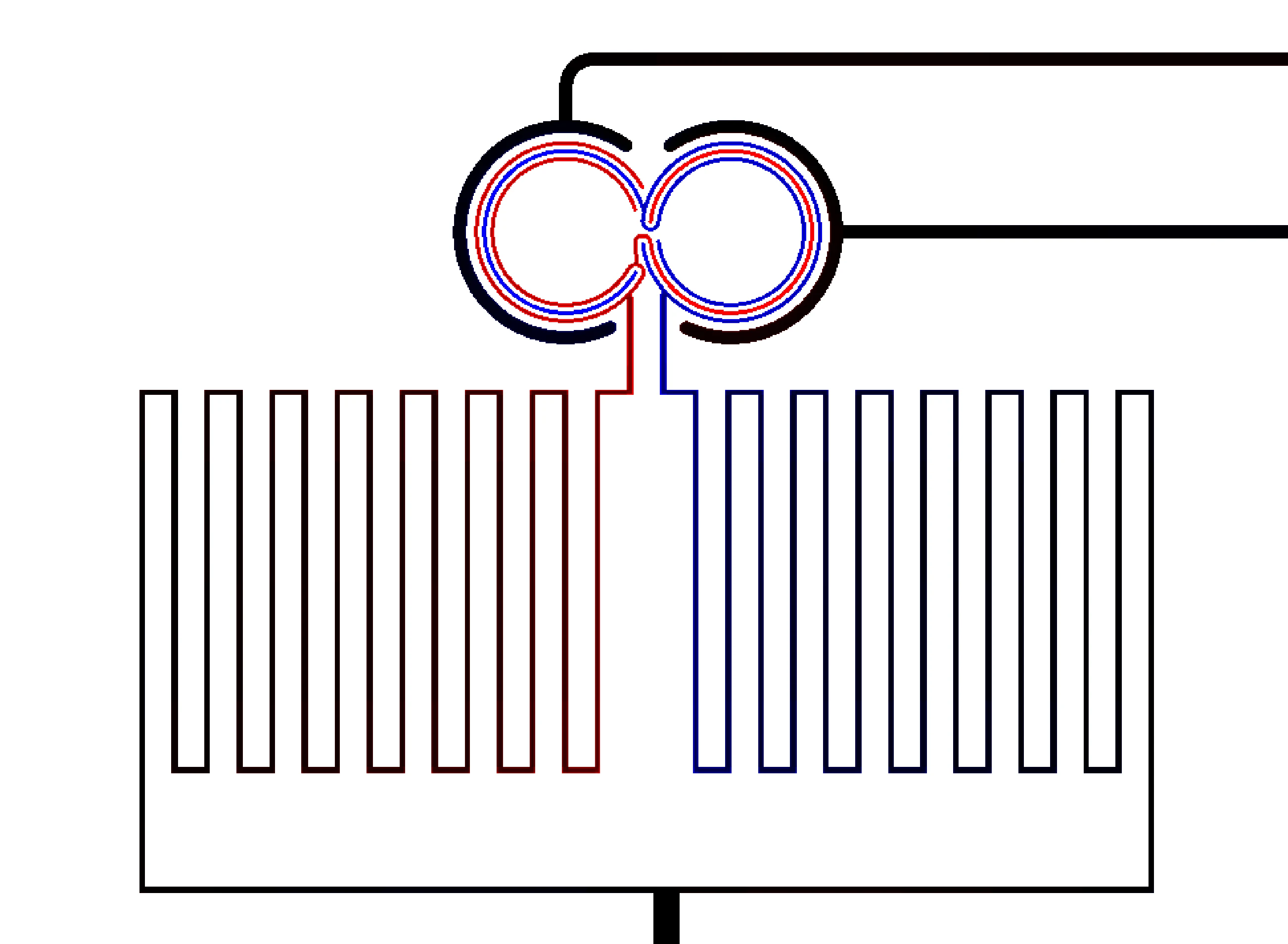
Two aluminum nitride electro-optic converters are installed in separate dilution cryostats at 50 mK. Each converter consists of a superconducting niobium resonator and an optical double ring. A microwave pulse at 9.960 GHz is fed to the first converter (Felix), converted into an optical photon, and sent through a 1 km length of SMF-28e single-mode fiber. At the second converter (Albert), the optical signal is converted back to microwave at 4.606 GHz. The resonator frequencies are tuned with DC voltages up to 160 V, and matching between the pair is achieved via the Vernier effect: a small difference in free spectral ranges guarantees a nearly coincident pair of resonances in the telecom band.
Results
Both converters showed on-chip conversion efficiency above 0.1% at an optical power of about 4 mW. The conversion bandwidth was 34.5 MHz for Felix and 13.0 MHz for Albert. The total microwave-optics-microwave line efficiency reached −60 dB on chip, which is 80 dB better than a pair of commercial electro-optic modulators. Channel coherence was confirmed by measuring the phase of the scattering matrix and by interference with a local oscillator. Data in QPSK format was transmitted through the channel with a clean signal constellation at microwave power below −30 dBm.
Implications
This work differs from neighboring studies in that it realizes, for the first time, a photonic channel between two separate cryostats rather than within one. Neighboring works are either confined to a single refrigerator or use wavelengths incompatible with telecom fiber. Here, the pair of aluminum nitride converters operates in the standard 1550 nm band and is frequency-matched to within gigahertz. This removes the main obstacle to scaling superconducting quantum processors: the physical isolation of cryostats.
Future development
The next step is to generate entanglement between microwave photons in two cryostats using heralding schemes. This would bypass the 50% efficiency threshold for quantum communication. In parallel, converter efficiency can be improved by reducing mode volumes and enhancing resonator quality factors. Increasing the gap between the electrodes and the optical ring will reduce added noise without sacrificing efficiency.
Impact
The result directly impacts the architecture of modular quantum computers and future quantum networks. A kilometer-long photonic channel between cryostats is a ready-made building block for distributed superconducting processors.
Next steps
Implement entanglement of microwave photons between two cryostats via a photonic channel using heralding schemes. Optimize electrode geometry to reduce added noise while maintaining conversion efficiency.
Key open problems
For superconducting quantum computing, the main unsolved problem is scaling beyond a single cryostat. This work shows that photonic channels can link remote superconducting circuits without loss of coherence, opening the path to distributed quantum processors. The question of creating quantum entanglement through such a channel remains open, as does reducing added noise to the level required for quantum operations.
The knowledge machine's view
This section is addressed to the author of the paper and their colleagues. Neighbouring works were found by meaning-based search across our archive, not by word overlap. We do not review: we show the field around the work.
What the work does
The work demonstrates, for the first time, coherent transmission of microwave pulses between two separate cryostats over a kilometer-long telecom fiber, using a pair of aluminum nitride electro-optic converters. Conversion efficiencies, bandwidth, coherence, and QPSK data transmission were measured. The total line efficiency was −60 dB on-chip, which is 80 dB better than commercial modulators.
Where its strength is
The strength of the work lies in taking the photonic channel outside a single cryostat and using the standard telecom band at 1550 nm, which removes the physical isolation of cryostats. The high on-chip conversion efficiency and precise frequency tuning of the converter pair provide a foundation for scaling superconducting quantum networks.
Where it could go next
- It might be interesting to look at approaches for integrating optical converters within a single cryostat, and then extend them to inter-node connections with a large number of nodes.based on: Light in a Cryostat: How Imperfect Converters Build Quantum Bridges arXiv:2505.00542v1
- A related work on microwave teleportation at elevated temperatures is nearby; its methods might help relax the cooling requirements for the converters.based on: Microwave Teleportation Withstands the Heat arXiv:2508.14691
- The idea of using optical fiber to connect quantum computers is developed in a neighboring article; there one can find architectural options for networks of multiple cryostats.based on: Light Instead of Wires: A Quantum Computer on Fiber Optics arXiv:2512.10706
Worth trying
- Test the scheme with three or more cryostats to verify the scalability of the channel.
- Consider using entanglement as a resource to improve transmission reliability, as in the work on on-chip entanglement.
- Investigate the possibility of operating the converters at higher temperatures (e.g., 1 K) to simplify cryogenic infrastructure.
Why this may matter
This result is important as a first step toward distributed superconducting quantum computing, where multiple cryostats are connected by optical links. It paves the way to overcome the size and cooling capacity limitations of individual refrigerators and could accelerate the development of quantum networks.
Nearby works in our archive
- Microwave Teleportation Withstands the Heatsimilarity 0.64
- Light Instead of Wires: A Quantum Computer on Fiber Opticssimilarity 0.62
- Light in a Cryostat: How Imperfect Converters Build Quantum Bridgessimilarity 0.62
- Quantum Entanglement on a Chip: 80 km Without Losssimilarity 0.57
- Liquid metal bridges quantum chipssimilarity 0.56
- Atoms on a Conveyor Belt: How to Move an Ultracold Gas in a Third of a Secondsimilarity 0.56
The closest work in the archive sits at 0.64 by meaning — the usual level for our corpus.
A kilometer of coaxial cable would attenuate the microwave signal 1000 times more than the optical fiber used. A commercial electro-optic modulator for this task would require about a watt of modulation power, whereas in the experiment less than a microwatt sufficed.
Key numbers
- optical fiber length: 1 km
- on-chip conversion efficiency: >0.1%
- improvement over commercial modulators: 80 dB
- cryostat temperature: 50 mK
- conversion bandwidth: 13–34.5 MHz