Magnetic Brakes for Cosmic Spinning Tops ✛
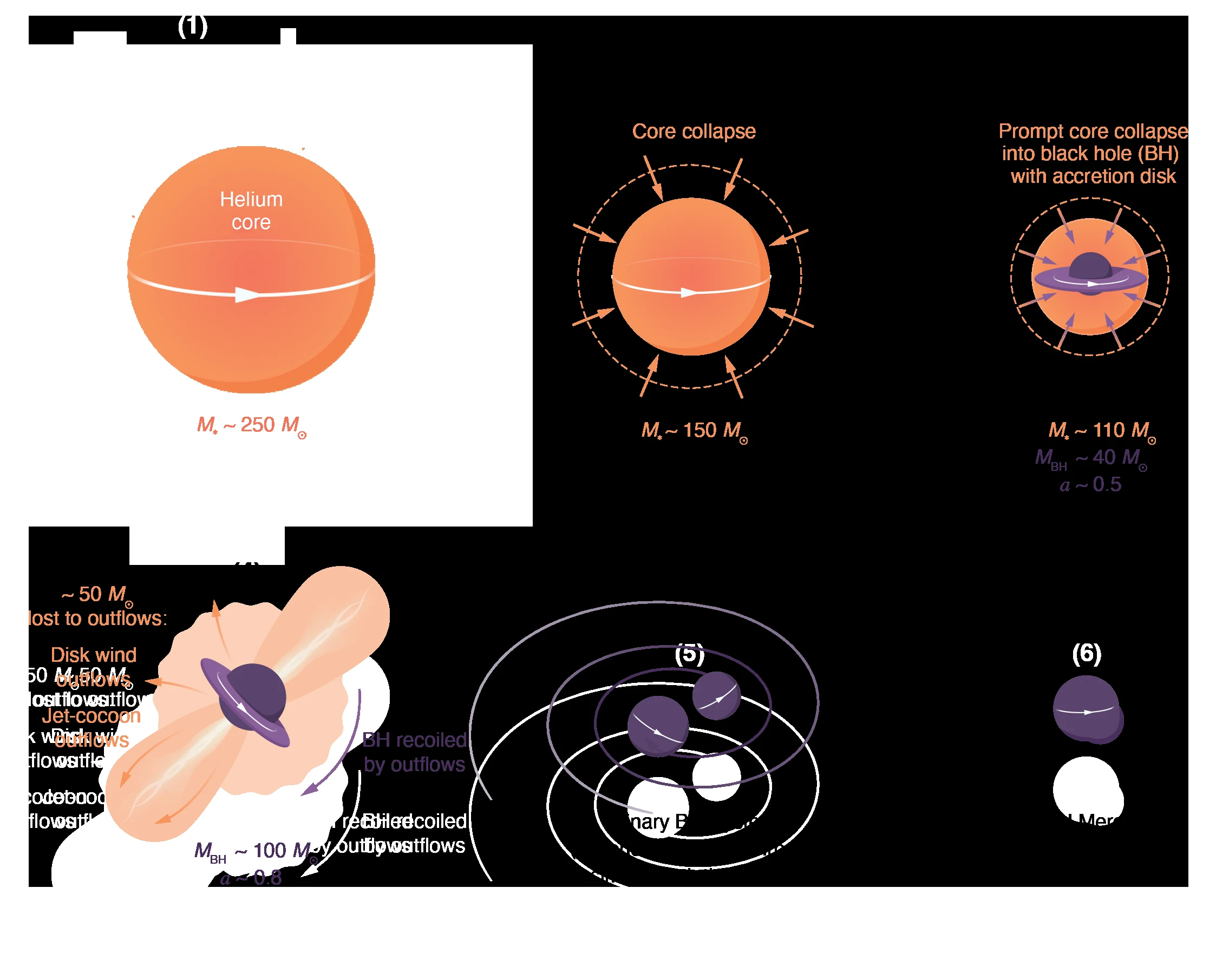
When the core of a dying star collapses, a black hole is born — a cosmic spinning top. The stronger the collapse, the faster the spin. But this top has a magnetic brake: a strong field flings some matter away, slowing the hole, while a weak field lets matter fall in and spin it up to nearly the speed of light.
This is exactly what explained the mysterious hole pairs spotted by gravitational wave detectors — instruments built by Rainer Weiss and his colleagues. Event GW231123 revealed holes with masses thought impossible: stars with such cores were expected to explode as supernovae leaving nothing behind. But simulations confirmed: with rapid rotation and a moderate magnetic field, the star collapses into a heavyweight hole.
The same magnetic fields that brake the hole can also create jets — streams of matter that outshine galaxies and are visible across the universe. The fruit of nearly a century of effort: Schwarzschild described the stationary hole, Thorne the spinning one, and new calculations have merged their ideas.
It was once thought that the core of a star with 250 solar masses would explode without a trace. It turns out it can produce a black hole.
Such a rapidly spinning hole is almost like Gargantua from Interstellar: extreme rotation and monstrous gravity.