Brian D. Metzger

5 articles · 30 co-authors · latest: 2026-06-22
112 citations · h-index 6 · 27 papersData: Semantic Scholar

We have retold 5 papers by this author. 2 of them with a full read. most often about: active galactic nucleus, black hole merger, active galactic nucleus. 30 co-authors across our retellings.

Links in the knowledge graph
The Cosmic Potter: How Rotation and Magnetic Fields Shape a Black Hole
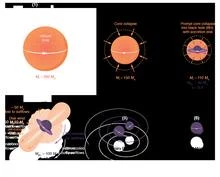
On November 23, 2023, the LIGO, Virgo, and KAGRA detectors caught a gravitational wave from the merger of two black holes with masses of 137 and 103 solar masses. Both fall into the pair-instability mass gap, the range from 69 to 139 solar masses where ordinary stellar evolution leaves behind nothing but expanding gas.

High Energy2026-03-241 minarXiv:2603.23597express
Mysterious Blue Flashes: What Their Host Galaxies Hide
Some explosions in space last only a few days, but at their peak they outshine entire galaxies. These are LFBOTs — rapid blue transients. They are rare and have been a mystery until now. Astronomers studied 11 such events.
High Energy2026-05-272 minarXiv:2605.28928express
A Starry Hit: Why a Black Hole 'Switches on the Radio' Late
A black hole rips apart a star, and we see a dazzling flare. Then, a couple of years later, when everyone has forgotten about it, radio telescopes suddenly pick up a new signal, like an echo from the past.
High Energy2026-06-031 minarXiv:2606.05322express
Cosmic Cuisine: Black Holes and Their Secret Recipes
Detectors pick up the “ripples” of gravitational waves from mergers of black holes or neutron stars — like an echo from the kitchen where a cosmic dish was being prepared. Astronomers are trying to reconstruct the recipe: how two massive stars turned into an exotic pair and collided.
The Collapsar's Gravitational Boomerang: Cracking the GW190814 Anomaly
LIGO and Virgo detectors catch ripples in spacetime, but some signals force us to rewrite the scripts of stellar death. GW190814 — the merger of a black hole of 23 solar masses with a compact object of 2.6 solar masses — is a discordant chord in the symphony of standard models.